
The AI Operating Model: How Enterprises Scale AI Beyond Pilots
Shivam B. · 7/17/2026

AI isn't failing because of technology. It's failing because organizations aren't designed to scale it. Every CIO has experienced some version of this conversation. AI investments are increasing. Multiple pilots are underway. Teams demonstrate promising prototypes, and the roadmap keeps expanding.
Then comes the question every executive team eventually asks: Which of these initiatives has created measurable business value?
For many organizations, the answer is still, "not yet."
The challenge isn't a lack of AI capability. It's that organizations often invest in models before building the operating model needed to scale them. Without clear governance, ownership, data readiness, and business accountability, even the most promising AI pilots struggle to become enterprise-wide capabilities.
An AI operating model bridges that gap. It defines how AI initiatives are prioritized, funded, governed, deployed, and measured, turning isolated experiments into repeatable business outcomes.
In this blog, we'll explore why AI pilots stall, the operating models enterprises use to scale AI successfully, the role of data readiness and governance, how to measure AI ROI beyond productivity metrics, and the practical steps organizations can take to move from experimentation to enterprise-wide impact.
What Is an AI Operating Model?
An AI operating model is the organizational framework that governs how AI initiatives are prioritized, funded, built, deployed, and measured across the enterprise. Also, an operating model doesn't replace strategy, it enables organizations to execute it consistently.
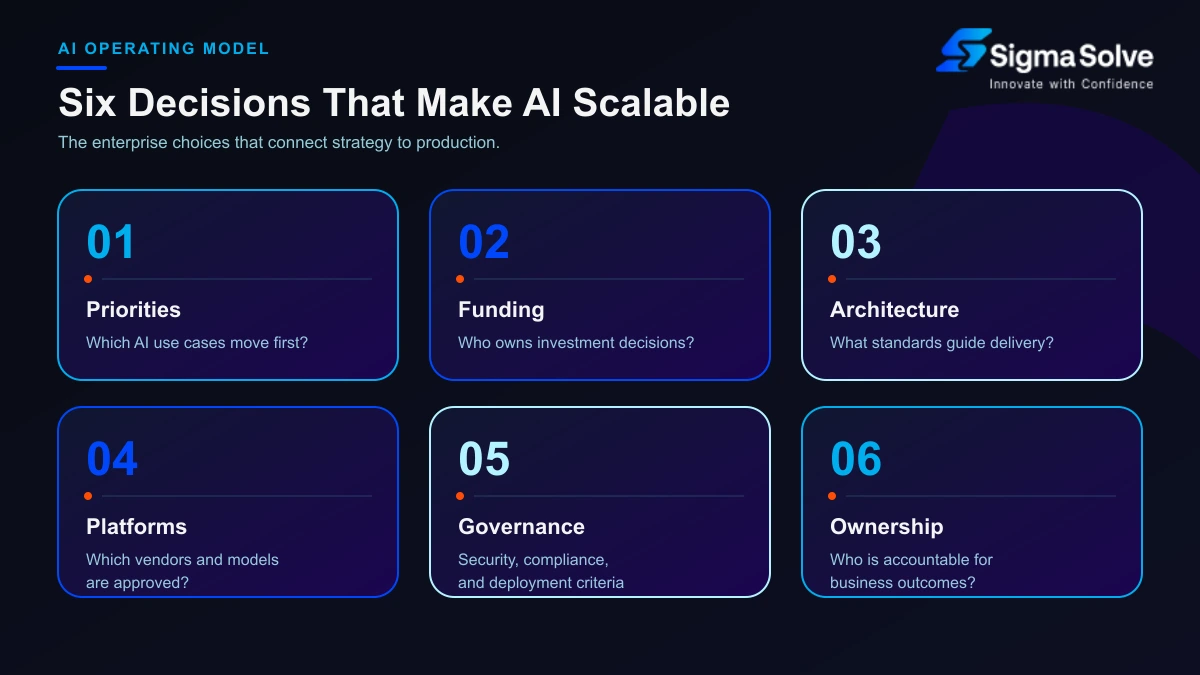
At its core, it answers six critical questions:
- Who decides which AI use cases are prioritized?
- Who owns funding and investment decisions?
- What architectural standards guide AI development?
- Which vendors, platforms, and models are approved?
- What governance, security, compliance, and business criteria must be satisfied before deployment?
- Who owns the solution after deployment and is accountable for business outcomes?
Why Do Most AI Pilots Never Reach Production?
Across industries, two challenges consistently prevent AI initiatives from scaling successfully.
1. Enterprise Data Isn't Ready for Production AI
Many AI pilots are developed using carefully prepared datasets that don't reflect production environments. Real-world enterprise data is often fragmented across legacy systems, disconnected applications, spreadsheets, and inconsistent governance processes.
Gartner predicts that through 2026, organizations will abandon a significant share of AI projects because their data foundations are not AI-ready. The same research consistently identifies poor data quality as one of the primary causes of AI implementation failures.
A successful pilot can mask these issues because limited datasets are manually prepared. Once organizations attempt enterprise deployment, inconsistent data quality quickly becomes a limiting factor.
2. Change Management Is Frequently Underestimated
Technology alone rarely determines the success of AI transformation. BCG's research suggests that while algorithms and technology remain important, the majority of transformation success depends on people, processes, and organizational adoption. Similarly, Deloitte's 2026 State of AI in the Enterprise found that workforce skills remain one of the largest barriers to scaling AI, while relatively few organizations have implemented incentives that encourage sustained AI adoption.
This pattern is common across enterprises. A motivated project team successfully launches a pilot, but adoption slows because workflows, operating procedures, governance, and employee enablement were never redesigned. Neither of these challenges can be solved through technology alone. Both require an operating model that aligns data, governance, people, and execution.
Choosing the Right AI Operating Model
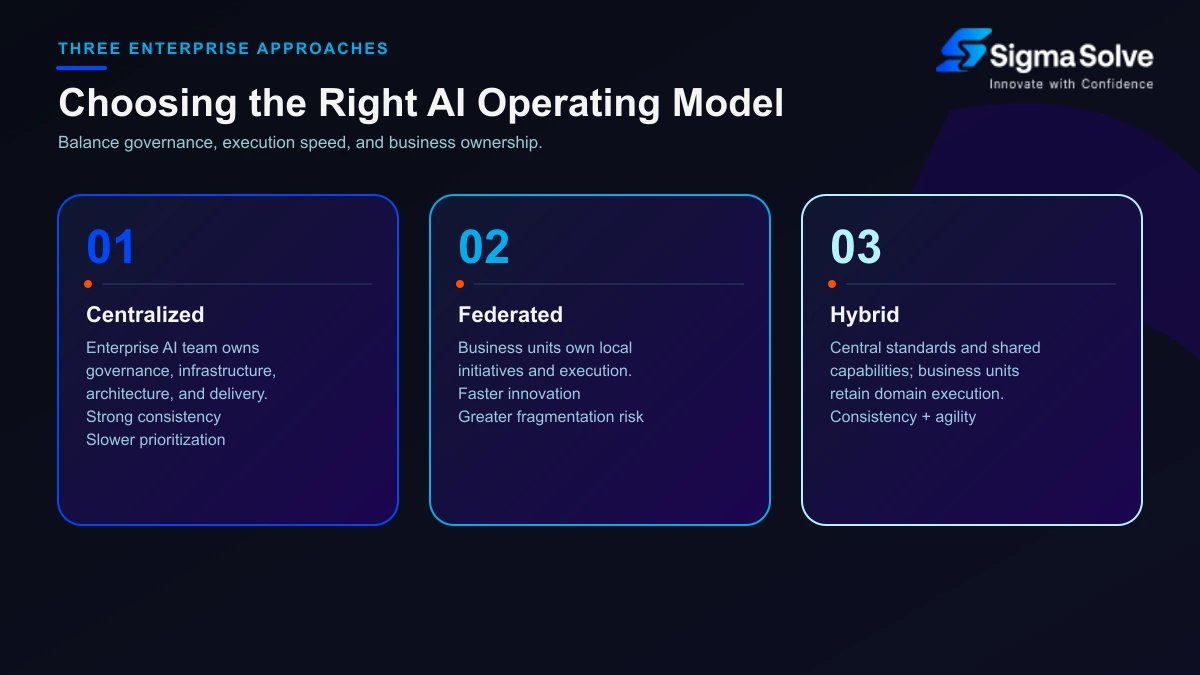
Most organizations adopt one of three operating approaches depending on their AI maturity, regulatory environment, and organizational structure.
Centralized
A dedicated enterprise AI team owns governance, architecture, infrastructure, and delivery. This approach provides strong governance, consistent standards, and reduced duplication, making it particularly effective for highly regulated industries such as financial services, healthcare, and pharmaceuticals. The trade-off is slower execution because business units depend on a central team for prioritization.
Federated
Individual business units manage their own AI initiatives while maintaining local ownership. This model accelerates innovation and keeps AI closely aligned with business challenges. However, without strong governance, organizations often duplicate investments, adopt inconsistent technologies, and create fragmented architectures.
Hybrid
Most mature enterprises ultimately adopt a hybrid operating model. A centralized AI function establishes governance, security standards, shared infrastructure, and reusable capabilities, while business units retain responsibility for execution and domain expertise. This balances enterprise consistency with business agility and has become the preferred model for organizations scaling AI across multiple functions.
Measuring AI ROI Beyond Productivity Metrics
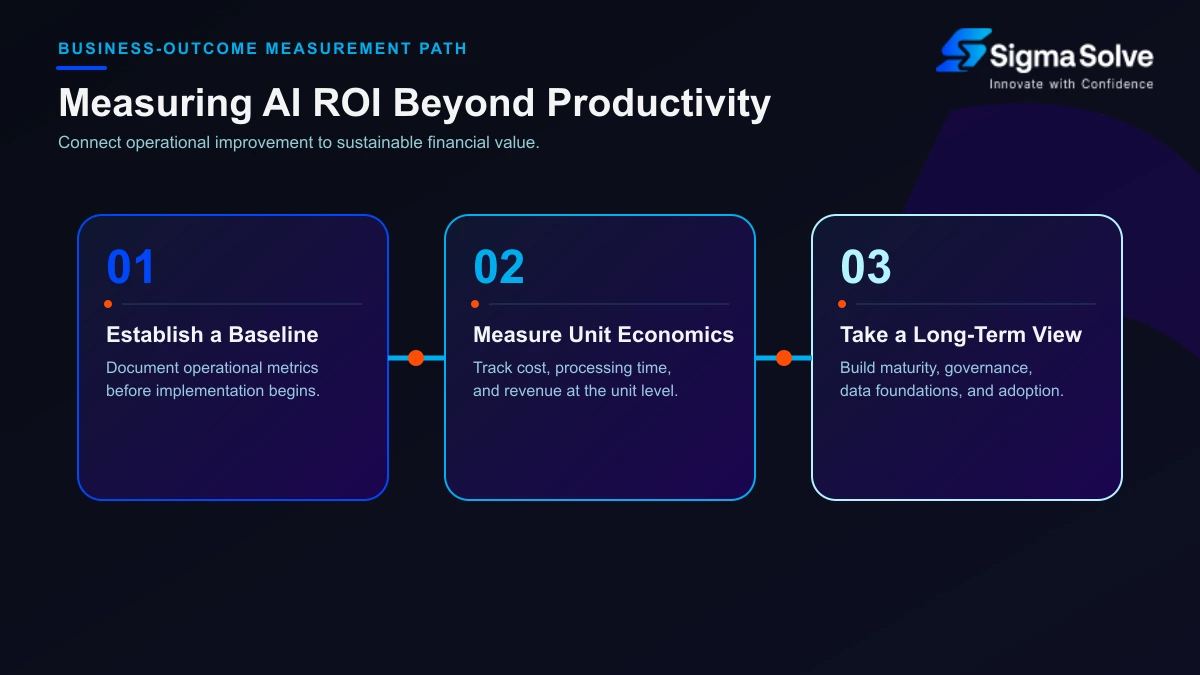
Even with the right operating model, executive leadership ultimately evaluates AI through one lens: measurable business outcomes. Recent enterprise research indicates that boards increasingly prioritize direct financial impact, including revenue growth and profitability, over general productivity improvements. Organizations that consistently demonstrate AI ROI typically follow three principles.
Establish a Baseline
Improvement cannot be measured without understanding the starting point. Operational metrics should be documented before implementation begins.
Measure Unit Economics
Instead of relying on broad productivity claims, organizations should track metrics that directly connect to financial performance, including:
- Cost per transaction
- Cost per support ticket
- Cost per claim
- Processing time per document
- Revenue per customer interaction
These metrics provide a clear line of sight from operational improvements to business value.
Take a Long-Term View
Enterprise AI transformations rarely generate meaningful returns within a few months. McKinsey's latest State of AI research found that only a small percentage of organizations currently attribute a significant portion of EBIT directly to AI. That doesn't suggest AI lacks value. It highlights that sustainable financial returns require organizational maturity, scalable data foundations, governance, and adoption over time.
Organizations expecting immediate payback often terminate promising initiatives prematurely or overestimate short-term pilot success.
Build Internally or Work with an AI Implementation Partner?
Organizations don't always need external partners to succeed with AI. However, research suggests enterprises working with experienced AI implementation specialists are often more successful at moving from pilots to production, particularly in complex or highly regulated environments.
The difference rarely comes from access to better models. It comes from proven delivery experience. The right partner helps organizations:
- Prioritize high-value AI use cases
- Modernize enterprise data foundations
- Build secure, production-ready architectures
- Establish governance and compliance frameworks
- Integrate AI into existing business processes
- Measure outcomes against operational and financial KPIs
How Sigma Solve Helps Enterprises Operationalize AI
Scaling AI requires more than selecting the right large language model. It demands the right combination of data engineering, cloud modernization, AI implementation, governance, and product development expertise.
Sigma Solve's AI Center of Excellence (AI CoE) helps enterprises move beyond isolated pilots by bringing these capabilities together through a structured, outcome-focused delivery approach.
Our teams help organizations:
- Identify and prioritize high-value AI use cases aligned with business objectives.
- Modernize and unify enterprise data platforms to establish AI-ready foundations.
- Develop AI copilots, intelligent agents, and embedded AI capabilities for products and internal operations.
- Implement scalable governance, security, and deployment frameworks.
- Measure business impact using operational and financial KPIs that executive leadership can track with confidence.
Whether modernizing legacy platforms, automating complex workflows, or embedding AI into digital products, Sigma Solve focuses on delivering production-ready solutions designed for long-term adoption, not short-term demonstrations.
Sigma Solve Helped a Food & Beverage Enterprise Scale AI-Powered Smart Cafes
Problem
A leading food and beverage enterprise wanted to reimagine the cafe experience by launching autonomous, AI-powered smart cafes that could deliver barista-quality beverages without human intervention. The challenge extended beyond beverage preparation, it required real-time inventory management, predictive machine monitoring, centralized operations, scalable cloud infrastructure, and consistent customer experiences across a growing network of locations.
Solution
Sigma Solve designed and implemented a cloud-native AI ecosystem that transformed each smart cafe into a connected, intelligent retail unit. The solution combined AI-powered beverage automation, event-driven architecture, real-time machine monitoring, automated deployment pipelines, centralized data management, and advanced analytics. By integrating inventory tracking, machine health monitoring, cloud infrastructure, and operational dashboards, the platform enabled seamless, autonomous operations at scale.
Outcome
- Delivered barista-quality beverages in under 90 seconds through fully autonomous AI-powered kiosks.
- Reduced manual intervention with intelligent inventory tracking and predictive machine monitoring.
- Compressed testing cycles from hours to minutes through automated QA workflows.
- Improved machine uptime and operational reliability with real-time monitoring and proactive alerts.
- Enabled centralized visibility into inventory, sales, and machine performance across locations.
- Built a scalable, cloud-native smart café platform capable of supporting rapid expansion with lower operational overhead.
The Bottom Line
The competitive advantage in enterprise AI won't come from access to better models. Most organizations already have access to the same foundational technologies. The real differentiator is the ability to operationalize AI, consistently connecting strategy, governance, data, engineering, and business ownership into a repeatable delivery model.
Organizations that build this capability move beyond isolated pilots toward measurable business outcomes. Those that don't risk accumulating disconnected experiments that consume budgets without creating lasting enterprise value.
Sigma Solve helps enterprises build AI-ready data platforms, modernize cloud infrastructure, implement AI copilots and intelligent automation, and establish governance frameworks that enable production-scale AI adoption.
Ready to Move Beyond AI Pilots?
Whether you're defining your AI strategy, modernizing your data ecosystem, or looking to turn successful pilots into enterprise-wide capabilities, Sigma Solve can help you build an AI operating model designed for measurable business outcomes.

References:
- https://www.rand.org/pubs/research_reports/RRA2680-1.html
- https://www.gartner.com/en/newsroom/press-releases/2025-02-26-lack-of-ai-ready-data-puts-ai-projects-at-risk
- https://www.deloitte.com/global/en/issues/generative-ai/state-of-ai-in-enterprise.html
- https://futurumgroup.com/press-release/enterprise-ai-roi-shifts-as-agentic-priorities-surge/