
B2B eCommerce Web Development: A Step-by-Step Guide
Milind Shah · 9/11/2024 · 15 min read

B2B ecommerce web development is the process of building an online sales platform for business buyers, with the pricing, catalogs, approvals, and system integrations that B2B purchasing demands. Buyers now expect the speed and convenience of consumer shopping, but their purchases are far more complex: account-specific pricing, negotiated terms, bulk orders, multiple approvers, real-time inventory, and technical product data.
That is why a B2B platform is much more than an online storefront. It has to connect customers, products, pricing, inventory, orders, payments, and enterprise systems, so that buying is simple for customers and efficient for internal teams.
This guide walks through each stage: defining requirements, choosing a platform, designing the experience, building, integrating, testing, launching, and optimizing.
Key takeaway: A B2B platform is much more than an online storefront. It connects customers, products, pricing, inventory, orders, payments, and enterprise systems so buying is simple for customers and efficient for internal teams.
What Is B2B eCommerce?
B2B ecommerce is the buying and selling of products or services between businesses through digital channels. Manufacturers, wholesalers, distributors, retailers, and procurement teams use it to research products, request quotes, place orders, manage accounts, and handle repeat purchases.
Most of the complexity sits behind the storefront. Pricing rules, product data, customer permissions, order management, and ERP and CRM integrations all shape what the buyer sees. The platform must therefore be designed around business processes as well as customer experience.
How Is B2B eCommerce Different from B2C?
The two models share technology but differ in almost every requirement that matters for development.
| Factor | B2C eCommerce | B2B eCommerce |
|---|---|---|
| Buyer | Individual consumer | Business or organization |
| Pricing | Usually standardized | Often negotiated or account-specific |
| Order size | Generally smaller | Often larger or recurring |
| Decision-making | Usually one person | Multiple stakeholders |
| Checkout | Relatively simple | May involve approvals and purchasing rules |
| Catalog | Usually public | May vary by customer |
| Payment | Cards, wallets, etc. | Cards, ACH, purchase orders, invoicing, credit terms |
| Reordering | Optional | Often central to the buying journey |
| Integrations | Usually fewer | ERP, CRM, PIM, OMS, inventory, payment, shipping, and other systems |
Why Invest in B2B eCommerce Development?
Reach and scale beyond sales territories
An ecommerce channel gives customers round-the-clock access and lets you serve new regions without every transaction starting with a sales conversation. A scalable architecture then absorbs more customers, products, orders, and channels without a rebuild.
Cut manual work
Automating order entry, inventory checks, account management, invoicing, and tracking reduces repetitive effort. Connecting the platform to ERP, CRM, and inventory systems also removes duplicate data entry and disconnected workflows.
Serve buyers faster
B2B buyers want instant access to product information, pricing, inventory, order history, invoices, and account details. Self-service lets them handle routine tasks without contacting a rep, while saved lists, quick reorder, and recurring orders shorten the buying cycle for repeat purchases.
Make better decisions with data
Digital commerce shows what customers search for, buy, and reorder. Combined with CRM, ERP, and analytics data, it can improve sales, marketing, inventory planning, and customer engagement.
B2B eCommerce Trends Shaping Web Development in 2026
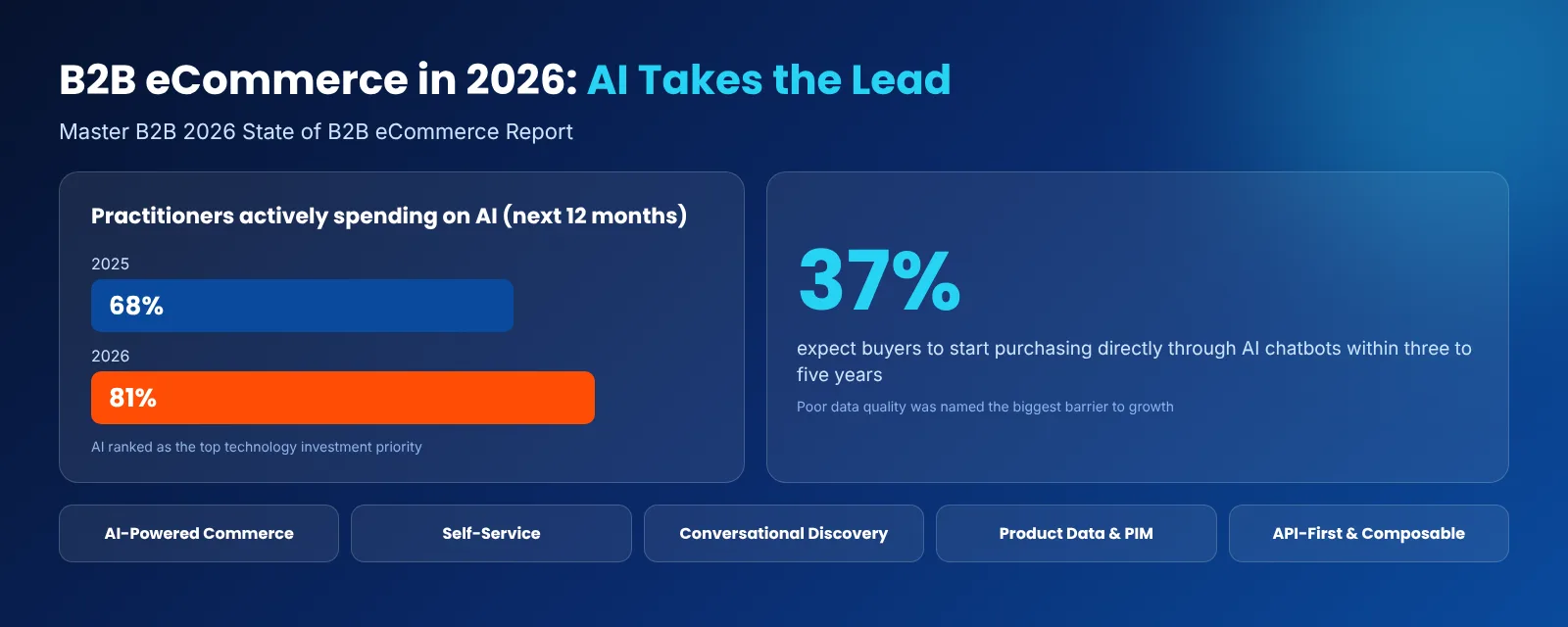
B2B ecommerce is evolving from a digital ordering channel into a broader commerce ecosystem built on self-service purchasing, intelligent product discovery, and personalized experiences. AI is accelerating that shift. In Master B2B's 2026 State of B2B eCommerce Report, 81% of practitioners said they are actively spending on AI over the next 12 months, up from 68% in 2025, and AI ranked as the top technology investment priority. The same report named poor data quality the biggest barrier to growth.
AI-Powered B2B eCommerce
AI is moving beyond basic chatbots and recommendation engines into product discovery, support, personalization, quoting, and purchasing assistance. Agentic commerce goes further, letting AI systems carry out parts of the buying journey on a customer's behalf. In the same report, 37% of practitioners expect buyers to start purchasing directly through AI chatbots within three to five years.
For developers, this is not a matter of adding an assistant to an existing site. It requires accurate product data, clear pricing rules, customer permissions, live inventory, well-documented APIs, and defined transaction workflows. Teams planning a new platform should check that the architecture can support these capabilities as they mature.
Self-Service B2B Commerce
Modern B2B buyers increasingly want to handle routine purchasing activities independently. A well-designed B2B ecommerce portal can allow customers to search products, view account-specific pricing, check availability, place and track orders, download invoices, manage users, and reorder frequently purchased products.
This changes the role of ecommerce from simply being another sales channel to becoming a self-service environment for customers. Research published for 2026 identifies self-service and rep-free purchasing as important developments in B2B commerce.
Sales teams can then spend more time on complex opportunities while customers handle routine transactions at their convenience.
Conversational Product Discovery
Traditional ecommerce search relies on keywords, SKUs, filters, and predefined product attributes. AI-powered discovery introduces another approach: allowing buyers to describe what they need using natural language.
For example, instead of searching for a specific product code, an industrial buyer could describe the operating conditions, materials, specifications, and application requirements of the product they need.
Supporting this type of experience requires accurate product attributes, well-structured catalog data, strong search capabilities, and relationships between products and their use cases.
Product Data and PIM
Product information is particularly important in B2B ecommerce because customers often need detailed specifications before making a purchase. Depending on the industry, this may include dimensions, materials, certifications, compatibility, technical documentation, packaging information, and product relationships.
A Product Information Management (PIM) system can centralize this information and help maintain consistency across ecommerce, marketplaces, sales channels, and other digital touchpoints.
This is becoming increasingly important as businesses adopt AI-powered search and product discovery. Master B2B's 2026 research identifies data quality as the biggest barrier to B2B ecommerce growth.
High-quality product data therefore supports more than catalog management. It provides the foundation for search, personalization, analytics, integrations, and AI-enabled commerce.
API-First and Composable Commerce
B2B ecommerce platforms rarely operate in isolation. They often need to exchange information with ERP, CRM, PIM, order management, inventory, payment, shipping, analytics, and customer service systems.
An API-first architecture allows these systems to communicate more efficiently and gives businesses greater flexibility as their technology environment evolves.
Composable commerce takes this approach further by allowing businesses to assemble different commerce capabilities from modular technologies. This can make it easier to introduce new search, payment, personalization, or AI capabilities without replacing the entire platform.
How to Develop a B2B Ecommerce Website
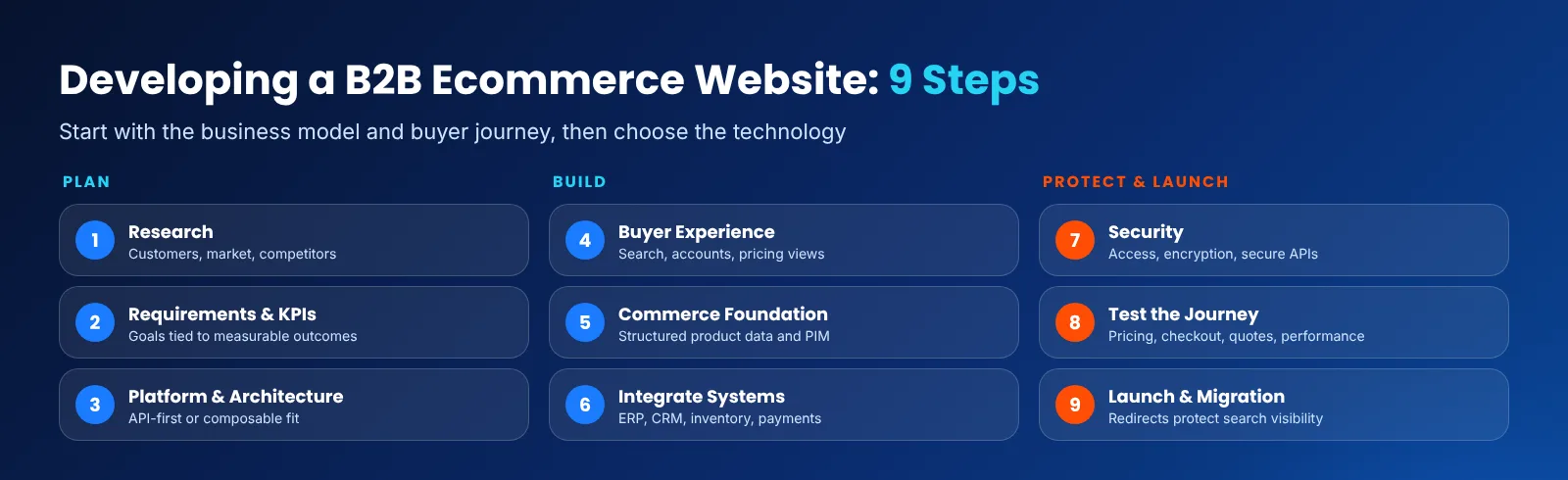
Building a B2B ecommerce website takes more than selecting a platform and designing product pages. Start with the business model and buyer journey, then translate them into the right technology, experience, integrations, and measurable outcomes.
Step 1: Research Your Customers and Market
Understand how customers discover, evaluate, purchase, and reorder products. Identify where they need sales assistance, where self-service could work, and how pricing, catalogs, or payment terms vary by account. Review competitors to identify gaps in search, pricing, product discovery, and customer experience. The goal is to understand what buyers need that existing solutions are not delivering well.
Step 2: Define Requirements and KPIs
Turn those insights into clear business goals, such as increasing online revenue, reducing manual order entry, improving self-service, or shortening quote turnaround times. Define KPIs for each goal and make sure every major feature serves a customer need or measurable business outcome.
Step 3: Choose the Platform and Architecture
Evaluate platforms based on your catalog, pricing, customer, and integration requirements rather than popularity. Consider capabilities such as account-specific pricing, multiple users, permissions, bulk ordering, quotes, payments, search, and scalability. Options range from platforms such as Adobe Commerce, BigCommerce, and Shopify Plus to composable solutions built around API-first services such as commercetools.
An API-first or composable architecture can make it easier to connect ERP, CRM, PIM, payment, shipping, and analytics systems and introduce new capabilities over time. Choose the approach that fits your business complexity and growth plans.
Step 4: Design the Buyer Experience
Design around how customers actually purchase. Search should support SKUs, categories, specifications, brands, applications, and compatibility, while account areas should surface relevant pricing, availability, orders, invoices, saved products, and permissions. In B2B ecommerce, effective personalization means giving each account the information and functionality relevant to its needs.
Step 5: Build the Commerce Foundation
Strong product data is essential for B2B ecommerce. Large catalogs often contain detailed specifications, certifications, technical documents, and compatibility information, making a PIM system valuable for maintaining consistent data across ecommerce and other channels. Clean, structured product data also provides the foundation for AI-powered search and product discovery.
Step 6: Integrate Business Systems
Connect ecommerce with the systems that run the business, including ERP, CRM, inventory, order management, payment, and shipping platforms. These integrations keep pricing, customer information, inventory, orders, and financial data synchronized and prevent the ecommerce site from becoming another isolated system.
Step 7: Build Security into the Platform
Protect customer, pricing, payment, and business data from the beginning. Implement appropriate authentication, role-based access, secure APIs, encryption, monitoring, and backups. Use compliant payment providers and address applicable privacy and security requirements for the markets you serve.
Step 8: Test the Complete Buying Journey
Test the workflows that matter most to customers and the business, including pricing, inventory, checkout, quotes, approvals, payments, tax, shipping, and order synchronization. Conduct performance testing with realistic traffic and catalog volumes, followed by user acceptance testing with business teams and representative customers.
Step 9: Plan the Launch and Migration
Before launch, verify products, pricing, customer accounts, inventory, integrations, analytics, security, content, and tracking. For an existing website migration, carefully transfer product data, customer information, URLs, and metadata. Map important legacy URLs to their new destinations and implement redirects to protect existing search visibility.
How Much Does B2B Ecommerce Development Cost?
Cost depends on scope, which varies widely. A B2B store with a limited catalog and basic ordering is a very different investment from an enterprise platform with thousands of products, several customer groups, negotiated pricing, approval workflows, ERP and CRM integrations, international markets, and advanced personalization.
The main cost drivers are the platform and licensing, UX and UI design, custom development, integrations, product data migration, security and compliance, payment infrastructure, search, PIM implementation, testing, and ongoing maintenance. Integrations and data work are often underestimated. Define requirements and architecture first, and teams can then estimate scope accurately.
Conclusion
B2B ecommerce web development has moved well beyond putting a catalog and cart online. Buyers expect relevant product information, account-specific pricing, self-service, accurate availability, and simple reordering, and delivering that means connecting product data, pricing, inventory, orders, and enterprise systems behind the storefront.
Whether you are launching a new B2B ecommerce platform, modernizing an existing store, or looking to introduce smarter search, personalization, automation, or AI capabilities, Sigma Solve can help you turn your ecommerce roadmap into a scalable digital commerce solution.
Ready to modernize your B2B ecommerce experience?
Talk to experts at Sigma Solve about your ecommerce development requirements.
- Define requirements, KPIs, and the right platform architecture for your buyers
- Integrate ERP, CRM, PIM, payment, and shipping systems into one connected platform
- Launch and migrate with search visibility protected and AI-ready product data

Frequently Asked Questions
How is B2B ecommerce different from B2C?
B2B involves negotiated pricing, larger orders, multiple decision-makers, customer-specific catalogs, and approval workflows, and it integrates with enterprise systems. B2C typically has standardized pricing, a single buyer, and a simpler checkout.
Which platform is best for B2B ecommerce?
No single platform is best. Choose based on pricing complexity, catalog size, integration needs, and growth plans. Packaged platforms such as Adobe Commerce, BigCommerce, and Shopify Plus suit many businesses, while composable architectures suit complex, fast-changing requirements.
How does AI affect B2B ecommerce?
AI improves search, product discovery, personalization, support, and quoting, and AI agents may eventually handle parts of buying. All of it depends on accurate product, pricing, and inventory data. Master B2B's 2026 report ranks AI as the top technology investment priority, with data quality the biggest barrier.