
AI Agents in Logistics: When Supply Chains Start Deciding
Sigma Solve · 10/29/2026 · 10 min read

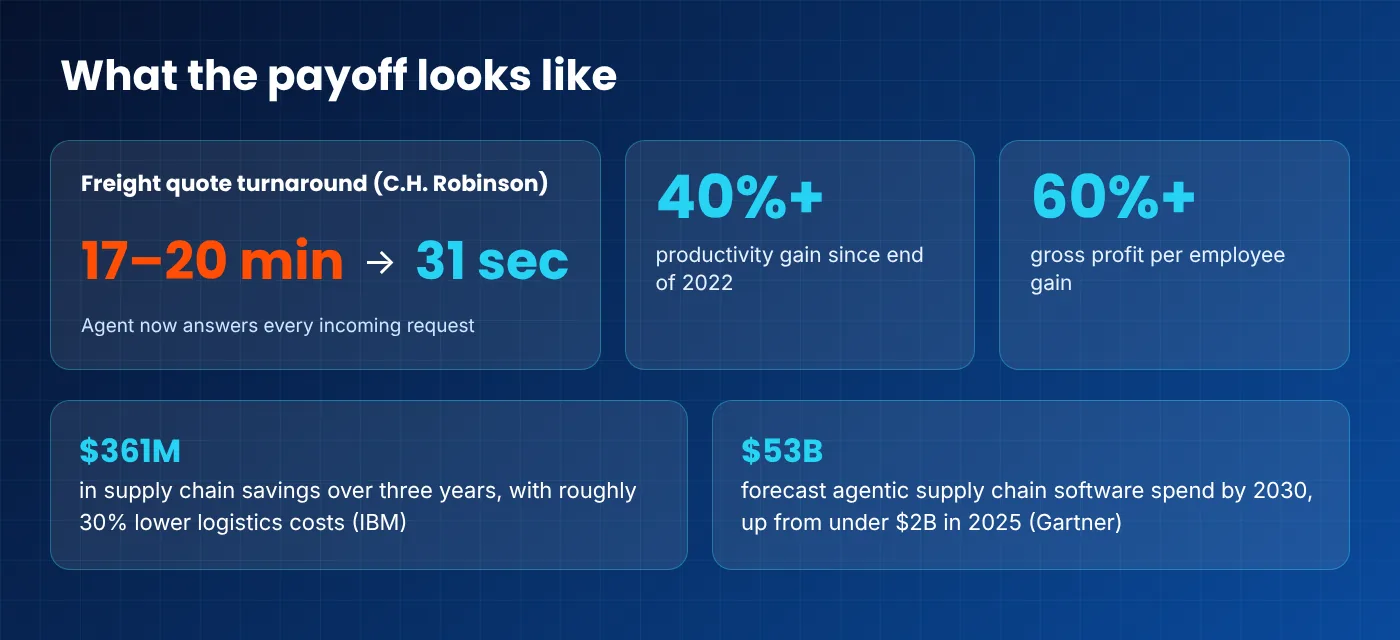
A freight quote used to take a C.H. Robinson specialist 17 to 20 minutes, and the team could respond to only about 60% of incoming requests. An AI agent now answers every request in about 31 seconds.
The company did this during a freight recession, with the Cass Freight Shipment Index down for the 15th consecutive quarter. In that market, every unanswered quote is lost revenue, and hiring your way to coverage isn't an option.
So, agents can work. Yet most logistics companies have little to show for their AI spending. In BCG's January 2026 survey, only 7% of shippers could point to measurable improvement from AI. The gap between those two outcomes has less to do with the technology than with which decisions companies hand to it and what they fix first.
The takeaway: the gap between agents that pay off and agents that stall comes down to which decisions you hand them, and what you fix first.
This blog covers what an AI agent is, why most projects stall, where agents are paying off today, and a practical way to choose your first one.
Data-Rich, Decision-Poor: The Logistics Paradox
What are AI agents in logistics? AI agents are software systems that pursue a defined business goal, such as resolving a late shipment or quoting a load. They pull data from TMS, WMS, ERP, and carrier systems, weigh the options, and carry out approved actions. When a decision exceeds their authority, they escalate it to a person.
Logistics has spent two decades getting better at knowing. Tracking, control towers, and predictive ETAs tell you what happened and what's likely to happen. Then a person still must check the carrier portal, the TMS, the customer's SLA, the appointment schedule, and the weather, make a call, and act in yet another system.
That model has two hidden costs. The quality of the response depends on who is on shift, and expertise scales only by hiring.
| Technology | What it does | Where it stops |
|---|---|---|
| Rule-based automation | Fires an alert or routes a document when a condition is met | Breaks on situations nobody wrote a rule for |
| AI assistant | Explains a delay or drafts a reply for a person | A human still investigates and acts |
| AI agent | Investigates, decides within limits, acts across systems, escalates | Only as good as its data and guardrails |
What the Difference Looks Like on a Late Load
An illustrative example. A refrigerated load is running four hours behind for a grocery distribution center.
An assistant tells the planner the load is late, explains that the driver hit weather delays, and drafts an email to the customer. The planner does everything else.
An agent confirms the delay against the tracking feed. It then reads the customer's SLA and finds a two-hour delivery window with a penalty clause. It checks the DC's dock schedule and books the next open appointment. Finally, it sends the customer a revised ETA. The new arrival time would still trigger the penalty, so the agent doesn't decide whether to pay for an expedited recovery. It sends that choice to the planner with two costed options attached. The planner makes one decision instead of running six lookups.
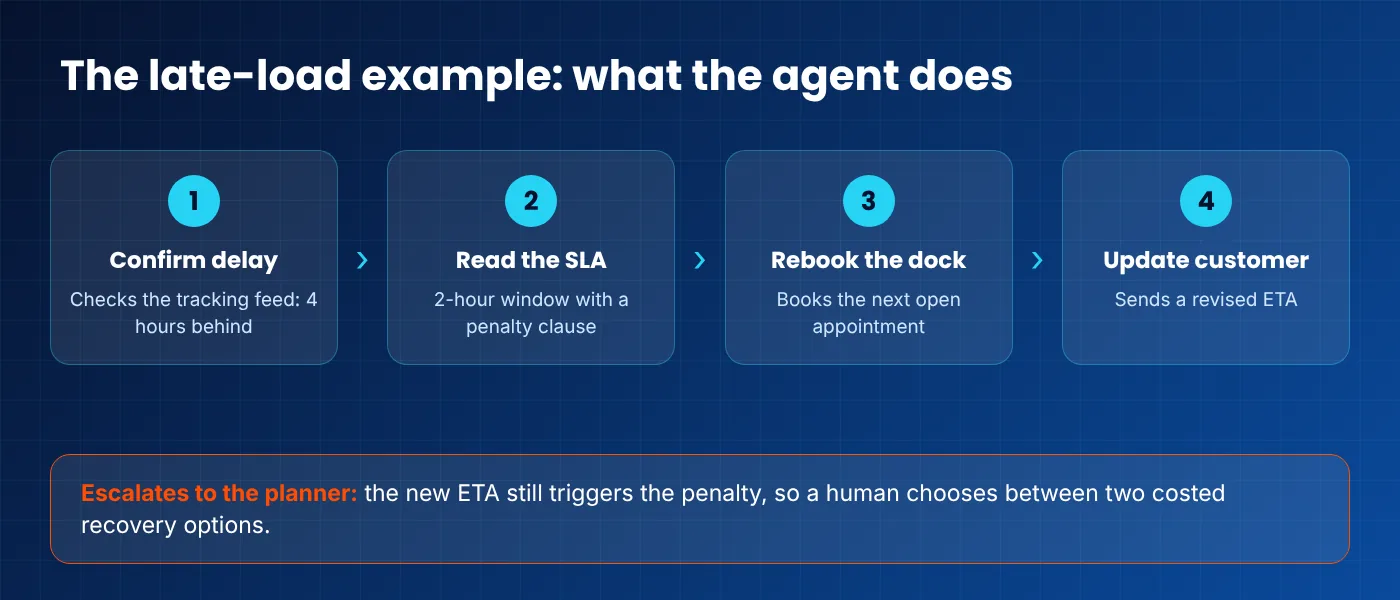
That split between routine actions the agent takes and consequential decisions a human makes is the whole design problem. It's also why buyers need to be careful. Gartner estimates that only about 130 of the thousands of vendors claiming agentic AI offer it. The rest are selling rebranded chatbots and automation.
Why Most AI Agent Projects Stall
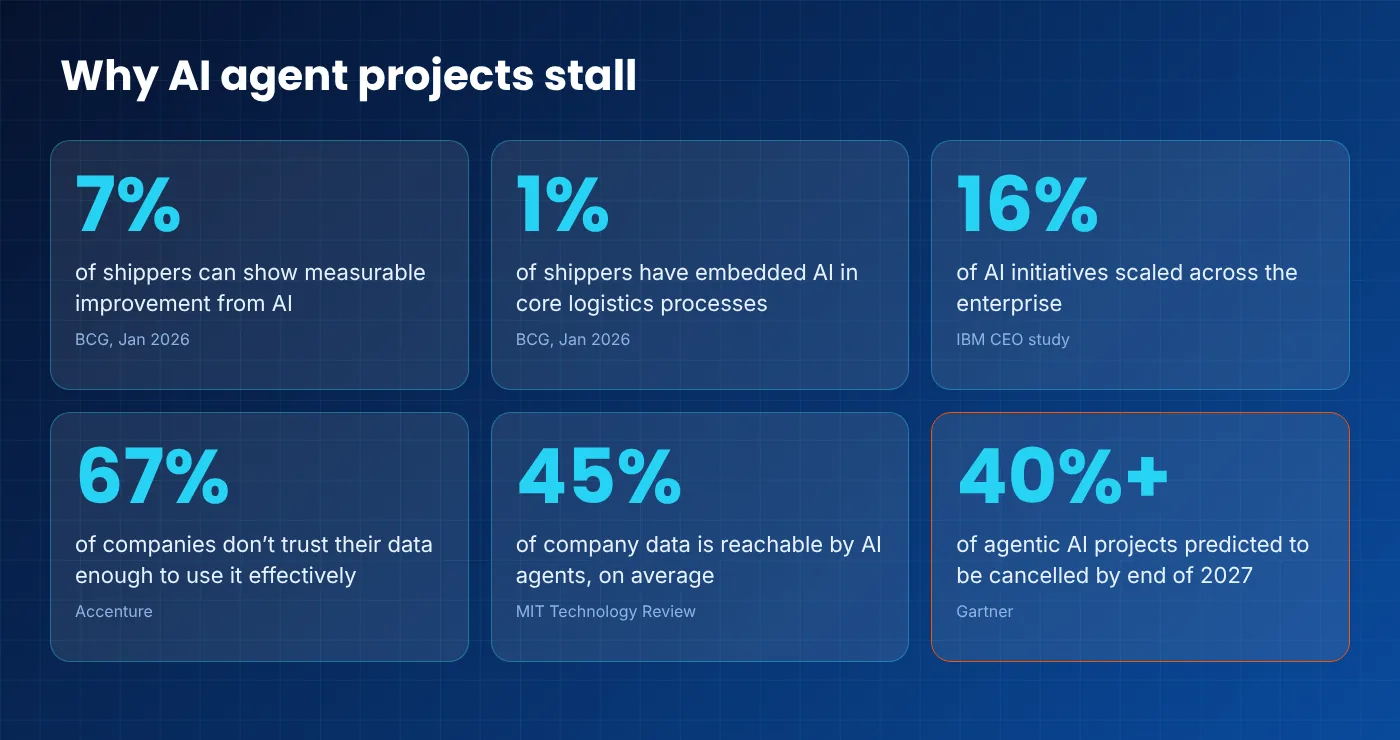
The adoption gap is wide. In BCG's survey, almost 70% of shippers were still exploring or piloting AI, and just 1% had embedded it in core logistics processes. Providers are further along, but not by much. About 40% deploy AI beyond pilots, yet only one in ten has embedded it in core operations at scale.
The bottleneck is management, not models. BCG's respondents ranked unclear ROI and internal capability gaps ahead of cost and technical complexity as barriers. IBM's CEO study points the same way: only 25% of AI initiatives delivered their expected return, and only 16% scaled across the enterprise. Companies are automating before deciding what's worth automating.
The data isn't ready. Accenture found that 67% of companies don't trust their data enough to use it effectively. An MIT Technology Review survey found that AI agents can reach, on average, just 45% of company data. An agent that can see less than half the picture will make confident decisions on incomplete information.
Governance lags deployment. Only 11% of CIOs and CTOs in IBM's 2026 study felt fully ready for the scale of agent deployment expected in the coming year. Gartner predicts over 40% of agentic AI projects will be cancelled by the end of 2027 over costs, unclear value or inadequate risk controls. It also notes that connecting agents to legacy systems is technically complex.
A Logistics-Specific Risk: The Agent Bullwhip
Supply chain managers know the bullwhip effect: small swings in customer demand grow into large swings in orders further upstream. A 2026 MIT-led study tested what happens when AI agents take over the ordering decisions in the classic Beer Game simulation.
The results cut both ways. An off-the-shelf reasoning model outperformed human teams and cut costs by up to 67%. But its decisions varied from run to run, and that inconsistency compounded across facilities and over time. The researchers call this the "agent bullwhip." Two measures reduced it: guardrails on the agents' decisions and centralized data sharing between the parties.
It's a simulation, not a live network, but the lesson carries over. Logistics is multi-party by nature. As your shippers, carriers, and suppliers deploy their own agents, you'll increasingly deal with other companies' agents. In that world, consistent decisions and shared data matter more than raw intelligence.
Where AI Agents Are Already Paying Off
So far, the real results cluster around high-volume, repetitive decisions.
- Tenders and exceptions. When a carrier rejects a tender, someone must find a backup and update every system. DAT describes agents that watch for rejections and reroute loads to backup carriers without anyone touching the TMS. It's a vendor claim for now, but it's exactly the kind of work agents are suited for. The same logic applies to missed pickups and late deliveries: investigate, fix what's routine, escalate what isn't.
- Customer communication. DHL's early deployments already handle hundreds of thousands of emails and millions of call minutes a year. DHL is explicit about its strategy: it targets high-volume, well-defined processes with strong data behind them.
- Warehouse coordination. In one vendor-published case, a consumer goods company used an agent to reallocate labor and sequence docks as conditions changed. Daily labor scheduling went from eight hours of manual work to a 20-minute review. Shipments going direct from plant to dock rose from 57% to 83.4%.
- Customs and freight audit. Vendors now offer agents that suggest HS codes with confidence scores and cite the tariff notes behind each suggestion. They send anything dual-use to a human. Others audit carrier invoices against contracted rates. The capability is promising, but there are no independent results yet.
- Supplier risk. IBM runs agents across more than 2,000 suppliers in over 170 countries. They flag risks, validate commitments, and kick off corrective actions.
What the Payoff Really Looks Like
C.H. Robinson reports productivity up more than 40% and gross profit per employee up more than 60% since the end of 2022. Over the same period, headcount in its North American Surface Transportation business fell about 30%. It spends under $1.2 million a year on AI tokens, a reminder that model costs are rarely the constraint.
IBM reports $361 million in supply chain savings over three years, and roughly 30% lower logistics costs from data, AI and automation.
The commercial stakes:
- Over 40% of shippers now weigh AI capability when choosing a logistics provider.
- Accenture's research suggests up to 86% of AI-mediated purchases could be abandoned or switched when fulfillment goes wrong. Your customers' own agents will be judging your operations, and they won't wait on hold.
- Investment is following. Gartner forecasts spending on supply chain management software with agentic AI will grow from under $2 billion in 2025 to $53 billion by 2030.
How to Start: Pick the Right First Decision
1. Redesign Before You Automate
C.H. Robinson mapped its workflows, removed tasks that added no value, and automated only the routine, repeatable ones. IBM's internal "Client Zero" program follows the same eliminate-simplify-automate sequence.
2. Score Your Candidate Decisions
Gartner advises starting where high-quality data is accessible, behavior is verifiable, and a high return is expected. In practice, a strong first candidate gets a "yes" to all five of these questions:
| Question | Why it matters |
|---|---|
| Does it happen hundreds or thousands of times a week? | Volume is where the savings are. |
| Could you write down what a good decision looks like? | If your best people can't explain it, an agent can't learn it. |
| Can the agent reach all the data the decision needs? | Missing data produces confident wrong answers. |
| Is a wrong decision cheap and easy to reverse? | Early mistakes should be learning, not losses. |
| Can you measure the outcome today? | Without a baseline, you can't prove ROI. |
3. Baseline Before You Deploy
Record turnaround time, cost per transaction, error rate, and recovery time.
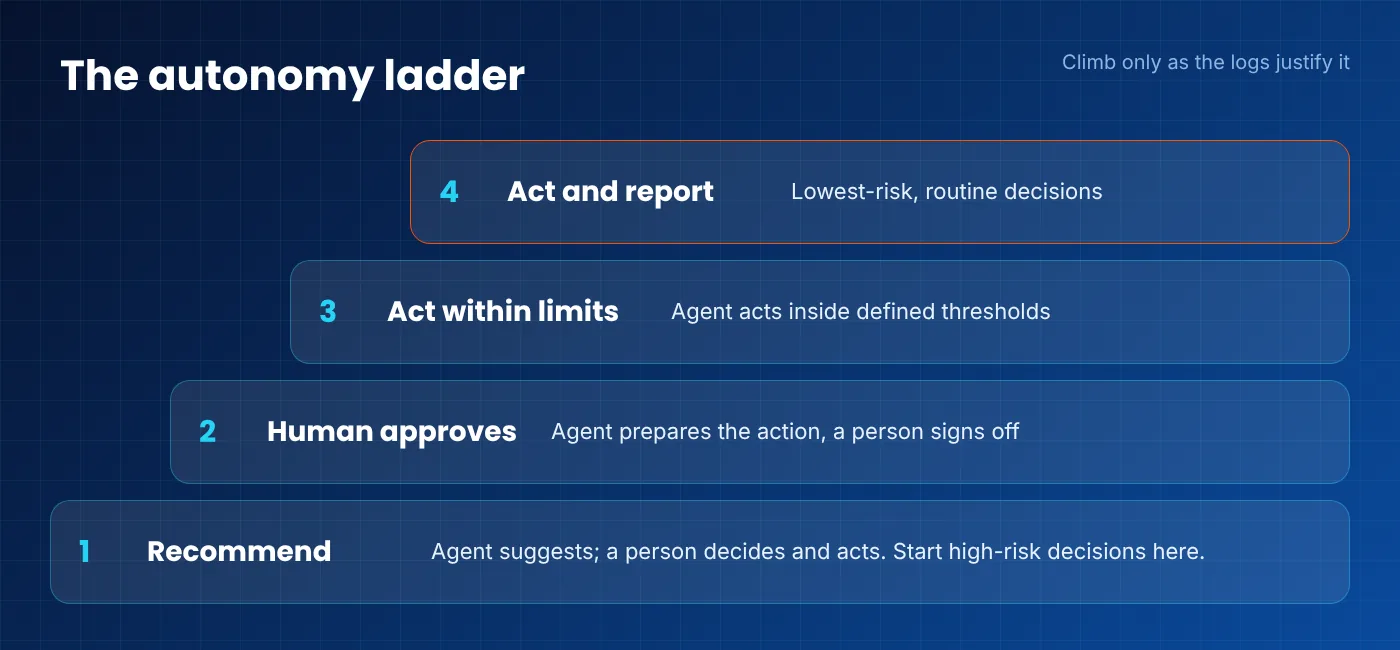
4. Climb the Autonomy Ladder
Move from recommend, to human approves, to act within limits, to act and report. Keep high-risk decisions on the lower rungs and move up only when the logs justify it.
5. Build Governance in From Day One
IBM's research finds that organizations that build controls into their AI architecture deploy 16 times more agents, at a quarter of the cost, and earn 18% higher operating margins. For every autonomous action, you should be able to answer four questions:
- What data did it use?
- Which policy applied?
- What did it do, and why?
- Who is accountable?
How Sigma Solve Can Help
Most of the obstacles in this guide come down to three things: data agents can't fully trust, systems that don't talk to each other, and autonomy granted before anyone defined its limits. Sigma Solve works on all three. Our data engineering team unifies and cleans the operational data your agents depend on, so every decision traces back to data you trust. And because we build custom logistics software, including TMS and CRM platforms, we design agents to work with the systems you already run. There's no need for a rip-and-replace.
Just as important, we help you start in the right place. That means scoring your candidate decisions, setting a baseline, and defining what success looks like before any build begins. It also means designing approval thresholds, audit trails, and escalation paths from day one, so your agents' autonomy grows only as fast as your trust in them.
Ready to Find Your First Decision Worth Automating?
Book a 30-minute AI readiness conversation with Sigma Solve's team and leave with:
- A scored shortlist of the decisions in your operation worth handing to an agent first
- A baseline and a definition of success, so ROI can be proven
- A governance outline covering approval thresholds, audit trails, and escalation paths

FAQs
Will AI agents replace logistics teams?
It depends on the company. About half of logistics providers in BCG's survey expect significant reskilling needs, and fewer than 30% expect imminent AI-led headcount reductions. But reductions do happen: C.H. Robinson's North American Surface Transportation headcount fell about 30% as productivity rose. The more common near-term shift is in the work itself. People move from routine lookups to handling exceptions, managing relationships and supervising agents.
Do we need to replace our TMS or WMS first?
No. An agent layer can work across your existing systems, so you can adopt it one decision at a time. What you do need is reliable, accessible data.
How can I tell a real agent from a rebranded chatbot?
Ask three questions. Can it take actions in your systems, not just answer questions? Can it handle situations outside a scripted flow? Can you see a log of what it did and why? If the answer to any of them is no, you're likely buying automation or an assistant.
Which decisions should stay human?
Keep any decision with major financial, contractual, safety or customer-relationship consequences with a person, at least at first. Give agents wider authority only as your logs show they make reliable decisions.