
AI Digital Marketing for Law Firms in 2026: A Guide
Milind Shah · 12/17/2024 · 31 min read

Artificial intelligence is changing how law firms create content and automate marketing tasks. It's also changing how prospective clients search for legal information, evaluate their options, and decide whom to contact. A potential client today might ask Google, an AI-powered search experience, or a conversational AI platform a detailed legal question, then compare firms, read attorney profiles, and ask follow-up questions before ever scheduling a consultation. Digital marketing can no longer be a checklist of SEO, ads, social, and a contact form. It has to function as one connected system, with AI touching nearly every stage.
According to Clio's 2025 Legal Trends Report, 79% of legal professionals reported using AI in their firms, and consumers are increasingly willing to use AI to answer legal questions before contacting an attorney. That creates real opportunity for firms that adapt, and real risk for those that treat AI as a shortcut rather than a system upgrade. Using it effectively means connecting AI to search visibility, authoritative content, intake, lead qualification, follow-up, and conversion, while maintaining the accuracy and confidentiality the legal industry demands.
What Is AI Digital Marketing for Law Firms?
It's the use of artificial intelligence, automation, and data analysis to improve how a firm attracts, engages, qualifies, and converts prospective clients: analyzing search behavior and content gaps, personalizing website and email experiences, automating intake and follow-up, prioritizing high-intent leads, and optimizing ad campaigns and CRM workflows.
AI is not a strategy by itself. A firm doesn't become more competitive just by adopting a writing tool, a chatbot, or an ad platform. The value comes from using AI to improve decisions across the full client journey, from initial discovery through evaluation, contact, qualification, consultation, and ultimately conversion. Each stage calls for a different approach.
How AI Is Reshaping the Client Acquisition Journey
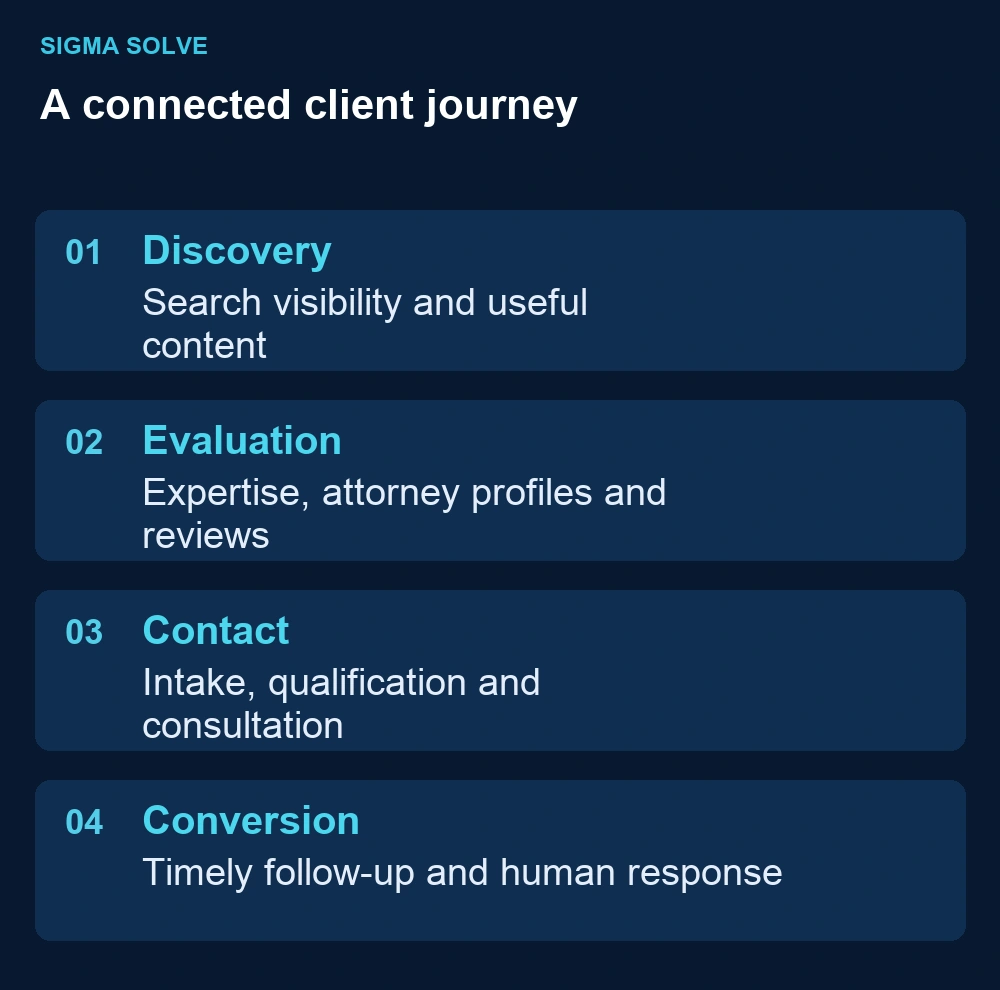
Firms have traditionally treated client acquisition as a linear funnel: traffic, leads, clients. The real journey rarely works that way. A prospective client might search a question, hit an AI-generated answer, browse several firm websites, compare reviews, leave without contacting anyone, and return days later. Firms that perform well aren't the ones producing the most content. They're the ones that make it easiest to find relevant information, trust the expertise behind it, take the next step without friction, and get a timely response. AI can strengthen each of these stages when applied with intent, not as a blanket automation layer.
Search Visibility: SEO Is No Longer Just About Rankings
Potential clients still search terms like "personal injury lawyer near me" or "how long do I have to file a lawsuit," but the environment around those queries has changed. Google's AI Overviews and AI Mode surface AI-generated answers alongside source links, and Google has been consistent that there's no separate trick for appearing in them. The same fundamentals that drive strong SEO (crawlability, genuinely helpful content, clear site architecture, reliable information) still apply, so firms should skip generic "AI SEO" hacks and focus on making their expertise legible to people and search systems alike.
Build content around real questions. Keyword volume alone isn't a strategy. Map content to what clients actually ask at each stage: early questions ("What should I do after a car accident?"), evaluation questions ("How do I choose a personal injury lawyer?"), and location-specific ones ("Car accident attorney in [location]"). AI can help analyze intent and spot gaps, but the strategy should be driven by client needs and legal expertise, not by whatever a tool surfaces.
Build practice-area and location authority. Depth beats breadth. A firm should consistently establish its practice areas, jurisdictions, service areas, and attorney credentials as a connected structure rather than scattered blog posts. A family law firm, for example, should build out divorce, custody, support, property division, and mediation as a linked ecosystem, so both clients and search systems understand what the firm knows.
AI-Assisted Content: Scale Without Sacrificing Accuracy
AI can meaningfully speed up content production: analyzing topics, identifying gaps, drafting outlines, repurposing approved content, and flagging performance issues. What it shouldn't do is act as an autonomous legal author. Google's guidance is clear that using AI for research and structure is fine, but generating volume without added value risks its scaled-content-abuse policies. For law firms, the stakes are higher, since legal information is often jurisdiction-specific and easy to misapply out of context.
A stronger workflow looks like this: research audience intent, bring in attorney expertise for perspective AI can't replicate, use AI for structure and early drafts, verify every citation and jurisdiction-specific claim, add original examples and decision factors, and optimize for readability without keyword stuffing. Then monitor and refresh over time. The goal is more useful, differentiated content, not just more of it.
Local Search: Easier to Find, Easier to Understand
Geography still drives much of law firm client acquisition, whether the search is "immigration lawyer near me" or "estate planning attorney in Austin." AI can analyze location-based search trends, competitor content, review themes, and local content gaps, but the foundation is still simple: accurate, consistent information about the firm's name, locations, contact details, practice areas, attorneys, and service areas across every listing. Google continues to recommend keeping this current as a baseline for visibility in AI-powered features. AI can accelerate analysis, but it can't fix inaccurate business information or a weak website.
Turning Website Traffic into Qualified Conversations
Traffic is only half the job. Visitors need to quickly understand whether the firm handles their issue, serves their location, and how fast they can talk to someone, and this is where AI-powered intake and automation add value. Smarter intake tools can identify the type of legal issue, confirm location, gauge urgency, route inquiries, and schedule consultations, without replacing legal judgment. The goal is removing friction between an interested prospect and the right human response.
Faster follow-up matters just as much. Consultation reminders, missed-call follow-up, lead routing, and appointment confirmations all protect marketing spend that would otherwise go to waste. Clio's 2025 research found that growing firms made significantly greater use of their intake and CRM software than stable or shrinking firms, a clear sign that client acquisition is as much an operations problem as a marketing one.
AI-Powered Lead Qualification
Not every inquiry carries the same value or urgency. A corporate firm might field everything from routine questions to high-value M&A opportunities, while a personal injury firm needs to separate eligible cases from ineligible ones fast. AI can help organize leads by practice area, location, case type, urgency, and estimated value, but firms should be cautious about letting automation make decisions that require professional judgment. The strongest setups pair clear qualification criteria with human oversight, transparent workflows, and secure handling of prospect information.
AI and Paid Digital Marketing
Ad platforms increasingly run on machine learning, and AI can assist with audience analysis, budget allocation, ad testing, and forecasting. None of that removes the need for strategy. A firm still must decide which practice areas deserve investment, what counts as a qualified lead, and what happens after someone clicks, a question most firms skip. A campaign can look successful on impressions and clicks while none of it reflects real growth. A better framework tracks the full path from qualified inquiries to consultations to retained clients to revenue, and AI can help pinpoint exactly where prospects drop off.
Personalization Without Losing the Personal Touch
Used carefully, personalization improves the client experience. Someone researching estate planning shouldn't get the same follow-up sequence as someone seeking help after a car accident. But it needs clear boundaries, since legal matters often involve sensitive information. The ABA's Formal Opinion 512 makes clear that lawyers using generative AI must weigh obligations around competence, confidentiality, and client communication, a principle that extends to marketing tools too. If a chatbot or intake system touches prospective or existing client information, firms need to know where that data lives, how the AI provider handles it, and what safeguards are in place. Done right, personalization builds trust. Done carelessly, it creates new risk.
Responsible AI as Part of the Strategy
An inaccurate AI-generated post can hurt credibility in any industry. For a law firm, the stakes run deeper, since AI can produce information that sounds authoritative while being outdated or fabricated. The ABA is clear that lawyers using generative AI remain fully responsible for meeting their professional obligations. A practical governance framework should include:
- Human review of substantive legal content before publication
- Accuracy checks on citations, statistics, and jurisdiction-specific claims
- Clear usage policies on which tools are approved and what data can go into them
- Data controls clarifying how vendors store and protect information
- Compliance review of AI-generated ads for misleading claims or prohibited guarantees
- Ongoing monitoring, not "set and forget"
This can feel slower than automating everything, but it protects a firm's most asset: trust.
Measuring the ROI of AI Digital Marketing
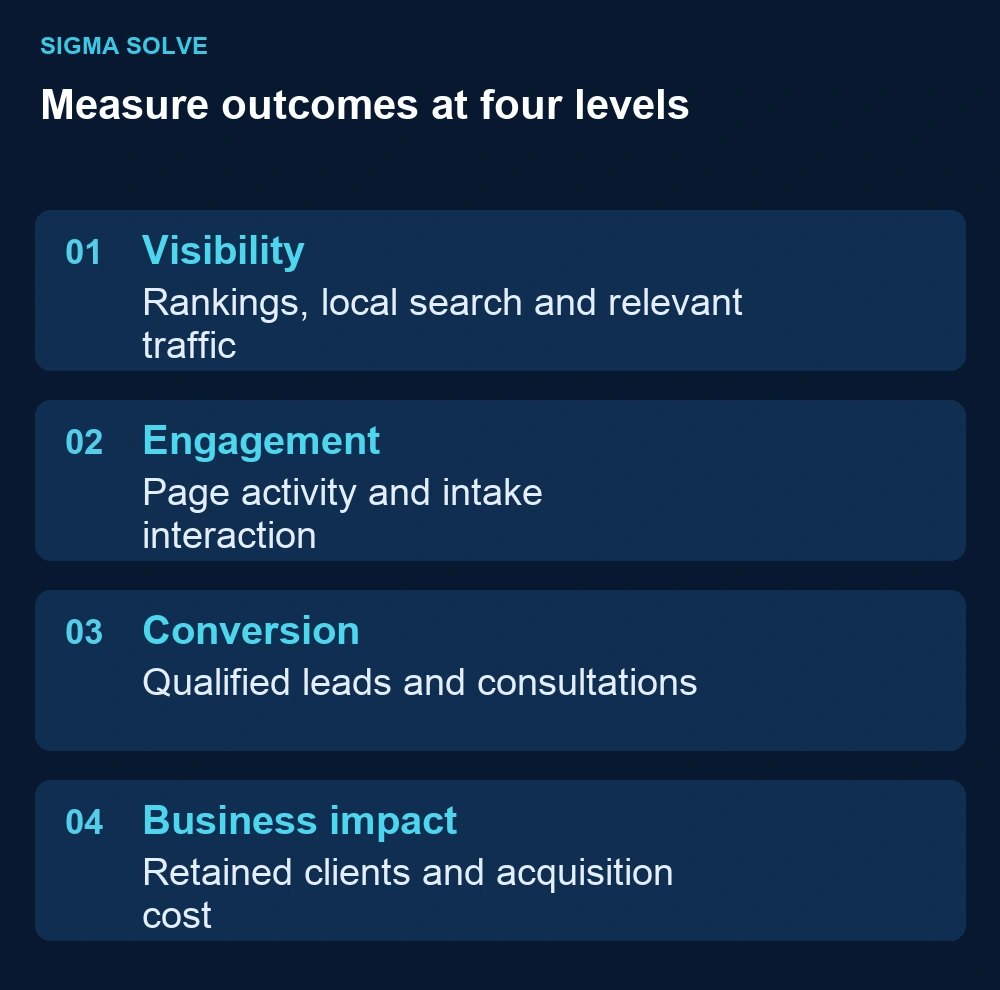
The biggest mistake firms make is measuring AI marketing on efficiency alone. Producing four times more content doesn't mean the strategy is working. Measure it against outcomes across four levels. Visibility covers organic rankings, local search performance, and relevant traffic growth; Google launched dedicated Search Console reporting for generative AI performance in June 2026, initially rolled out to a subset of sites, giving an early, if still limited, window into AI Overviews visibility. Engagement covers practice-area page activity, return visits, and intake tool interaction. Conversion covers qualified leads, consultation requests and attendance, and response time. Business impact covers retained clients, cost per acquisition, revenue by channel, and lifetime value. AI can make reporting faster, but the goal stays the same: marketing should drive outcomes, not just activity.
A Practical Roadmap
Firms don't need to automate everything at once. A phased approach works better:
- Audit the journey. How clients find the firm, where they drop off, how fast inquiries get a response.
- Strengthen the foundation. Site architecture, technical SEO, practice-area pages, analytics, and CRM/intake processes, since AI can't fix a weak base.
- Introduce high-value AI use cases. Content research, intake automation, lead routing, and reporting, prioritized by clear business benefit.
- Establish governance. Approved tools, data handling rules, review responsibilities, and compliance monitoring.
- Measure and refine. Track what's improving and adjust based on real performance.
The Future Isn't Fully Automated
AI will keep weaving deeper into how people search and how firms manage client acquisition, but the firms that benefit most won't be the ones that automate the most. They'll combine AI efficiency with human expertise, reliable information, and responsible data practices. AI's role isn't to replace attorney expertise or turn marketing into a content factory. It's to help firms build a more connected, responsive system that reduces friction and frees up human attention for what matters most. In 2026, AI digital marketing for law firms is about connecting the entire journey from search visibility to client acquisition, not just producing more content, faster.
Build a Smarter Client Acquisition System with AI
AI creates real opportunities for law firms, but only when connected to a clear business strategy. At SigmaSolve, we help organizations design AI-enabled digital solutions that connect customer experience, data, automation, and business workflows, whether that means improving digital visibility, modernizing intake, or exploring a broader AI transformation strategy.
Talk to the SigmaSolve team to explore how AI and digital technology can support your law firm's growth strategy.
Talk to Us