
AI in Software Development 2016: Benefits, Challenges, and Future Opportunities
Milind Shah · 1/8/2025 · 20 min read

Two years ago, the question was whether developers should try an AI coding assistant. That question is answered as most organizations have moved well past pilots and nine out of ten now use AI to assist with coding in some form, and most of them have already put AI coding agents into production code paths rather than keeping them in sandbox experiments.
The real question for business leaders in 2026 isn't adoption. It's governance: which workflows can safely run with an AI agent in the loop, how much autonomy to grant it, and how to keep code quality, security, and accountability intact as agents move from suggesting lines of code to opening pull requests on their own.
Dive into the blog to learn where AI stands today in software development, the shift from autocomplete to agents, what's working, what's still risky, and what a sensible adoption path looks like for a mid-size engineering team.
What Has Changed in the Last Few Years
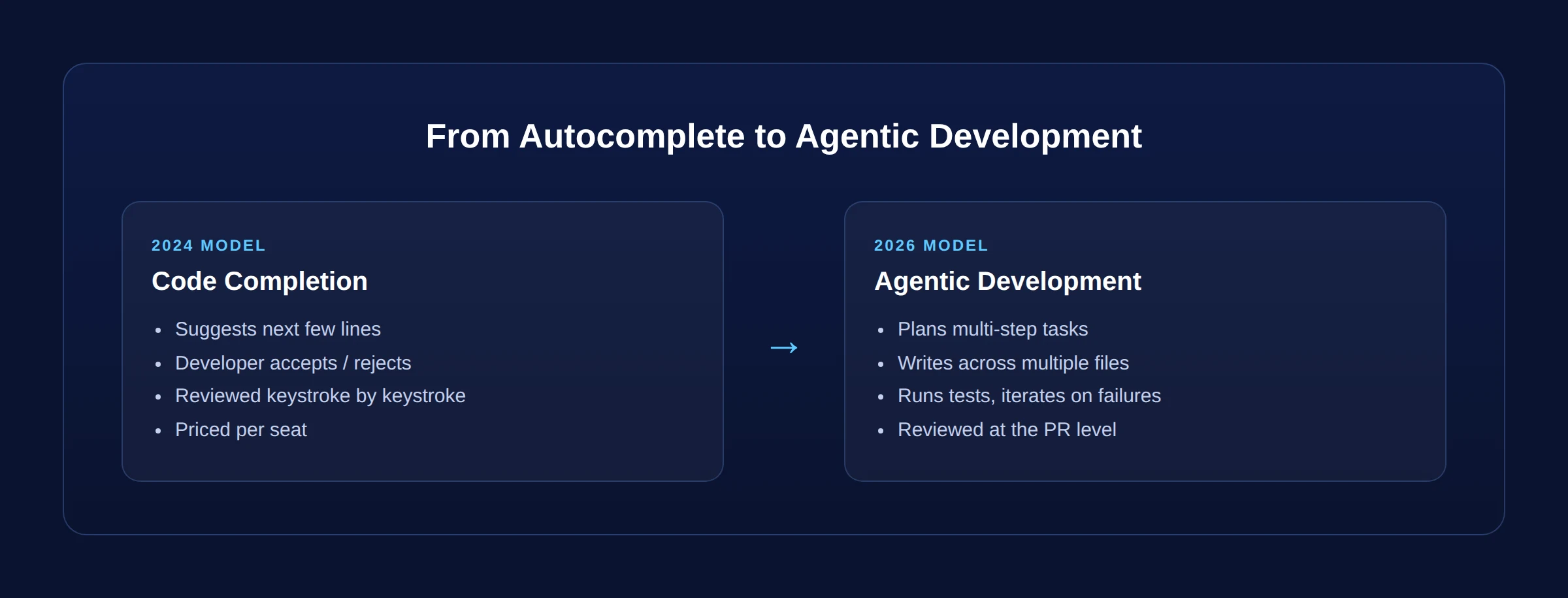
The 2024-era mental model of "AI in software development" was code completion: a tool suggests the next few lines, a developer accepts or rejects them. That model still exists, but it's no longer the centre of the conversation.
The centre has moved to agentic development, AI systems that can plan multi-step tasks, write code across multiple files, run tests, and iterate on failures with limited human oversight. Terminal-based and IDE-embedded coding agents have gone from a niche experiment to a mainstream engineering tool in roughly eighteen months, and the market has shifted from seat-based pricing to usage-based pricing because agents now do sustained, compute-heavy work rather than single autocomplete calls.
The practical shift for a development team: less "does this tool suggest good code," more "how do I scope a task well enough that an agent can own it end-to-end, and how do I review its output at the PR level instead of the keystroke level."
Where AI is earning its place in the SDLC
Tools like GitHub Copilot's agent mode, Cursor, and Claude Code have moved past single-line suggestions into planning and executing multi-file changes, with Model Context Protocol (MCP) giving agents standardized access to a team's own tools and repositories rather than just the code in front of them. Sigma Solve's AI & Automation team sees this shift play out directly in client delivery work.
Code Generation and Refactoring
Agents now handle scaffolding, boilerplate, and increasingly whole feature branches when the task is well-specified. But the productivity story here is more specific than most blogs let on. A widely cited GitHub study found a 55.8% speed gain, but that figure came from a controlled experiment on a single, well-defined HTTP server task, not a general multiplier. Broader 2026 data tell a more layered story: developers who use AI heavily do ship 4–10x more code than non-users, but most of that gap predates AI adoption; it's the same top performers who were already fast. The AI-attributable velocity gain, isolated, is closer to 25%. That's still meaningful. It's just a different number than the one usually quoted.
Code review and quality gates
AI-assisted review tools flag security issues and regressions before a human reviewer opens the PR, useful, but worth pairing with a caution: AI-generated code tends to be well-formatted and syntactically clean, which makes it look higher quality during review even when it has architectural or integration problems a human wouldn't catch on a quick pass. Clean formatting isn't the same signal it used to be.
Testing
Test generation is a clear win for well-defined behaviour; agents are less reliable at judging what deserves a test in the first place. Test strategy stays a human decision.
The Maintainability trade-off Nobody Puts in the "Benefits" List
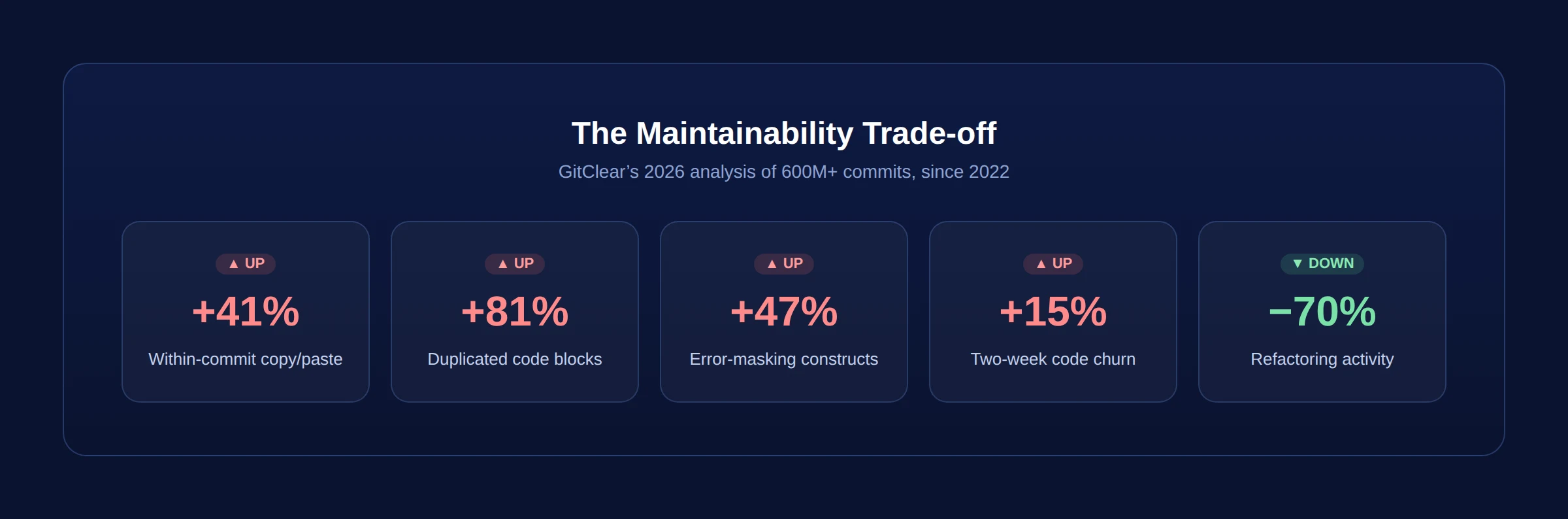
This is the part most AI-in-development content leaves out. GitClear's 2026 analysis of over 600 million commits found that as AI authorship has risen, several codebase-health signals have moved the wrong direction: within-commit copy/paste is up 41%, duplicated code blocks are up 81%, error-masking constructs (code that silently swallows exceptions rather than handling them) are up 47%, and two-week code churn, code rewritten or deleted shortly after being merged, is up 15%. Meanwhile, refactoring activity (code being properly moved and reused rather than duplicated) is down 70% from 2022 levels. The pattern: agents are good at producing code that passes review, less good at integrating it cleanly into what already exists. That's a codebase-awareness problem, not a code-generation problem, and it's exactly why documentation and cross-file context (what MCP integrations are trying to solve) matter more in 2026 than they did in the pure-autocomplete era.
Where AI Coding Agents Still Fail
It's worth being direct about this, because a lot of AI-in-software-development content skips it.
- Trust doesn't scale linearly with capability. A meaningful share of organizations still limits agents to assistive roles rather than letting them lead development work unsupervised, and for good reason: agent-generated code that looks correct but embeds subtle logic errors is a known failure mode.
- Most agentic pilots still don't reach production. The gap isn't model quality; it's scoping, ownership, and governance discipline. Teams that treat agent adoption as "turn it on and see what happens" tend to stall.
- Skill erosion is a real management question. Junior developers who lean on agents before they've internalized fundamentals can end up unable to evaluate the agent's output critically.
- Security and IP exposure. Agents get more autonomy, broader codebase access, more tool integrations (via protocols like MCP), and more surface area for a misconfigured permission to matter.
How to Roll Out AI Coding Agents without the Pilot Stalling
The single biggest lever isn't tooling choice or access policy, it's how much specification work happens before a task is handed to an agent. The GitClear findings above line up with a pattern researchers are calling specification-driven governance: teams that write a detailed spec, expected inputs, edge cases, and how the change should integrate with existing code, before delegating to an agent, see meaningfully less of the duplication and churn problem, because the agent isn't guessing at codebase context it was never given. Teams that treat the prompt as the spec ("add a login flow") are the ones showing up in the duplication and churn numbers.
Practically, that means:
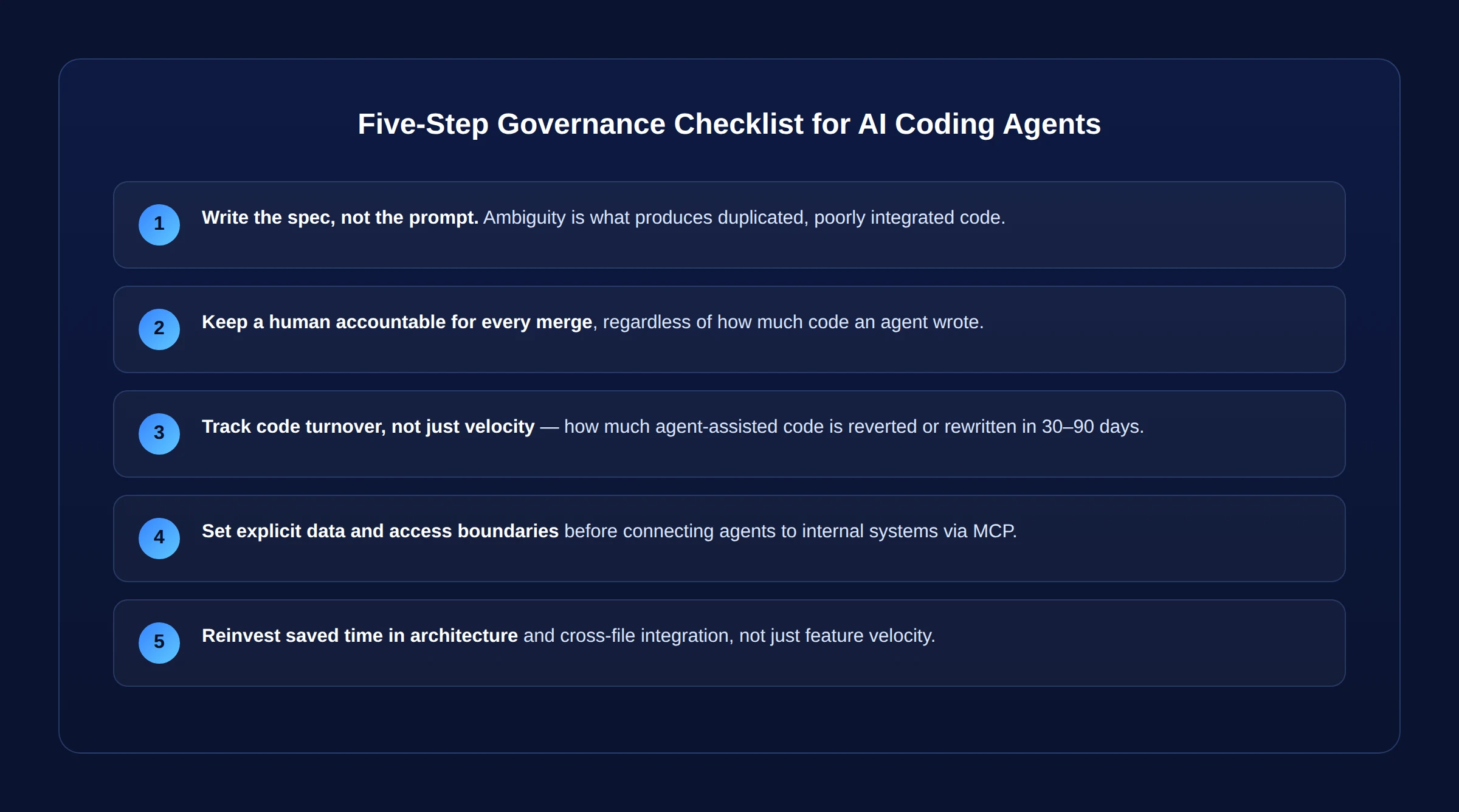
- Write the spec, not the prompt. Bounded, high-volume, low-ambiguity work still matters, but the reason it works is that ambiguity is exactly what produces duplicated, poorly integrated code. A one-paragraph prompt is not a spec.
- Keep a human accountable for every merge, regardless of how much of the code an agent wrote. Agent-authored doesn't mean agent-owned.
- Track code turnover, not just velocity. Defect rate and review time matter, but the metric that catches this failure mode is how much agent-assisted code gets reverted, deleted, or substantially rewritten within 30–90 days. Velocity without a turnover check will hide the churn problem, not solve it.
- Set explicit data and access boundaries before connecting agents to internal systems via MCP or similar integrations; broader access is exactly what turns a scoping mistake into a security incident.
- Reinvest saved time in the thing agents are still bad at: codebase-level architecture and cross-file integration, rather than just more feature velocity. That's the gap the data above points to directly.
The bottom line
The argument this piece has been building toward: AI coding agents are no longer a productivity add-on you either try or skip, they're a governance problem you either get ahead of or clean up after. The teams seeing durable gains aren't the ones with the most autonomous agents; they're the ones who've made specification, review, and turnover-tracking as much a part of the workflow as the agent itself. Skip that discipline, and the same tools that promise 25% more velocity show up later as duplicated code, unreviewed churn, and the kind of technical debt nobody notices until a sprint slows down for no obvious reason.
That's the gap between "we use AI" and "we've built AI into how we ship", and it's where most of the value on the table in 2026 sits.
How we govern AI-assisted delivery at Sigma Solve
We build AI-assisted engineering practices into client delivery the same way we'd build any other engineering discipline, with defined review gates, not blanket trust. If you want to see how that's played out in production, including a 25+TB data migration completed with an AI-assisted engineering approach, our case studies walk through the specifics.
If you're weighing how much autonomy to hand your own engineering team's AI tools or trying to fix a codebase that's already showing the churn signals above, talk to our engineering team about what a governed AI adoption plan looks like for your stack.