
Cost of Hiring a Software Developer in 2026
Milind Shah · 1/9/2025 · 17 min read

Introduction
Hiring a software developer in 2026 is no longer just a question of comparing hourly rates. Businesses today are evaluating a much broader range of factors, including technical expertise, AI capabilities, delivery speed, scalability, security requirements, and long-term business impact.
Whether you are building a minimum viable product (MVP), developing a SaaS platform, modernizing legacy applications, or integrating artificial intelligence into existing systems, understanding software developer costs is critical for making the right investment decisions.
One of the biggest mistakes businesses make is assuming that software development costs can be calculated using a single average rate. In reality, pricing varies significantly depending on multiple factors, including:
- Developer experience and specialization
- Technology stack requirements
- Project complexity
- Geographic location
- Hiring model
- Team structure and delivery approach
For example, hiring a senior AI engineer in the United States will involve a very different investment compared to hiring a full-stack developer in India, not simply because of location, but because of differences in expertise, market demand, project complexity, and expected business outcomes.
The rise of AI-assisted development has also changed how companies plan engineering budgets. AI tools can accelerate coding, testing, documentation, and automation, but they have not eliminated the need for skilled software developers. Instead, businesses increasingly value engineers who can design scalable architectures, solve complex technical problems, integrate AI solutions, and build secure, maintainable software.
This blog explains the real cost of hiring software developers in 2026, including pricing by hiring model, experience level, location, specialization, and project type. It also covers hidden costs, AI's impact on development pricing, and strategies to maximize your software investment.
Software Development Cost Overview by Hiring Model
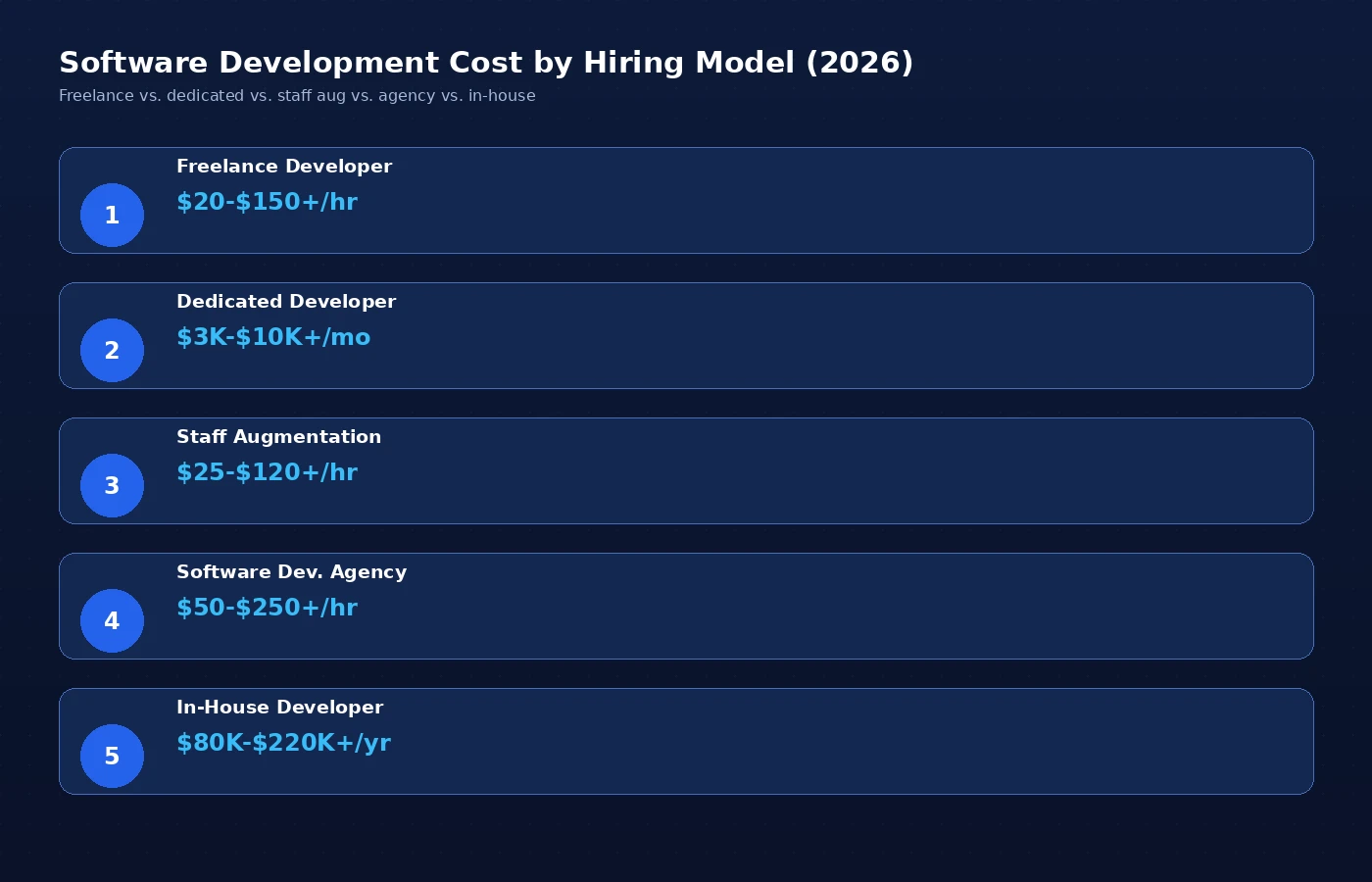
The cost of hiring software developers depends largely on the engagement model you choose. While freelancers may offer lower upfront costs, dedicated developers, staff augmentation, agencies, and in-house teams provide different levels of flexibility, control, and delivery capability.
| Hiring Model | Typical Cost | Best For | Key Consideration |
|---|---|---|---|
| Freelance Developer | $20–$150+ per hour | Short-term tasks, prototypes, bug fixes | Cost-effective for limited scope projects but less suitable for complex, long-term development |
| Dedicated Developer | $3,000–$10,000+ per month | Product development and ongoing engineering support | Provides continuity, deeper product knowledge, and predictable monthly costs |
| Staff Augmentation | $25–$120+ per hour | Expanding existing engineering teams | Helps businesses quickly access specialized skills without permanent hiring |
| Software Development Agency | $50–$250+ per hour | End-to-end product development and enterprise solutions | Offers complete teams, delivery management, QA, DevOps, and technical expertise |
| In-House Developer | $80,000–$220,000+ annually | Long-term internal engineering capabilities | Provides maximum control but includes recruitment, benefits, infrastructure, and retention costs |
Factors That Influence Software Developer Costs
Several factors influence the cost in the software development market, and understanding these factors helps businesses create realistic budgets and choose developers based on long-term value rather than simply selecting the lowest available rate. Let's have a look:
1. Developer Experience and Expertise
Developer experience is one of the strongest factors influencing cost because it directly affects productivity, decision-making, and software quality.
Junior developers are generally suitable for well-defined tasks, basic application features, and projects where technical guidance is available. Mid-level developers can independently manage most development activities and senior developers, technical leads, and solution architects command higher rates because they bring deeper expertise.
2. Technology Stack and Required Skills
The technologies used in a project have a direct impact on developer pricing. And technology choices also influence long-term costs. A well-supported technology stack can make future hiring, maintenance, and scaling easier, while outdated or highly specialized technologies may increase operational expenses over time.
3. Project Complexity and Scope
Software complexity is one of the biggest drivers of development cost. Clearly defining project scope early helps businesses control costs, reduce delays, and avoid unnecessary development effort caused by changing requirements.
4. Geographic Location
Developer rates vary significantly across regions due to differences in labor costs, talent availability, economic conditions, and technology market maturity. However, location should not be evaluated only by hourly rates. Communication, time-zone compatibility, technical expertise, security practices, and delivery experience also influence the overall success and cost of a project.
5. Hiring Model
The engagement model you choose significantly affects both cost and flexibility. And the right hiring model depends on project duration, internal capabilities, business goals, and the level of technical ownership required.
6. Team Structure and Required Expertise
Modern software development involves more than just writing code. Depending on the project, businesses may require product managers, UI/UX designers, QA engineers, DevOps specialists, cloud engineers, security experts, data engineers, or solution architects.
7. Security and Compliance Requirements
Security and compliance requirements can significantly influence development costs, particularly for businesses operating in regulated industries as they require compliance standards such as HIPAA, GDPR, PCI DSS, SOC 2, and ISO 27001.
Software Developer Hourly Rates by Country in 2026
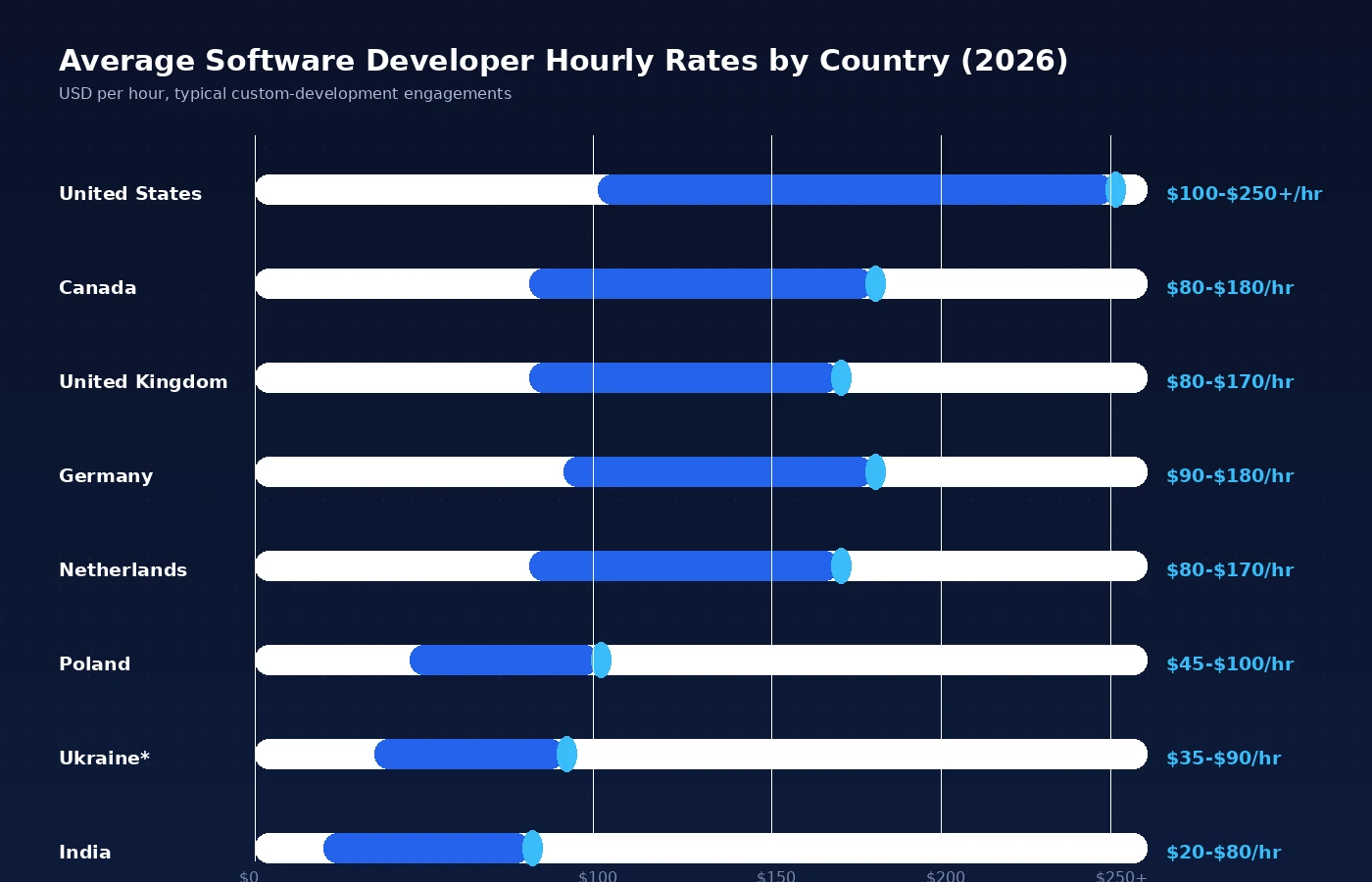
Geographic location remains one of the most important factors affecting software development costs. Developer pricing varies across regions based on labor markets, technical talent availability, cost of living, demand for specialized skills, and the maturity of the technology ecosystem.
While offshore and nearshore development can significantly reduce costs, businesses should evaluate regions based on more than pricing alone. Technical expertise, communication, time-zone alignment, security standards, and delivery experience often have a greater impact on project success than the hourly rate itself.
Average Software Developer Rates by Country (2026)
| Country / Region | Average Hourly Rate (USD) | Best Fit For |
|---|---|---|
| United States | $100–$250+ | Enterprise applications, AI solutions, complex architecture |
| Canada | $80–$180 | SaaS products, cloud solutions, enterprise software |
| United Kingdom | $80–$170 | FinTech, digital transformation, enterprise modernization |
| Germany | $90–$180 | Industrial software, enterprise systems, engineering platforms |
| Netherlands | $80–$170 | Cloud-native applications, digital transformation |
| Poland | $45–$100 | Product engineering, SaaS, enterprise development |
| Ukraine* | $35–$90 | Full-stack development, dedicated engineering teams |
| India | $20–$80 | Web development, enterprise software, AI, dedicated teams |
Is the Lowest-Cost Developer Location Always the Best Choice?
Not necessarily.
Choosing a development location purely based on hourly rates can create hidden costs through communication challenges, slower delivery, quality issues, or limited scalability.
A better approach is to evaluate potential development partners based on:
- Technical expertise
- Relevant industry experience
- Communication effectiveness
- Delivery processes
- Security capabilities
- Team scalability
- Long-term support
The best development location is the one that provides the right balance of cost efficiency, technical capability, and business alignment.
Software Developer Costs by Role and Specialization in 2026
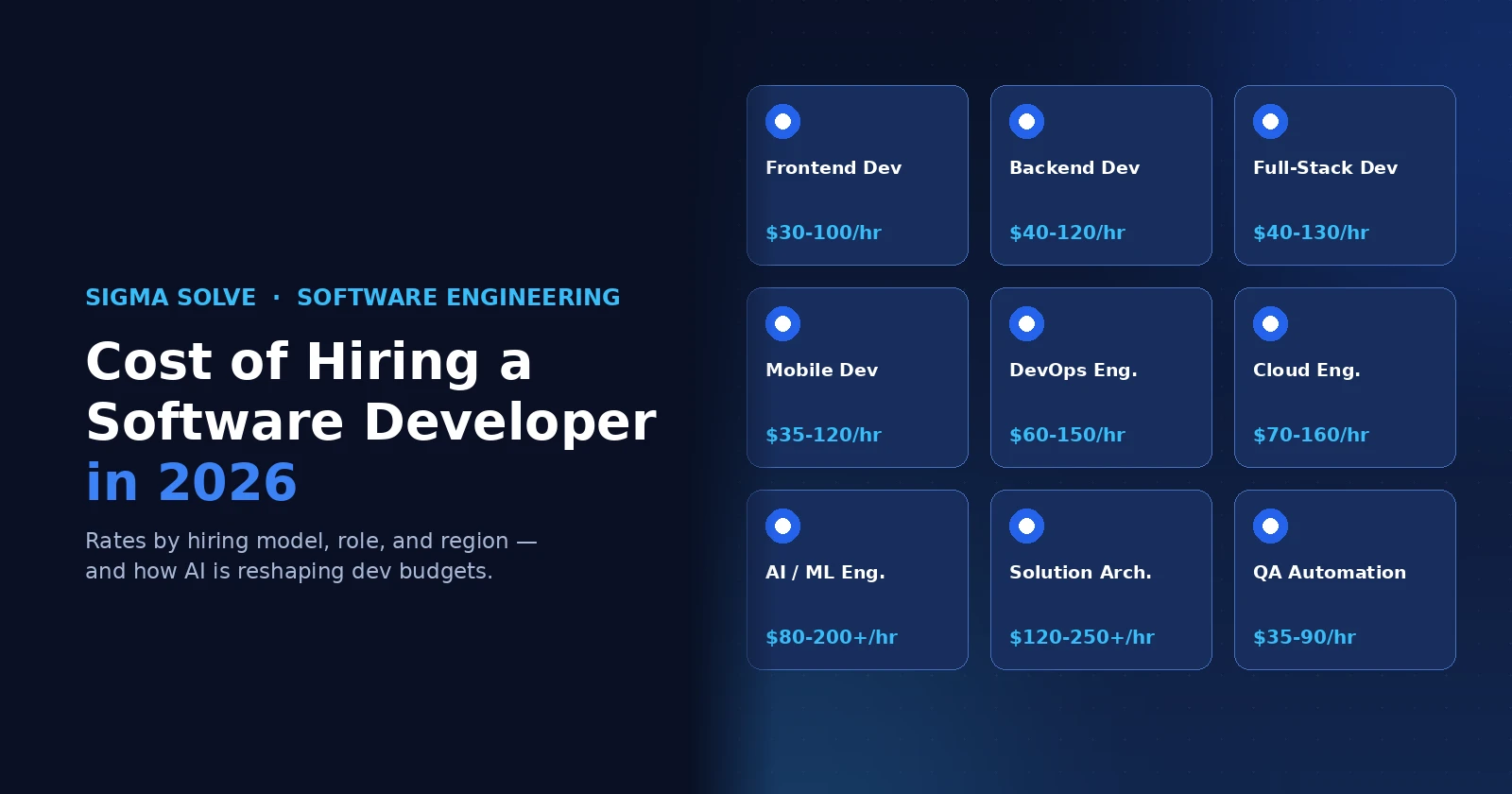
Software development costs also vary significantly based on the type of expertise required. A frontend developer building user interfaces, an AI engineer developing intelligent systems, and a solution architect designing enterprise platforms all contribute differently to a project, and their pricing reflects the complexity and specialization involved.
Choosing the right role is not about hiring the most expensive developer. It is about matching expertise with the actual requirements of the product, technology stack, and business goals.
Average Developer Rates by Role (2026)
| Developer Role | Typical Hourly Rate (USD) | Primary Use Cases |
|---|---|---|
| Frontend Developer | $30–$100 | Web interfaces, dashboards, customer applications |
| Backend Developer | $40–$120 | APIs, databases, business logic, integrations |
| Full-Stack Developer | $40–$130 | End-to-end application development, MVPs |
| Mobile App Developer | $35–$120 | iOS, Android, and cross-platform applications |
| DevOps Engineer | $60–$150 | CI/CD, automation, cloud infrastructure |
| Cloud Engineer | $70–$160 | Cloud migration, scalability, infrastructure design |
| QA Automation Engineer | $35–$90 | Automated testing, quality assurance |
| Data Engineer | $60–$150 | Data pipelines, analytics platforms, data infrastructure |
| AI / Machine Learning Engineer | $80–$200+ | AI applications, predictive models, automation |
| LLM / Generative AI Engineer | $100–$250+ | AI assistants, RAG systems, enterprise GenAI solutions |
| Cybersecurity Engineer | $80–$180 | Application security, risk management, compliance |
| Solution Architect | $120–$250+ | Enterprise architecture and technology strategy |
Key Factors Used to Estimate Software Development Costs
1. Project Scope and Feature Requirements
The foundation of any accurate estimate is a clearly defined scope.
2. Team Size and Required Expertise
The size and composition of the development team directly impact cost.
3. Development Timeline
Project duration has a direct relationship with overall cost.
4. Design, Testing, and Deployment Requirements
Software development involves much more than writing code.
5. Infrastructure and Technology Costs
Modern applications require reliable infrastructure to operate effectively.
6. Maintenance and Continuous Improvement
Software development does not end after launch.
How to Estimate the Cost of a Software Development Project in 2026
Understanding developer rates is only the starting point when planning a software project. The final cost depends on several factors, including the product scope, technical complexity, team structure, timeline, infrastructure requirements, and long-term maintenance needs.
A common mistake business make is estimating costs only by multiplying developer hourly rates with expected development hours. While this approach may work for smaller tasks, successful software projects require a broader view that considers the complete development lifecycle, from planning and design to deployment and continuous improvement.
The most accurate estimates are based on three key questions:
- What needs to be built?
- What expertise is required to build it?
- What level of scalability, security, and reliability does the business need?
Typical Software Development Cost Ranges
Software costs vary widely depending on the type of application and business requirements.
A simple proof of concept may require an investment of around $10,000–$30,000, while a minimum viable product (MVP) typically ranges between $30,000–$100,000 depending on features, platforms, and complexity.
Small business applications often fall in the $50,000–$150,000 range, while larger SaaS platforms, enterprise systems, and AI-powered applications can require investments ranging from $100,000 to several million dollars.
The final cost depends less on the number of features and more on the complexity behind those features, such as integrations, security requirements, scalability needs, and technical architecture.
A Practical Approach to Estimating Your Software Budget
Before requesting a development estimate, businesses should define:
- The primary business problem being solved
- The target users and expected usage
- Essential features for the first release
- Required platforms and integrations
- Security or compliance requirements
- Expected launch timeline
- Long-term maintenance expectations
Clear requirements allow development teams to provide more accurate estimates and reduce unexpected costs during execution.
How AI Is Changing Software Development Costs in 2026
Artificial intelligence has changed how software is designed, developed, tested, and maintained. However, AI is not simply reducing development costs, it is changing the type of expertise businesses need.
AI-powered coding assistants can accelerate routine tasks such as code generation, documentation, testing, and debugging. This allows developers to work faster and focus more on architecture, problem-solving, and innovation.
However, businesses still require experienced engineers to make critical decisions around system design, security, scalability, data management, and AI implementation.
The value of developers is shifting from writing every line of code manually to designing, validating, integrating, and managing increasingly complex software systems.
How AI Impacts Developer Hiring
Modern businesses increasingly look for developers who can work effectively with AI tools and understand emerging technologies such as:
- Large language models (LLMs)
- Retrieval-Augmented Generation (RAG)
- AI application architecture
- Automation workflows
- Cloud-based AI deployment
This has increased demand for AI engineers, LLM specialists, cloud architects, and developers who can combine traditional software engineering skills with AI capabilities.
Conclusion
The cost of hiring a software developer in 2026 is influenced by far more than hourly rates.
Developer experience, technology expertise, location, hiring model, project complexity, and AI capabilities all play a role in determining the true investment required to build successful software.
Businesses that focus only on finding the lowest-cost developer often overlook factors that determine long-term success, such as code quality, scalability, security, maintainability, and delivery reliability.
Ready to Build Your Software Solution?
If you are planning a new software product, need additional engineering expertise, or want to explore the right development strategy for your business, Sigma Solve can help you make right decisions, as they have an experienced team of expert software developers helping clients worldwide.
Contact our experts to discuss your project requirements and get a customized software development cost estimate.