
Custom Software Development in 2026: A Strategic Guide for Enterprise Leaders
Shivam B. · 8/10/2026 · 5 Min

Enterprise software is entering a new era.
Over the last decade, organizations accelerated digital transformation through cloud platforms, SaaS applications, and automation tools designed to improve efficiency and scale. Those investments worked. But the next challenge enterprises face isn't digital adoption, it's digital adaptability.
As technology ecosystems expand, many organizations are running into the same wall: disconnected applications, rising SaaS costs, limited customization, fragmented data, and growing dependence on vendor roadmaps. The software that once enabled growth is now becoming difficult to manage at enterprise scale.
At the same time, expectations have shifted. AI, real-time analytics, automation, and evolving cybersecurity requirements are redefining what businesses need from their technology. Software is no longer just a tool that supports operations, it's a strategic capability that shapes how companies innovate, compete, and serve customers.
The question enterprise leaders are asking has changed. It used to be "Which platform should we buy?" Now it's "Do our technology capabilities actually support our long-term business objectives?"
Custom software development sits at the center of that question, not because enterprises need to build everything themselves, but because certain capabilities require technology designed around the business, rather than the business adapting to technology limitations.
Why Enterprise Software Strategy Is Changing
Most enterprise technology environments evolved through years of incremental decisions, a department picks up a SaaS tool to solve an immediate need, a legacy system gets extended rather than replaced, a new platform is bolted on as requirements shift. Individually, these decisions made sense. Collectively, they've created ecosystems that are harder to integrate, govern, and scale.
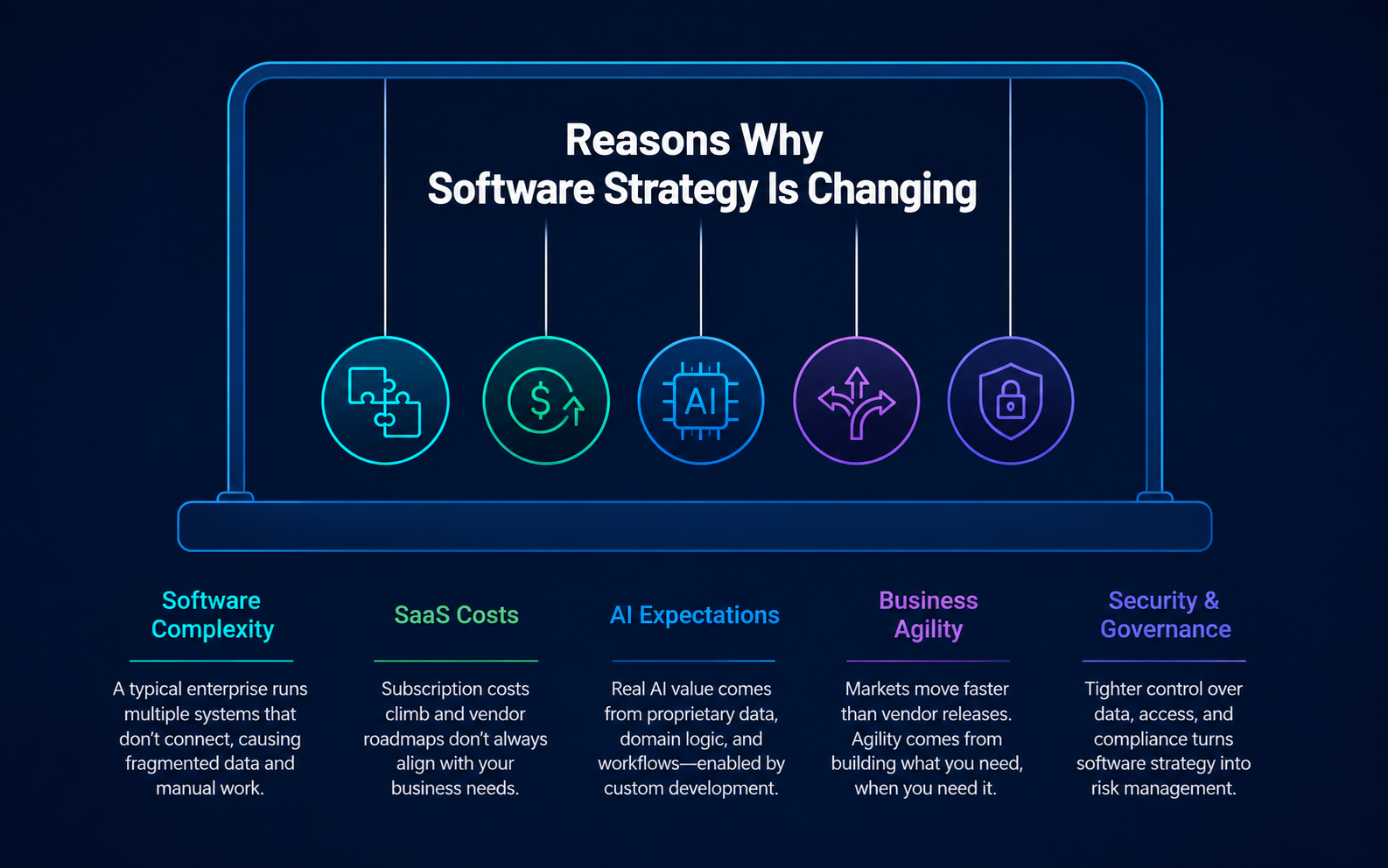
The problem isn't a lack of software, most enterprises already run platforms for finance, CRM, collaboration, operations, and analytics. The problem is getting those systems to work together as a connected, intelligent environment. Five shifts are driving this:
More software has created more complexity
A typical enterprise runs ERP, CRM, SaaS tools, legacy applications, and data platforms simultaneously. Each may work well on its own, but disconnected systems fragment data, force manual work between departments, and make consistent reporting difficult. Increasingly, custom software's role isn't replacing these platforms, it's building the integration layer that connects them.
SaaS costs and vendor dependency are rising
Subscription costs climb with more users, premium features, storage, and overlapping tools, and at enterprise scale, that adds up to a real strategic line item. Beyond cost, there's the dependency question: commercial platforms evolve on the vendor's roadmap, not yours. When product priorities don't match business needs, enterprises look to build the capabilities they need direct control over.
AI is raising the bar
Organizations are moving past basic automation toward applications that analyze data, predict outcomes, and personalize experiences. But a generic AI feature bolted onto commercial software solves generic problems. Real AI value comes from connecting it to proprietary data, domain-specific logic, and existing workflows, which is exactly what custom development enables.
Business agility is now competitive advantage
Markets, regulations, and customer expectations are moving faster than typical vendor release cycles. Enterprises tied entirely to vendor-controlled platforms can find themselves waiting on someone else's roadmap when the business needs to move.
Security and governance are now strategic, not operational
As enterprise software handles more sensitive data, organizations need tighter control over access, compliance, and architecture, particularly in regulated industries like healthcare, finance, and insurance, where software decisions are inseparable from risk management.
Taken together, these shifts explain why software has stopped being back-office infrastructure and become a lever for customer experience, operational efficiency, and competitive differentiation.
What Actually Makes Software "Custom"
Custom software is often misunderstood as something built entirely from scratch. In practice, it's defined less by how it's built and more by how well it fits, the workflows, data, compliance needs, and competitive edge that are specific to one organization.
And building custom doesn't mean replacing everything. Successful enterprises rarely take an all-or-nothing approach. Most run a mix of SaaS platforms for standardized functions (HR, accounting, collaboration) alongside custom applications built where technology needs to differentiate the business, not just support it. The goal isn't to customize everything, it's to build the specific capabilities that matter most.
That shows up in a few common forms: extensions to existing ERP or CRM platforms that add industry-specific workflows; customer-facing portals and self-service experiences; workflow automation that connects systems, data, and approvals; integration platforms that let SaaS tools, legacy systems, and databases exchange data securely; and AI-powered applications built around proprietary data rather than generic model features.
Where Custom Software Creates the Most Value and When It's the Right Call
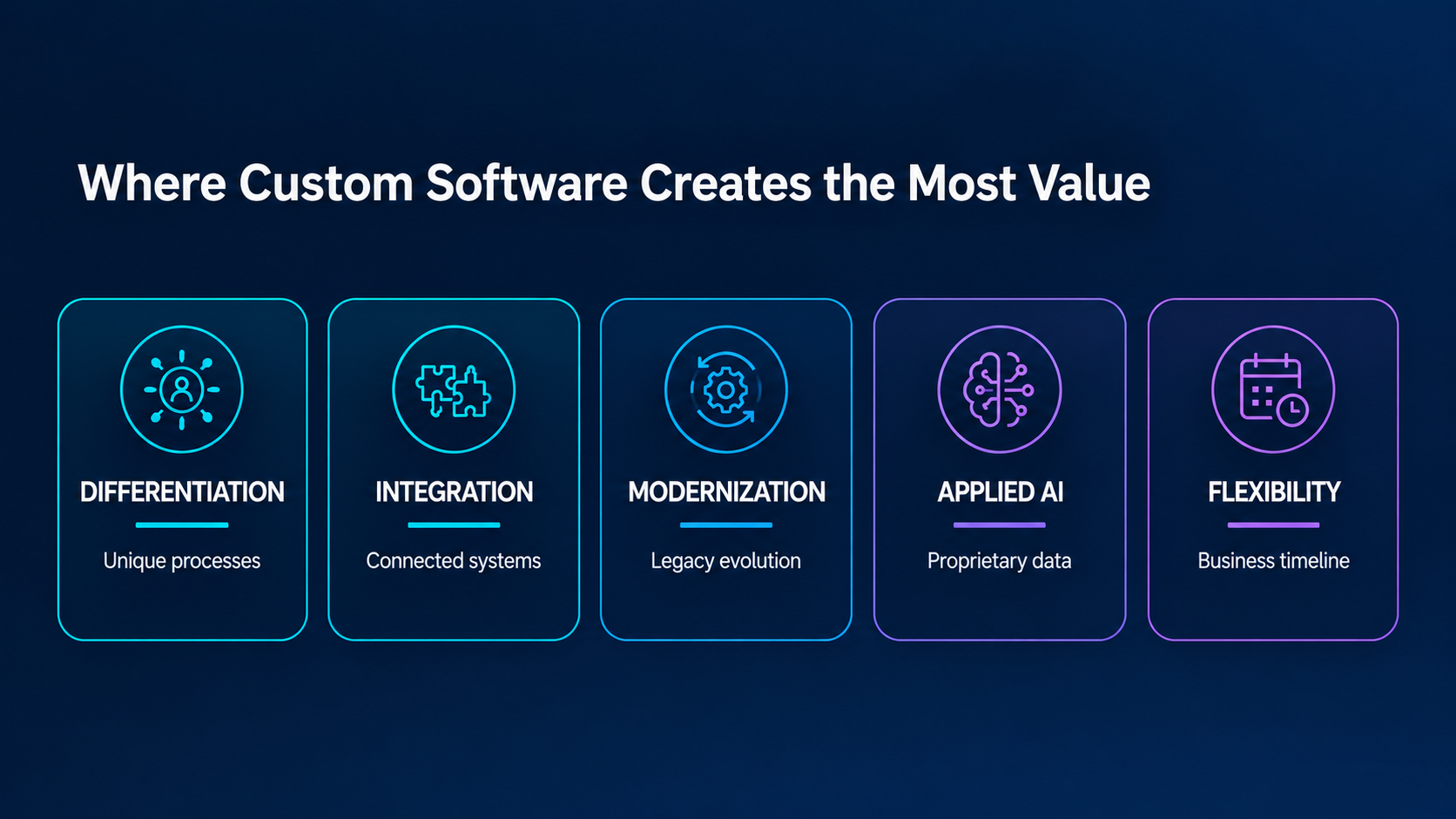
Custom software isn't the right answer for every requirement. For standardized functions, commercial platforms remain the faster, cheaper, more proven choice. The decision to build custom should hinge on one question: does this capability directly affect business performance, efficiency, customer experience, or competitive advantage? Custom software earns its cost in five situations:
When a process is your differentiator
Standard software supports common industry practice. But a bank's risk model, a manufacturer's production workflow, an insurer's underwriting logic, or a retailer's customer engagement strategy is often the thing that makes the business competitive in the first place, and forcing it into generic software flattens the advantage.
When disconnected systems create data silos
Fragmented data, manual transfers, and inconsistent reporting are symptoms of systems that were never designed to talk to each other. Custom integration layers fix this without ripping out what already works.
When legacy systems are holding back modernization
Older applications often lack the APIs, cloud compatibility, or AI-readiness the business now needs, but replacing them outright is expensive and disruptive. Incremental modernization, layering new custom capabilities on top of existing systems, is usually the more practical path.
When AI needs to be more than a feature
AI delivers real value when it's connected to business-specific data and rules, a bank's internal risk models, a manufacturer's equipment data, a healthcare provider's compliance constraints. That requires purpose-built architecture, not a generic AI toggle.
When the business needs long-term flexibility
Strategic capabilities, new markets, acquisitions, regulatory shifts, often move faster than vendor release cycles. Custom software lets the technology evolve on the business's timeline instead of the vendors.
The most effective enterprises don't choose between SaaS and custom software. They use SaaS where standard functionality is genuinely sufficient, and build custom where technology creates real differentiation.
How Industries Are Applying This
The pattern holds across sectors, even though the specifics differ.
Healthcare organizations use custom platforms to connect clinical systems, support telemedicine, and enable AI-driven workflows while staying compliant.
Banking and financial services rely on custom software for fraud detection, automated lending, risk management, and personalized digital banking.
Manufacturers are building connected ecosystems linking IoT devices, production systems, and analytics to enable predictive maintenance and quality control.
Retail, logistics, and insurance companies use custom applications for personalized customer journeys, supply chain optimization, and automated claims processing.
The common thread: organizations invest in custom software when technology becomes a driver of differentiation and operational excellence, not just a support function.
The Role of AI in Custom Enterprise Software
AI is now a primary driver of enterprise software investment, but success depends on more than adding AI capabilities to existing applications. The real value comes from integrating AI with business-specific data, operational processes, and industry requirements. Have a look at how its shaping:
Building AI Around Business-Specific Needs
Custom software enables enterprises to develop AI solutions designed around their unique objectives. A financial institution can build intelligent risk assessment systems based on internal models and compliance requirements. A manufacturer can develop predictive maintenance solutions using equipment data. A healthcare organization can create AI-supported workflows while maintaining strict privacy and security standards.
Unlike generic AI features within commercial platforms, custom AI solutions are designed to reflect how an organization actually operates.
AI Requires Strong Software Foundations
The growth of generative AI and AI agents is accelerating demand for enterprise software that can support intelligent decision-making and workflow automation. However, these capabilities require secure architecture, connected data ecosystems, governance controls, and scalable platforms.

Custom software provides the foundation needed to integrate AI into existing enterprise environments while maintaining control over data, security, and business processes.
Turning AI Into a Strategic Capability
The competitive advantage will not come from simply adopting AI tools. It will come from embedding AI into the processes that make each organization unique.
Custom software helps enterprises transform AI from a standalone technology feature into a scalable business capability that supports innovation, efficiency, and long-term growth.
Enterprise Technology Trends Shaping 2026
A few forces are shaping how custom software gets built this year:
Cloud-native Architecture: APIs, microservices, composable systems, is replacing rigid platforms with ecosystems that can scale and evolve independently.
Data and automation are converging, with organizations connecting fragmented sources into analytics-driven decision systems rather than treating data platforms as a separate initiative.
Security-first development is becoming the default rather than a late-stage add-on, with identity management and compliance controls built into architecture from day one.
None of these trends standalone as the enterprises getting the most value are the ones treating AI, cloud, data, and security as one integrated capability rather than four separate projects.
Measuring ROI
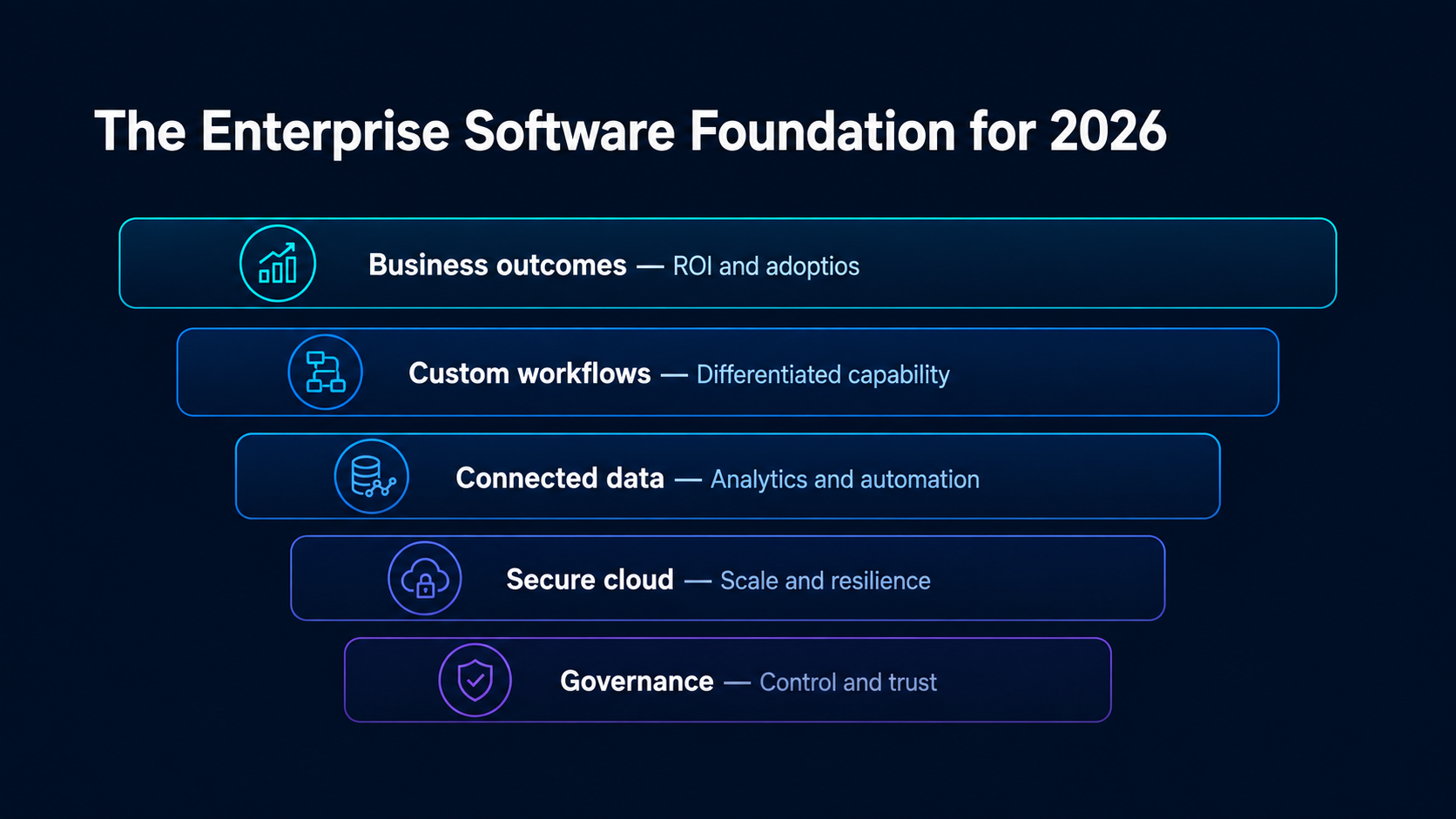
Custom software's return shouldn't be judged only by development cost or delivery timeline. The value shows up in four places:
Operational efficiency: Less manual work, fewer workarounds, lower error rates
Decision quality: Unified data feeding real dashboards instead of disconnected reports.
Customer experience: Journeys designed around your actual customers rather than a vendor's template.
Long-term flexibility: The ability to evolve the software as the business changes, without waiting on someone else's roadmap.
The strongest ROI shows up when custom software solves a problem that directly touches efficiency, growth, or competitive position, not when it's built simply because building was possible.
Common Challenges and How to Get Them Right
Custom software can deliver significant business value, but successful implementation requires more than technical development. Enterprise software initiatives involve complex decisions around business alignment, architecture, integration, security, adoption, and long-term management.
Understanding these challenges early helps organizations reduce risk and improve the chances of delivering a solution that creates lasting value.
Aligning Software With Business Objectives
One of the biggest challenges is starting development without clearly defining the business problem being solved. When projects focus only on features rather than measurable outcomes, complexity increases and the final solution may fail to deliver expected value.
Successful enterprises begin with clear objectives, defined success metrics, and alignment between business and technology teams.
Managing Complexity and Integration
Enterprise applications rarely operate independently. Custom solutions often need to connect with ERP platforms, CRM systems, legacy applications, cloud services, and third-party tools.
Without proper architecture planning, integration challenges can create data inconsistencies, performance issues, and operational disruption. A strong integration strategy ensures the software can scale and evolve with the business.
Building Security into the Foundation
Security and compliance cannot be treated as final implementation steps. Enterprise applications often handle sensitive customer information, financial data, and critical business operations.
Security-first development practices, including access controls, encryption, monitoring, and governance processes, are essential for building reliable enterprise software.
Driving Adoption and Long-Term Success
Even well-designed software can fail if users do not adopt it effectively. Successful implementation requires stakeholder involvement, user feedback, training, and change management.
Additionally, enterprise software should be designed for long-term growth through scalable architecture, continuous improvement, and ongoing support.
Choosing the Right Development Partner
The right technology partner plays a critical role in managing these challenges. Enterprises should look for partners who understand business objectives, modern engineering practices, security requirements, and long-term software evolution.
A successful custom software initiative is not just about building an application; it is about creating a sustainable technology capability that supports business growth.
Is Custom Software the Right Investment?
The decision shouldn't be "can we build this", it should be "does this capability meaningfully affect how we operate, compete, or grow." Custom development makes sense when existing platforms are creating real operational limitations, when disconnected systems are preventing teams from using data effectively, or when future plans, new markets, AI adoption, modernization, compliance requirements, need more flexibility than an off-the-shelf platform can offer.
Even then, success depends on more than the investment itself: clear objectives, stakeholder alignment, strong governance, and the right partner.
Building the Enterprise of 2026
Software decisions have stopped being a simple choice between buying a platform and building an application. As AI adoption accelerates, digital ecosystems grow more complex, and customer expectations keep shifting, software has become a strategic capability that shapes how well a business performs, not just how it operates.
The enterprises that get this right aren't the ones customizing everything. They're the ones being deliberate about where custom software creates real differentiation, and building deliberately in those places.
Build your next enterprise software capability with Sigma Solve.
Whether you're evaluating a new platform, modernizing legacy applications, or exploring AI-driven innovation, Sigma Solve can help identify the right approach and turn it into a scalable solution.
Connect with Sigma Solve to explore how custom software development can support your enterprise growth and digital transformation strategy.