
AI Agents: From AI That Talks to AI That Does
Sigma Solve · 11/5/2026 · 13 Minute Read

Most of us have used AI the same way: ask a question, get an answer, then do the work ourselves. The next shift is more practical. Enterprise AI agents can be given a goal, access to selected tools and data, and a set of boundaries, and then carry out parts of a job within them.
Take a shipment that may be running late. A chatbot can tell someone what to check. An agent can check the tracking data, chase the carrier within agreed rules, and pass the exception to a person if it can't be resolved.
The shift in one line: a chatbot tells you what to check. An agent checks it, chases the carrier within agreed rules, and hands the exception to a person.
That doesn't mean every process needs an agent, or that an agent should make every decision. The useful questions are more grounded: where is work getting stuck, what can safely be delegated, how will people stay in control, and how will you know it worked? This article works through those questions, using freight logistics as an example.
What is an AI Agent?
An AI agent is software that uses an AI model and connected tools to pursue a goal across multiple steps. It decides what to do next, interacts with systems, checks the results, and adjusts its approach. When a decision falls outside its limits, it pauses and asks a person. A simple comparison shows the difference:
| Type | What it does | Who decides the next step | Example |
|---|---|---|---|
| Chatbot | Answers a question or generates content | The human | "Summarize this contract" |
| AI workflow | Runs a defined sequence, with AI at selected steps | The designer, in advance | Classify each incoming email and route it to the right queue |
| AI agent | Works toward a goal, choosing from permitted steps and using connected tools | The agent, within set limits; people keep approval rights | Find contracts renewing next quarter, flag terms for review, and draft renegotiation notes |
A chatbot is a colleague you ask for advice. A workflow is a checklist everyone follows. An agent is a colleague who can carry a task forward using approved tools. That colleague still needs a clear brief, the right access, boundaries, and someone accountable for the result.
How an AI Agent Works
Most business agents combine four ingredients, and each one raises a business decision, not just a technical one.
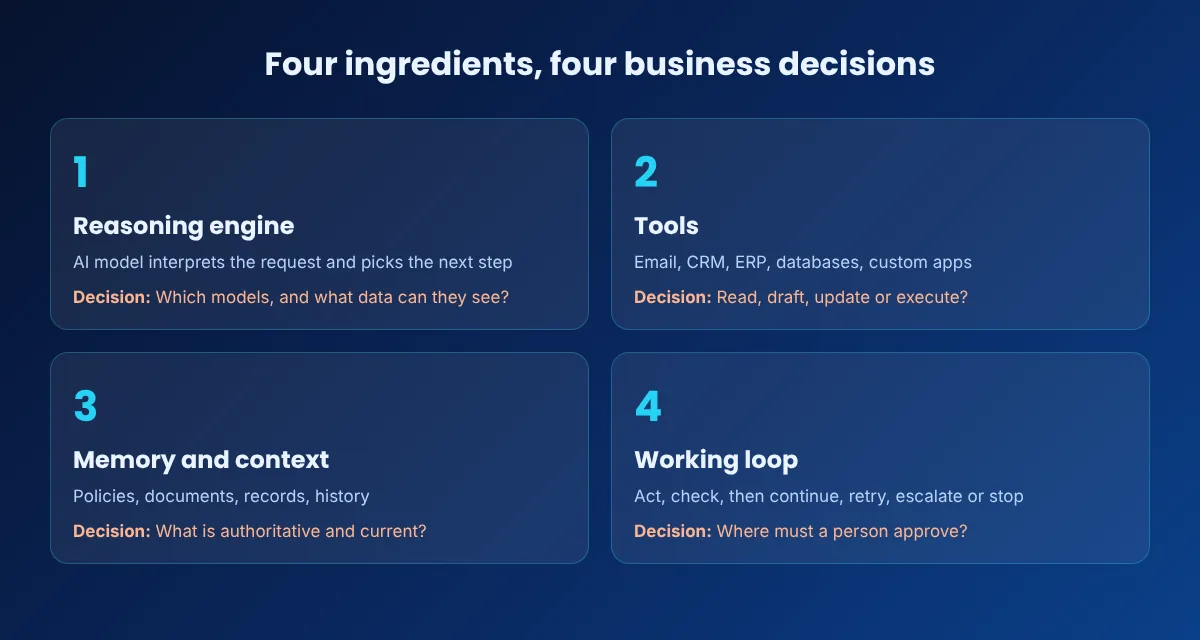
- A reasoning engine: An AI model interprets the request and chooses the next step. The decision: which models suit the task, and what data may be sent to them?
- Tools: These let an agent work in email, CRM, ERP, databases, or custom applications. The decision: which actions it can take (read, draft, update or execute) and which need approval.
- Memory and context: An agent needs the right information: policies, documents, records and relevant history. The decision: which information is authoritative, who can access it, and how it stays current.
- A working loop: The agent acts, checks what happened, and decides whether to continue, retry, escalate, or stop. The decision: where a person must approve, and what happens when confidence is low, or something fails.
Open standards help too. The Model Context Protocol (MCP) gives agents a common way to connect to tools and data, which cuts bespoke integration work, though permissions and testing still must be designed. Agents are also arriving inside tools people already use, from email and spreadsheets to coding environments. The model matters, but so do the data, tools, permissions and checks around it. Those choices usually decide whether an agent is useful day to day.
Where an Enterprise AI Agent Creates Value
Agents are worth exploring where a process involves repeated work, clear rules, information spread across systems, and outcomes that can be checked. A promising use case is not automatically a production-ready one, so start where results are easy to verify.
| Industry | Where agents are being applied |
|---|---|
| Financial services | KYC document preparation, fraud-alert triage, reconciliation support and regulatory-report drafting, with review controls |
| Healthcare | Prior-authorization paperwork, clinical documentation support, appointment and referral coordination, with privacy and clinical oversight |
| Logistics and transportation | Quote preparation, shipment-exception monitoring, carrier-compliance checks and freight-billing support |
| Manufacturing and supply chain | Supplier follow-up, order-exception handling, warranty-claim processing and maintenance scheduling |
Across industries, good starting points sit in shared functions: customer support, sales research, finance operations, HR onboarding and internal IT. The work is frequent enough to measure, and most actions can start in draft or recommendation mode while people keep approval authority.
A closer look: AI agents in Logistics
Freight brokerage is a useful example because a single load involves sales, dispatch, carriers, drivers, customers and accounting. The work moves through email, a transportation management system (TMS), load boards and accounting software, and people bridge the gaps by re-entering details, chasing updates and checking paperwork.
Imagine a brokerage platform where the load record connects those activities and agents handle specific, repeatable jobs. One agent sorts incoming inquiries, another prepares a quote for review, and another watches for late pickups or missing proof of delivery. The goal is not to remove the broker. It is to surface the right information earlier and cut the manual chasing.
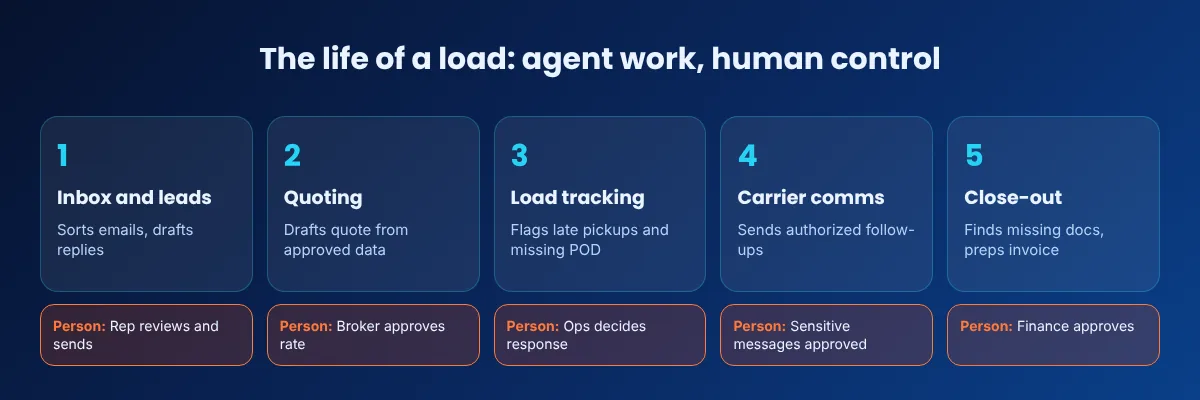
Illustrative: the life of a load
| Operation | What the agent does | Where people stay in control |
|---|---|---|
| Inbox and leads | Classifies incoming emails as leads, incomplete requests, duplicates or spam, and drafts replies to real inquiries | A sales rep reviews and sends |
| Quoting and pricing | Extracts customer, lane and freight details, then prepares a draft quote from approved historical and market data | The broker checks assumptions and approves the rate |
| Load tracking | Watches status signals, flags missed pickups, stalled updates or late proof of delivery, and suggests next actions | Operations staff decide how to respond |
| Carrier and driver communication | Prepares or sends scheduled follow-ups where explicitly authorized | Sensitive or consequential messages need approval |
| Close-out and billing | Identifies missing documents and prepares invoice data for the accounting system | Finance validates and approves every financial action |
Managing the Risks of AI Agents
A chatbot can give a wrong answer; an agent connected to business systems may also make a mistake. The risks are well understood: compounding errors, manipulated inputs, excessive access, unclear accountability, and runaway cost. Each is managed by design, not luck.
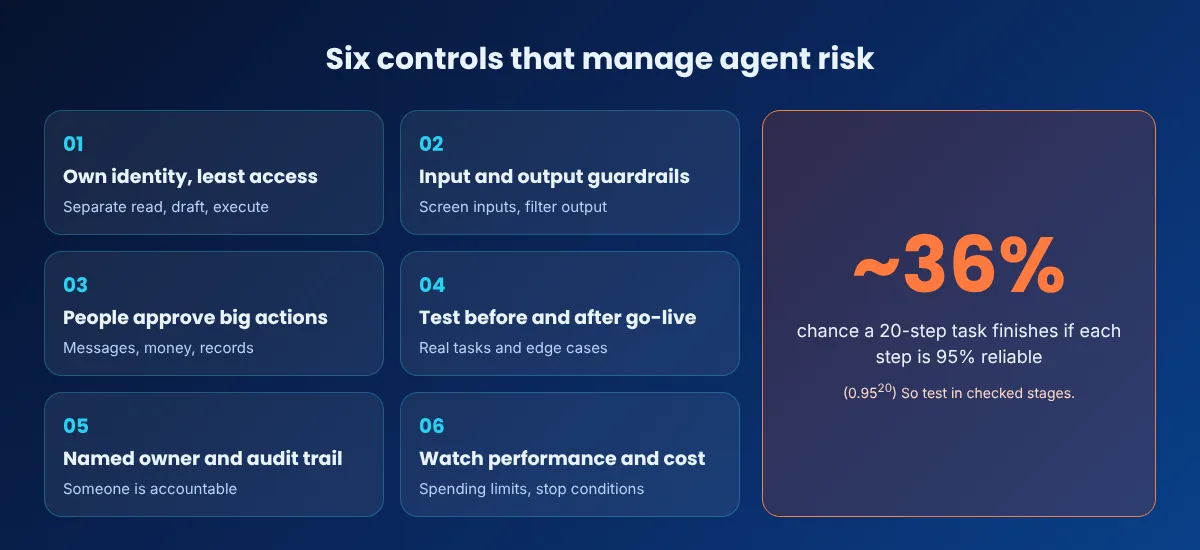
- Give every agent its own identity and the least access it needs. Separate read, draft, and execute permissions, and review and revoke access as you would an employee.
- Put guardrails on what goes in and what comes out. Screen inputs for hidden instructions, filter unsafe output, and validate data before an agent acts on it.
- Keep people in the loop for consequential actions. External messages, financial transactions, and record changes wait for approval. Approval-by-exception comes only after performance is proven.
- Test before go-live and keep testing. An agent that is 95% reliable per step completes a 20-step task only about a third of the time. Break long tasks into checked stages and test on real tasks, edge cases, and adversarial inputs.
- Name an owner and record what agents do. Every agent has an accountable person and an audit trail.
- Watch performance and cost. Track every run, tie usage to each completed task, and set spending limits and stop conditions.
On Microsoft, many of these controls are built in, including agent identity and access, content safety, evaluations, tracing, and audit. Where a client's estate needs other tools, the same principles apply.
A Practical Playbook for Getting Started
The best first project is rarely the most ambitious one. Start with a process people find frustrating, agree what a good result looks like, and give the agent only as much freedom as the evidence supports.
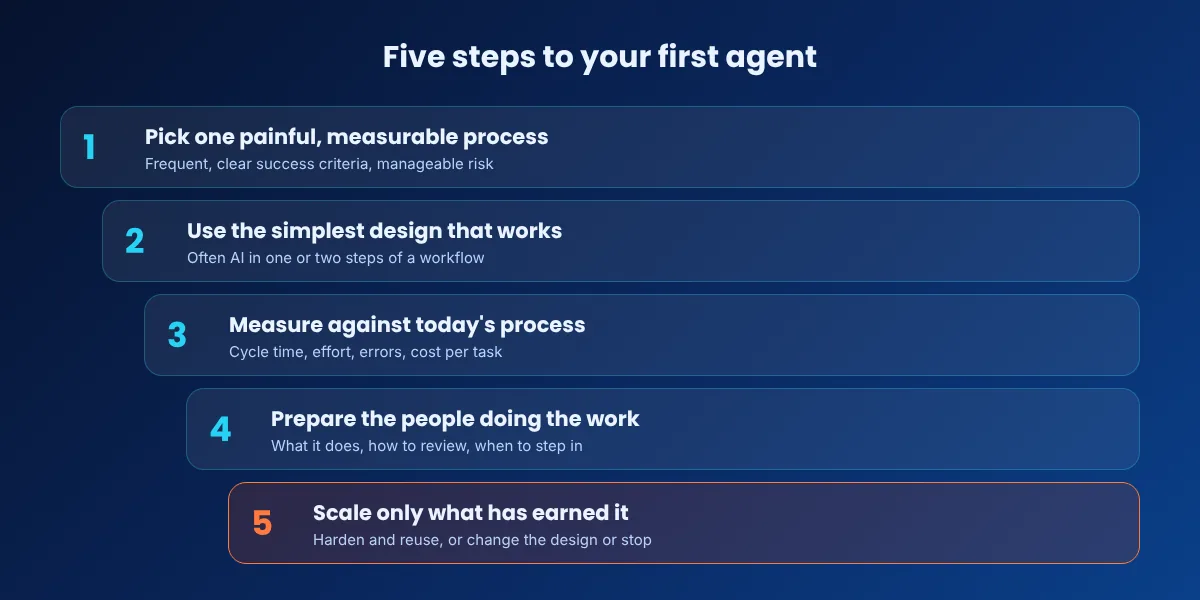
- Pick one painful, measurable process. Frequent work, clear success criteria, and manageable risk. Not your most sensitive process.
- Use the simplest design that works. A workflow with AI in one or two steps is often more reliable and easier to govern than an autonomous agent.
- Measure against today's process. Before the pilot starts, agree a baseline for cycle time, manual effort, error and rework rates, cost per task, and employee or customer experience.
- Prepare the people doing the work. Explain what the agent does and doesn't do, how to review its output, and when to step in. Their feedback exposes edge cases that testing misses.
- Scale only what has earned it. If the pilot meets its measures, harden it, document the controls, and reuse the pattern. If it doesn't, change the design or stop. That is a useful result too.
Conclusion
AI agents are not a strategy in themselves. They are a way to redesign work: less chasing, fewer handoffs, problems spotted earlier, and more time for decisions that require judgment. The right measure is not how many agents you launch, but whether a process gets measurably better.
At Sigma Solve's AI Centre of Excellence, we frame agents as AI Employees: each has a defined role, access only to the systems it needs, and a human owner accountable for the outcome. We start with the business process, not a model or a demo, look for patterns we can reuse, and build for production. We're Microsoft-first, because its data, identity, security, and governance services let AI Employees work inside the controls our clients already use. Where a client's problem needs other technology, we use it.
Ready to find your first agent use case?
Bring us one process that eats time in follow-ups, document handling, or moving data between systems. In 30 minutes, our experts will analyse which AI agent suits your business best. You leave with:
- A shortlist of processes where an agent can help safely and measurably
- A clear view of where people keep approval rights and control
- A baseline to judge a pilot against before it starts
Book a free 30-minute call to find your first AI agent use case
Frequently asked questions
What are enterprise AI agents?
Enterprise AI agents are software that uses an AI model and connected tools to pursue a goal across multiple steps. They decide what to do next, work in business systems, check results, and pause for a person when a decision falls outside their limits.
How is an AI agent different from a chatbot or an AI workflow?
A chatbot answers a question, and the human decides what happens next. A workflow runs a sequence its designer set in advance. An agent chooses from permitted steps to reach a goal, while people keep approval rights.
Does every process need an AI agent?
No. A workflow with AI in one or two steps is often more reliable and easier to govern than an autonomous agent. Start with the simplest design that works.
Where should we start with AI agents?
Pick one painful, measurable process with frequent work, clear success criteria and manageable risk. Shared functions such as customer support, sales research, finance operations, HR onboarding and internal IT are good candidates.
What are the main risks of AI agents?
Compounding errors, manipulated inputs, excessive access, unclear accountability, and runaway cost. Each is managed by design: least-privilege access, input and output guardrails, human approval for consequential actions, ongoing testing, a named owner with an audit trail, and spending limits.
Do AI agents replace people?
The aim is to cut manual chasing and surface problems earlier, not to remove people. External messages, rate decisions and financial actions stay with a person until performance is proven.
How do we know an AI agent is working?
Agree a baseline before the pilot starts: cycle time, manual effort, error and rework rates, cost per task, and employee or customer experience. Scale only if the pilot meets those measures.