
PPC for Real Estate Lead Generation
Milind Shah · 1/10/2025 · 25 min read

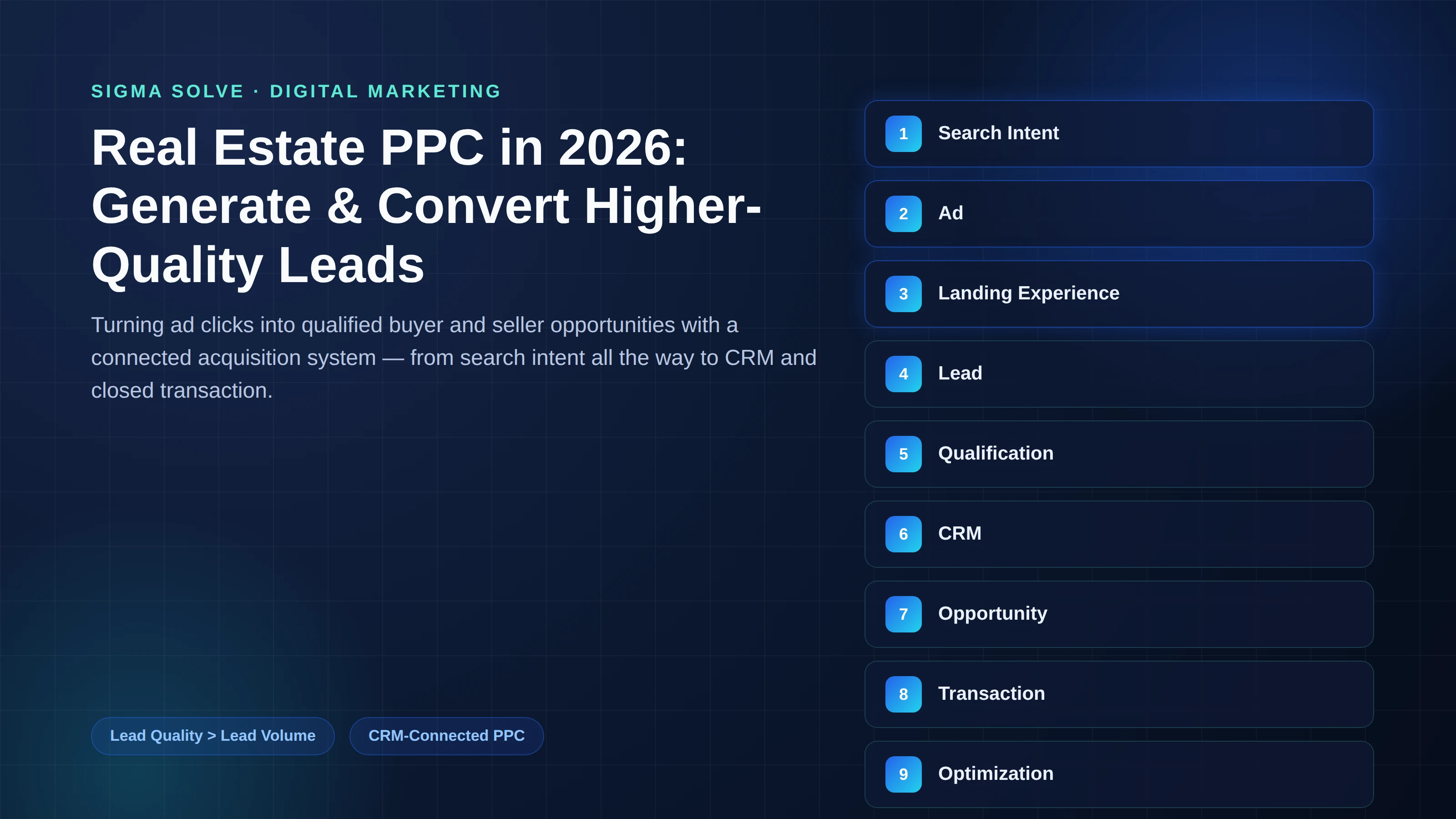
Real estate PPC has always been about visibility: put the right offer in front of the right person at the right moment, and paid advertising will generate property inquiries, seller requests, and consultation bookings.
But in 2026, generating a lead is only the beginning. A form submission doesn't automatically indicate that a prospective buyer exists. A low cost per lead doesn't mean a campaign is profitable.
The gap between lead volume and lead quality has become one of the biggest challenges in real estate PPC, and it's widening as advertising platforms become more automated. Google Ads can use AI to expand reach, adjust creative, and optimize bidding, but automation only works with the signals it receives. If every form fill is treated as equally valuable, the system will simply learn to generate more form fills, not to identify which prospects become qualified buyers or close transactions.
Google's own guidance for lead-generation campaigns reflects this shift, increasingly emphasizing accurate conversion measurement and deeper-funnel goals such as qualified and converted leads. For real estate businesses, the opportunity is bigger than simply improving ads; it's about building a connected acquisition system:
- Search intent
- Ad
- Landing experience
- Lead
- Qualification
- CRM
- Opportunity
- Transaction
- Optimization
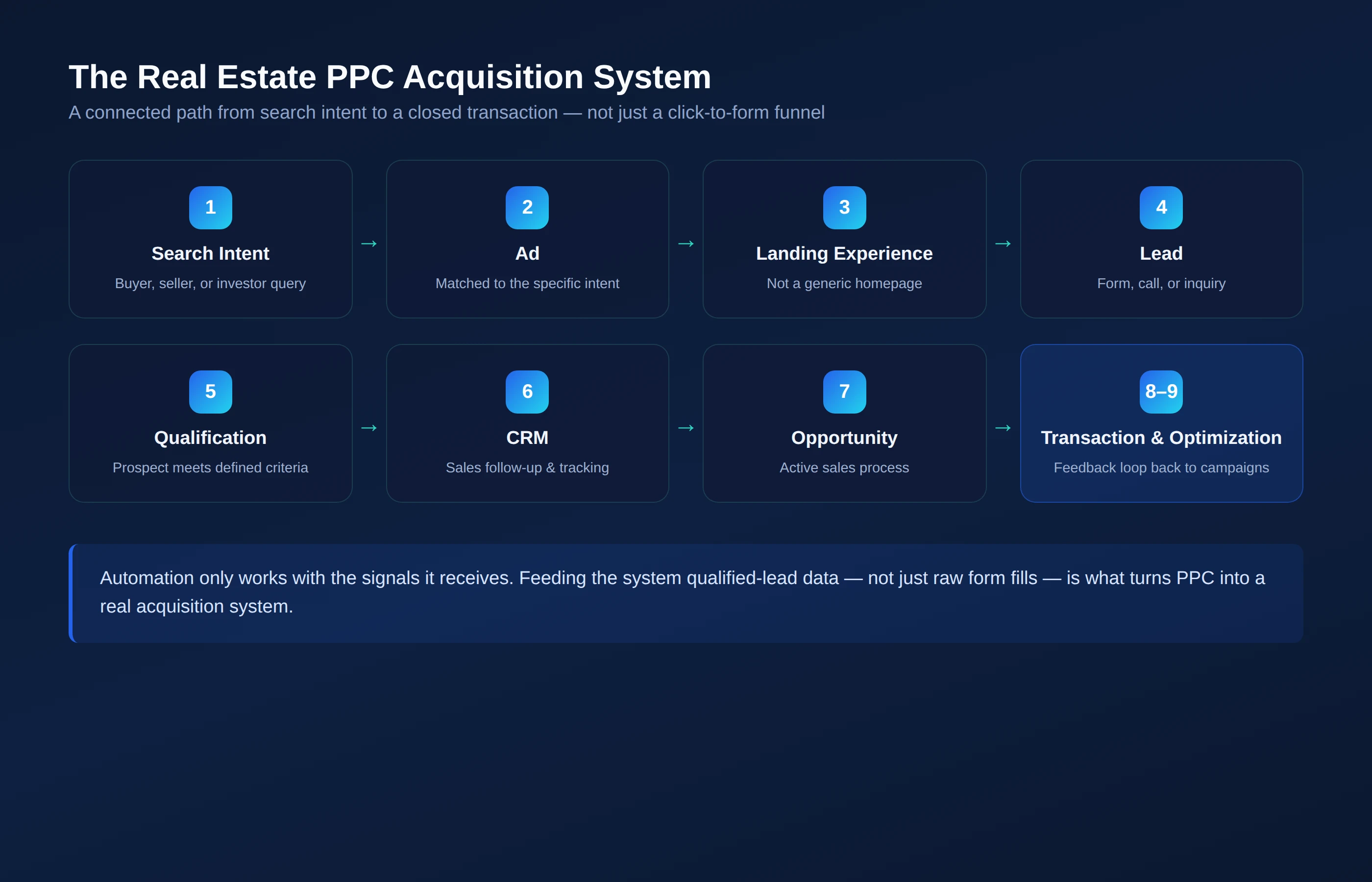
This blog explains how to build that system and create a real estate PPC strategy focused on leads with a genuine potential to become business.
Why Real Estate PPC Still Matters in 2026
Digital discovery remains central to the real estate journey. According to NAR's 2025 Profile of Home Buyers and Sellers, 88% of buyers purchased through an agent or broker, and 91% of sellers used an agent. First-time buyers represented only 21% of all buyers, the lowest share since NAR began tracking in 1981, reflecting how affordability is reshaping the audience.
For advertisers, this reinforces an important point: the real estate market isn't one homogeneous audience. A first-time buyer researching affordability has different needs than a repeat buyer. A homeowner considering a sale needs a different message than an investor evaluating rental returns. PPC lets businesses build campaigns around those differences. Search captures existing demand, social advertising builds awareness, retargeting supports longer decision journeys, and CRM integration reveals which campaigns generate qualified opportunities.
How Real Estate PPC Has Changed
The traditional model was straightforward: research keywords, write ads, set bids, measure clicks and conversions. Those fundamentals still matter, but three shifts now shape how well they work.
- Automation plays a bigger role: AI Max for Search moved out of beta in 2026, as Google shifts legacy features toward AI-assisted query expansion, creative adaptation, and landing page selection. This doesn't make keywords irrelevant; it means advertisers need to feed the platform clear goals, relevant conversion actions, high-quality landing pages, first-party data, and feedback about lead quality. Automation finds opportunities; strategy determines whether they're valuable.
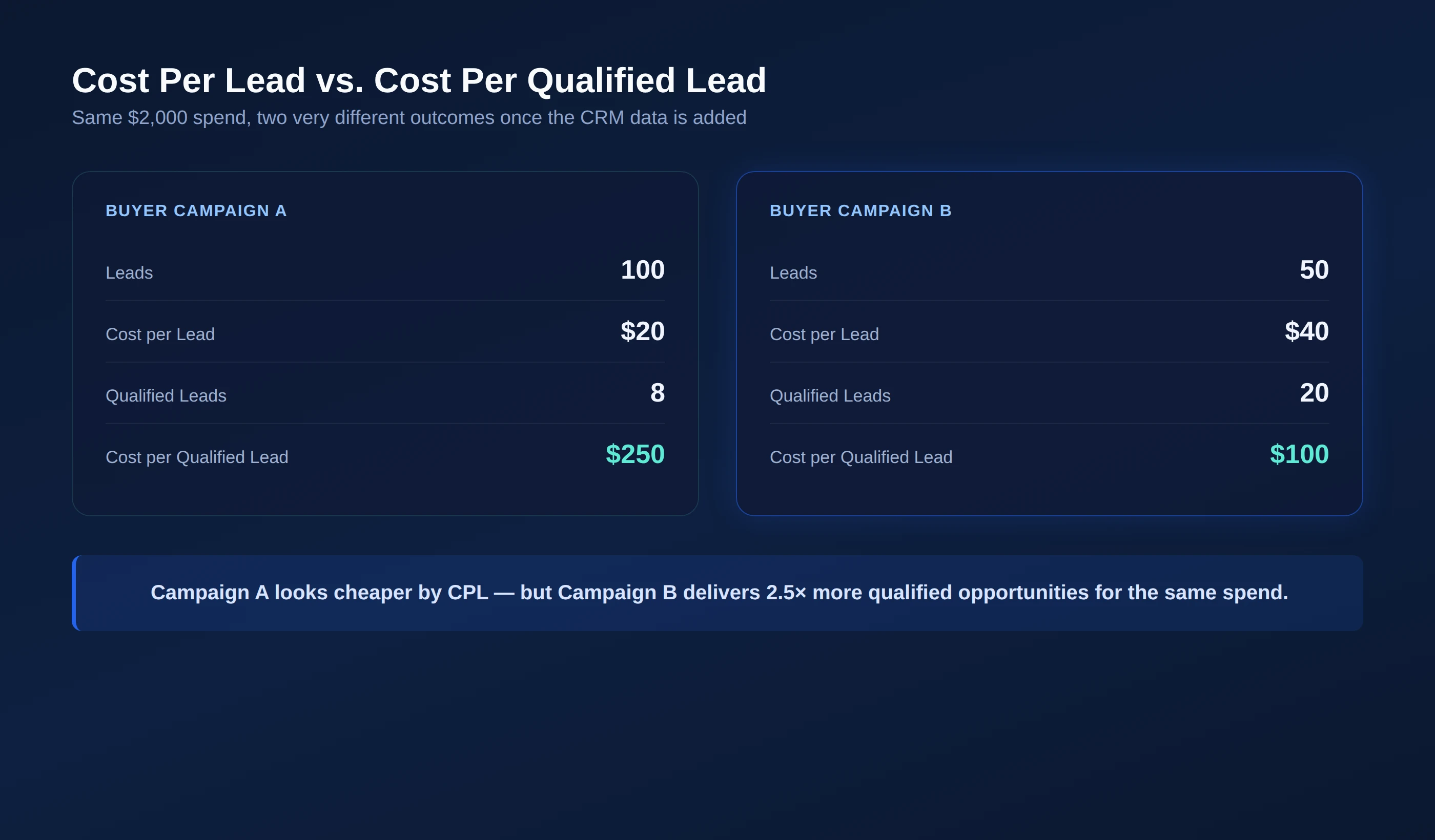
- Measurement has moved down the funnel: Clicks, CTR, and CPL are useful diagnostics but don't tell the full story. Consider: Campaign A generates 100 leads at $20 each ($2,000 spend); Campaign B generates 50 leads at $40 each (also $2,000). By CPL, A looks more efficient. But if the CRM shows A produced 8 qualified leads and B produced 20, B has generated two-and-a-half times as many qualified opportunities for the same spend. Google Ads now supports conversion goals for qualified and converted leads, allowing advertisers to optimize for outcomes that better reflect actual business value.
- First-party data matters more: Property preferences, budget ranges, appointment history, and qualification status, collected appropriately, can improve measurement and follow-up. Google's enhanced conversions for leads uses hashed first-party data to connect website leads with downstream offline outcomes, improving both measurement and bidding.
Start With the Right Lead Goal
The most common mistake in real estate PPC is setting the objective as simply "generate more leads", too broad to guide a meaningful campaign. Define the specific prospect type instead: buyer inquiries, seller valuation requests, viewing requests, consultation bookings, investor inquiries, or rental leads. Each represents a different audience and usually needs its own campaign. A practical lead-quality framework looks like this:
| Stage | Example |
|---|---|
| Lead | Form submission, call, or inquiry |
| Contacted lead | Sales team successfully reaches the prospect |
| Qualified lead | Prospect meets defined criteria |
| Appointment | Property viewing, consultation, or valuation |
| Opportunity | Prospect enters an active sales process |
| Converted lead | Purchase, sale, lease, or another defined outcome |
The exact definitions should come from the business; a qualified seller lead might be someone who owns a property in the service area and intends to sell within a set timeframe; a qualified buyer lead might hinge on budget or financing readiness. What matters is that marketing and sales agree, or optimization drifts away from what the business values.
Build Campaigns Around Search Intent
Organize campaigns around what people are trying to accomplish, not just topic.
- Buyer Intent: Homes for sale in [city], new construction homes in [area], luxury homes in [location]. Send these searchers to relevant listings or neighbourhood pages, not a generic homepage.
- Seller Intent: Sell my house in [city], home valuation [location], best agent to sell a home in [area]. These prospects want local expertise and pricing guidance, not listings.
- Investor Intent: Investment properties, rental opportunities, commercial property, development projects. The landing experience often needs market insights and investment criteria, not just a contact form.
Keyword Research: Go Beyond High-Volume Terms
Search volume alone shouldn't set priorities. Real estate attracts traffic but reveals little intent; sell my house in Austin reveals a clear commercial need. Group keywords by intent, location + intent (homes for sale in [city]), property + intent (waterfront homes in [location]), problem + intent (how much is my home worth), service + intent (real estate agent for first-time buyers), so each group gets consistent messaging and a consistent landing experience.
Negative keywords matter too: filter out real estate jobs, agent licensing, training courses, and locations outside the service area. This becomes more important as campaigns lean on broader targeting or AI-assisted query expansion; Google's Performance Max guidance recommends reviewing search term insights regularly.
Choose the Right Campaign Type
- Google Search captures active intent: someone looking for a property, an agent, or a valuation. Structure campaigns around clear commercial objectives, not broad industry terms.
- AI Max for Search uses AI to identify additional relevant queries and adapt creative to intent. Google reports advertisers using the full feature suite see an average of 7% more conversions or conversion value at a similar CPA, compared with search term matching alone, though results depend on campaign setup, conversion tracking, and data quality. Test it as part of a structured strategy, not a replacement for oversight.
- Performance Max distributes across Search, Display, YouTube, Discover, Gmail, and Maps, but needs reliable signals to work well. It performs best when lead tracking is accurate, landing pages are conversion-focused, and CRM outcomes connect back to campaigns. Without that foundation, it scales the wrong outcome.
- Social Advertising (Meta, etc.) introduces opportunities before someone starts actively searching, useful for listing promotion, video tours, and market education.
- LinkedIn suits commercial real estate, developers, and institutional investors better than residential campaigns. Choose each channel because it matches the audience, not because it's available.
Compliance: Know the Targeting Restrictions
Whichever channel you choose, one constraint applies across all of them: housing ads carry specific targeting restrictions that most other industries don't deal with. Google's US and Canada policy, for example, restricts targeting by age, gender, parental status, marital status, and ZIP code, though radius and city targeting remain available. Review applicable platform and regional policies before launching, and lean on search intent and contextual relevance over standard demographic segmentation; this should shape campaign setup from day one, not get bolted on after launch.
Match Ads and Landing Pages to Intent
Ads should help the prospect take the next logical step, not just describe the business. Compare Find Your Dream Home Today with Explore New Homes Available in [Location]; the second connects the search to the offer directly. CTAs should do the same: View Available Homes, Schedule a Property Tour, and request a Home Valuation work better than a generic "Learn More."
Landing pages need the same specificity. Sending every visitor to the homepage forces them to search for what they expected to find immediately.
- Property campaigns: Visuals, price and availability, key details, a clear viewing option.
- Seller campaigns: Market expertise, valuation, the selling process, testimonials, a consultation path.
- Buyer consultation campaigns: The buying process, local expertise, financing resources, a discovery call.
Form length matters too: volume-focused campaigns can ask for just name and contact info, while quality-focused campaigns can justify a few qualifying questions (location, timeline, budget range). The goal isn't to create barriers; it's to make follow-up more relevant. Google's guidance also recommends lead validation, reCAPTCHA, and qualifying questions to reduce invalid submissions.
Connect PPC to Your CRM
This is where a PPC strategy becomes a lead-generation system rather than a collection of ads. The ad platform sees the initial conversion; the CRM sees what happened after. A connected workflow looks like this:
- Ad click
- Landing page
- Lead capture
- CRM
- Sales follow-up
- Qualification
- Appointment
- Opportunity
- Transaction
This lets you compare campaigns on actual quality, not just cost:
| Campaign | Leads | Cost per Lead | Qualified Leads | Cost per Qualified Lead |
|---|---|---|---|---|
| Buyer Campaign A | 100 | $20 | 8 | $250 |
| Buyer Campaign B | 50 | $40 | 20 | $100 |
Campaign A looks cheaper by CPL; Campaign B is more efficient once qualification is factored in. Google's lead measurement framework supports this kind of mapping: a prospect clicks, submits an inquiry, enters the CRM, gets contacted and qualified, books an appointment, and that downstream event connects back to the ad platform via enhanced conversions for leads. The closer your optimization signal sits to genuine business value, the more useful your advertising data becomes.
Use Retargeting Based on Behavior
CRM data doesn't just improve reporting; it should shape what happens to the leads who don't convert on the first visit. Someone who viewed one property page once has shown different intent than someone who viewed multiple listings, visited seller pages, or requested a valuation, and retargeting should reflect that. Property researchers respond to similar listings and neighbourhood information. Potential sellers respond to market reports and valuation offers. Early-stage buyers respond to area guides and affordability information. The goal is moving the prospect to the next stage, not repeating the same ad.
Set Your Budget from Business Economics
There's no universal "good" PPC budget; it depends on the value of a successful transaction and the efficiency of the funnel. Start with revenue from a closed deal, then factor in acceptable acquisition cost and your lead-to-close rate.
A campaign generating leads at $50 each tells you little alone. If 1 in 20 becomes a customer, that's $1,000 in ad spend per customer; if 1 in 100 converts, the economics are entirely different. Budget backward from the value of a closed transaction, not forward from an arbitrary monthly spend.
Measure the Full Funnel
| Funnel Stage | Key Metrics |
|---|---|
| Ad performance | Impressions, CTR, CPC |
| Landing page | Conversion rate, engagement |
| Lead generation | Leads, CPL |
| Lead quality | Qualified lead rate, cost per qualified lead |
| Sales engagement | Contact rate, appointment rate |
| Business outcomes | Cost per acquisition, ROAS where measurable |
Even connecting ad data to a simple qualification status in the CRM provides more insight than optimizing around raw lead volume alone.
Common Real Estate PPC Mistakes
- Optimizing for the cheapest lead instead of evaluating against qualification and downstream outcomes.
- Mixing buyers, sellers, and investors into one campaign instead of aligning keywords, copy, and landing pages to each.
- Sending every visitor to the homepage instead of continuing the conversation the ad started.
- Feeding AI-powered campaigns weak signals; automation amplifies whatever it's optimized around, good or bad.
- Ignoring housing advertising restrictions on demographic and geographic targeting.
- Treating retargeting as one audience instead of tailoring follow-up to behaviour.
Final Thoughts: More Leads Are Not Always Better Leads
Real estate PPC in 2026 isn't just about keywords, ads, and form submissions; it's about connecting the entire journey, from what the prospect is trying to achieve through to CRM visibility and feedback from downstream outcomes.
The more useful question isn't how many leads did this campaign generate? It's: which campaigns generated the leads most likely to become customers, and how can we generate more of them? That's the difference between running PPC campaigns and building a real estate acquisition system.
At Sigma Solve, we help businesses connect the technology behind that system, from conversion-focused digital experiences and CRM integrations to automation, data workflows, and AI-enabled solutions. If your real estate advertising is generating activity but not enough qualified opportunities, the next improvement may not be a larger ad budget. It may be a better connection between your campaigns, your lead data, and the systems responsible for turning interest into business.
Ready to turn more of your real estate leads into closed transactions? Talk to the Sigma Solve team about integrating your PPC campaigns, landing pages, and CRM into a single, measurable system.
Talk to Us

Sources
- National Association of REALTORS® — 2025 Profile of Home Buyers and Sellers
- NAR — Top 10 Takeaways from the 2025 Profile of Home Buyers and Sellers
- Google Ads — Performance Max Best Practices for Lead Generation
- Google Ads — About Qualified Leads and Converted Leads
- Google Ads — About Enhanced Conversions for Leads
- Google — Dynamic Search Ads Are Upgrading to AI Max
- Google Ads Policy — Housing in Personalized Advertising