
Why Data Engineering Has Become the Most Critical AI Investment in 2026
Shivam B · 7/30/2026 · 10 min read

Enterprises aren't struggling to adopt AI anymore. They're struggling to make it trustworthy, scalable, and business-ready.
Over the last two years, enterprise conversations around AI have changed dramatically. In 2024, boardrooms were debating which large language model (LLM) to adopt. By 2026, that discussion has shifted to a far more practical question:
Why isn't our AI delivering the business outcomes we expected?
The models have matured. Copilots, AI assistants, intelligent search, autonomous agents, and AI-powered customer experiences are becoming commonplace. Yet many organizations still struggle with inaccurate responses, inconsistent recommendations, disconnected business insights, and AI systems employees don't trust. The reason is becoming increasingly clear.
The biggest obstacle to enterprise AI isn't the model. It's the data.
McKinsey recently highlighted AI data readiness as one of the defining factors separating organizations that successfully scale AI from those that struggle to move beyond isolated use cases. As AI adoption accelerates, existing issues around data quality, governance, accessibility, and context become significantly more visible, and far more expensive.
This explains an interesting trend across the technology landscape. Microsoft, Snowflake, Databricks, AWS, and Google Cloud may offer different platforms, but they're all investing in solving the same underlying problem: helping enterprises build AI-ready data foundations.
This blog explores why enterprise AI initiatives struggle despite advances in AI technology, how the role of data engineering is evolving, and what organizations need to build if they want AI to become a sustainable business capability rather than another promising pilot.
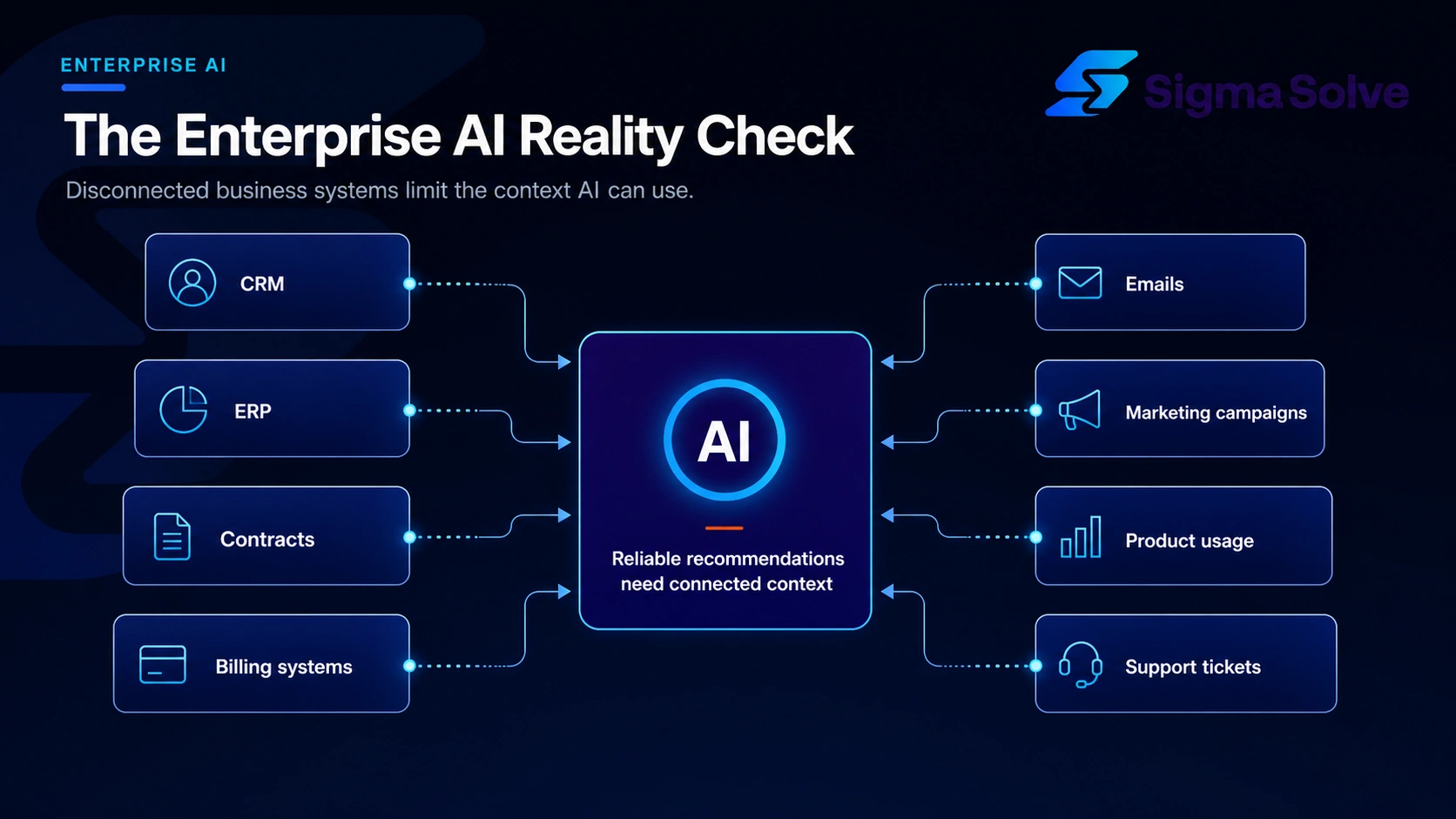
The Enterprise AI Reality Check
Imagine a sales executive asking an AI assistant a seemingly simple question:
"Which enterprise customers are most likely to churn in the next quarter?"
The question is simple. The answer isn't.
To generate a reliable recommendation, AI needs to connect customer interactions across CRM, ERP, billing systems, support tickets, product usage, marketing campaigns, contracts, and even emails. In most enterprises, that information lives across dozens of disconnected platforms, each with its own data model, ownership, and business definitions.
The AI isn't struggling because the model lacks intelligence. It's struggling because the enterprise lacks a unified view of its own business. When customer records are duplicated, product definitions vary across systems, or critical information remains buried in documents, AI can only reason with the context it's given.
That's why many organizations experience an unexpected decline in confidence after successful AI pilots. The technology performs as expected, but the underlying business data isn't complete enough to support consistent, enterprise-wide decisions
Why Traditional Data Engineering Isn't Enough Anymore
For years, data engineering focused on one objective: getting data from point A to point B. Success meant reliable ETL pipelines, well-managed data warehouses, and dashboards that helped leaders understand what had already happened.
Enterprise AI has changed that definition completely.
Today's AI applications don't just consume structured tables; they need access to policies, contracts, product documentation, customer conversations, knowledge bases, operational events, and other forms of enterprise knowledge. More importantly, they need to understand how all that information connects.
This explains why Microsoft is investing in Microsoft Fabric, Snowflake is expanding its AI Data Cloud, and Databricks is building its Data Intelligence Platform. While the products differ, the strategy is remarkably similar: make enterprise data unified, governed, and accessible enough for AI to reason over it with confidence.
Modern data engineering is no longer about building pipelines. It's about building AI-ready data foundations, where quality, governance, metadata, real-time access, and business context are engineered into the data before AI ever sees it.
The Five Capabilities Every Enterprise Needs to Be AI-Ready
As organizations move from AI experimentation to enterprise-scale adoption, five capabilities consistently separate successful initiatives from stalled ones.
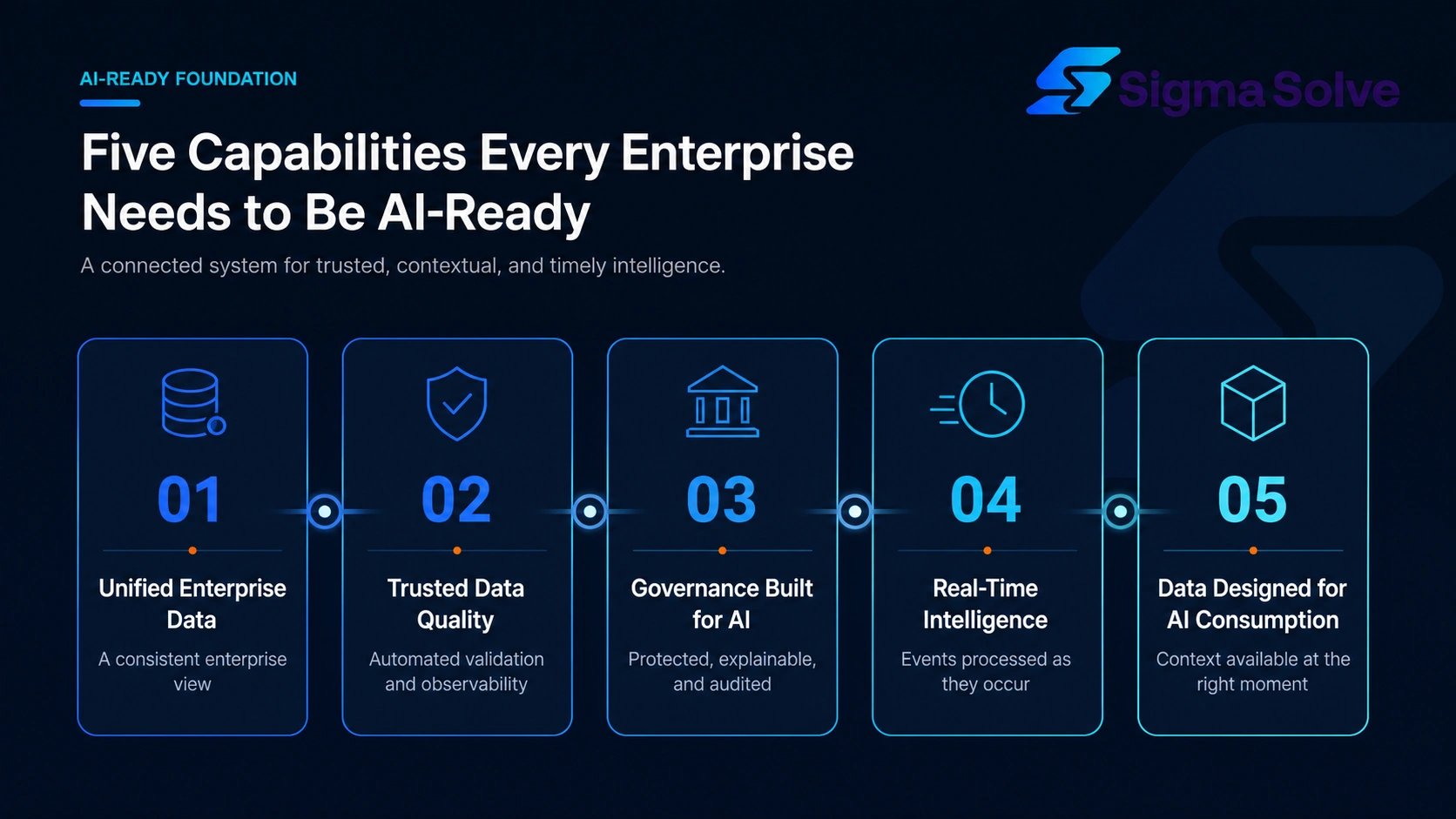
1. Unified Enterprise Data
AI cannot reason across disconnected business systems. Customer, operational, financial, and product data must be integrated into a consistent enterprise view rather than remaining trapped within individual applications. The goal isn't moving everything into one database. It's creating a unified layer that allows AI to access trusted business context regardless of where data resides.
2. Trusted Data Quality
Even the most advanced AI models cannot compensate for inaccurate or inconsistent data. Organizations must establish automated validation, standardization, monitoring, and observability processes that continuously improve data reliability. Trust becomes the foundation for AI adoption. If employees question the underlying data, they will question every AI recommendation.
3. Governance Built for AI
Governance has expanded well beyond compliance, and it's enabling responsible AI adoption. Organizations increasingly need to know:
- Where data originated
- Who modified it
- Which AI systems accessed it
- Whether sensitive information is protected
- How decisions can be explained and audited
4. Real-Time Intelligence
Traditional reporting answers yesterday's questions. AI is expected to support decisions happening right now. Whether optimizing supply chains, detecting fraud, personalizing customer experiences, or automating service operations, enterprises increasingly require architectures capable of processing events as they occur. This shift makes streaming data, event-driven integration, and cloud-native engineering essential components of modern data platforms.
5. Data Designed for AI Consumption
Enterprise data was originally designed for transactions. AI requires data designed for understanding. Metadata, semantic relationships, business definitions, document indexing, vector search, and contextual retrieval are becoming core components of enterprise data engineering. The objective is no longer storing information. It's enabling AI to retrieve the right information at the right moment with confidence.
Why This Matters Beyond Technology
For years, data engineering was viewed as a back-office IT function, essential for reporting and analytics but largely invisible to the business. That mindset no longer reflects how enterprises operate in the AI era.
Today, every AI-driven interaction depends on the quality of the underlying data. A sales copilot recommending the wrong pricing, a customer service chatbot referencing outdated policies, or a forecasting model built on inconsistent operational data can directly influence revenue, customer trust, and strategic decisions. In each case, the AI isn't malfunctioning; it's responding to the data it's been given.
This is why leading organizations are shifting their investments from AI experimentation to data readiness. They're recognizing that competitive advantage doesn't come from deploying another model, it comes from building a trusted data foundation that allows every AI application to deliver accurate, contextual, and explainable outcomes.
Data engineering is no longer just an enabler of analytics. It's the foundation of enterprise AI and, increasingly, a core business capability
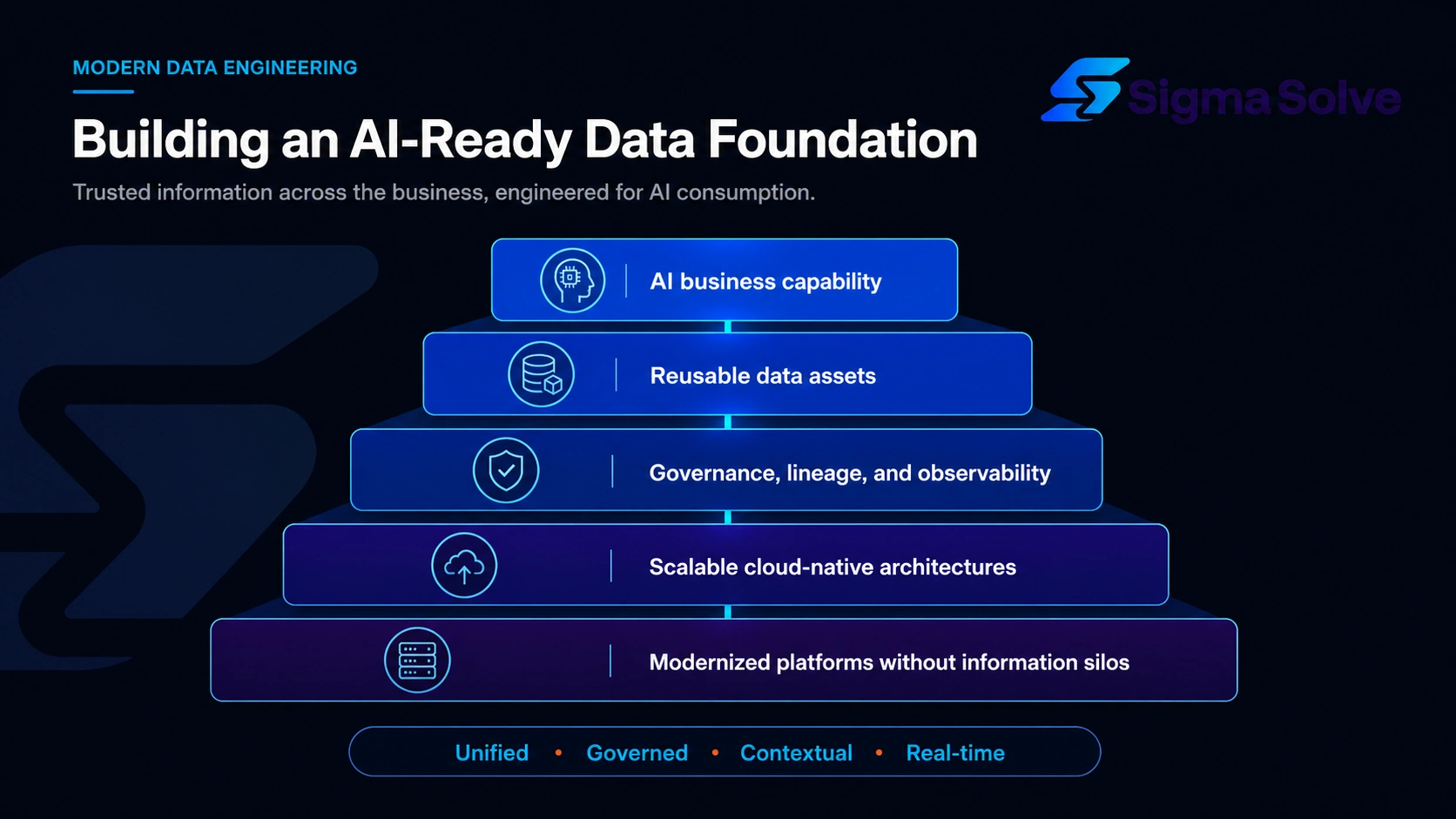
Building an AI-Ready Data Foundation
Creating an AI-ready enterprise isn't about replacing every existing platform. It's about building an architecture that allows AI to securely access trusted information across the business.
Organizations leading this transformation typically focus on four priorities:
- Modernizing legacy data platforms and eliminating information silos.
- Establishing scalable cloud-native architectures that support both analytics and AI workloads.
- Embedding governance, lineage, and observability throughout the data lifecycle.
- Designing reusable data assets that enable faster AI development without rebuilding pipelines for every new initiative.
How Sigma Solve Helps Enterprises Build AI-Ready Data Foundations
Building AI-ready data platforms requires more than migrating data to the cloud. It demands a strategic combination of modern architecture, engineering excellence, governance, and AI expertise. Sigma Solve partners with enterprises to modernize data ecosystems that support today's AI-driven business landscape. Our Data Engineering team helps organizations:
- Modernize legacy data warehouses and fragmented data architectures.
- Build scalable cloud-native data platforms on technologies such as Snowflake, Databricks, Microsoft Fabric, AWS, and Azure.
- Design robust data ingestion, integration, and transformation pipelines that connect enterprise applications.
- Improve data quality, governance, lineage, and observability for trusted AI outcomes.
- Enable AI-ready data foundations that power copilots, intelligent automation, predictive analytics, and next-generation digital products.
- Deliver secure, scalable architectures that continue supporting business growth long after implementation.
Final Words
For years, organizations believed better AI would solve their business challenges. In 2026, the reality is becoming much clearer. AI has advanced faster than enterprise data. The organizations gaining the greatest value from AI aren't necessarily using different models. They're building stronger data foundations that make those models more reliable, contextual, and trustworthy.
Ready to Build an AI-Ready Data Foundation?
If your organization is investing in AI, the next competitive advantage may not come from another model; it may come from strengthening the data foundation that powers every AI initiative.
Connect with Sigma Solve to discover how modern data engineering can help transform AI from isolated experiments into measurable business outcomes.