
How an AI-Native Operating System Is Changing the Way Freight Brokerages Run
Industry
Logistics
Overview
BrokerOne is a US freight technology company building a multi-tenant operating system for freight and auto-transport brokerages, covering both selling to shippers and buying from carriers. The founders knew where a broker’s day disappears: follow-ups, status checks, document chases, and re-keying data between systems. They came to Sigma Solve with a clear goal: a platform where AI agents take on that coordination work, while brokers keep control of every decision involving a customer, a carrier, or money.
Challenge
A typical brokerage runs on a CRM, a TMS, load boards, accounting software, and a lot of email. Staff becomes the integration layer, and every extra load means more manual touches. The client wanted AI built into the foundation, not bolted on, and safe enough to trust with live freight.
Key challenges included:
- Disconnected tools CRM, TMS, load boards, and accounting ran as separate tools, so staff re-typed the same data.
- Late visibility into problems Missed pickups, stalled trucks, and late PODs surfaced only when a customer called.
- Manual order entry Load requests and rate confirmations arrived by email and were keyed in by hand.
- Inconsistent follow-ups Follow-ups depended on who was on shift.
- Limits on AI authority Brokers would not give AI authority over messages, orders, or billing without clear limits.
- Tenant data isolation Competing brokerages on one platform needed fully isolated data.
- No single LLM vendor The platform could not be locked to one LLM vendor, and AI cost had to be visible per customer.
The Solution
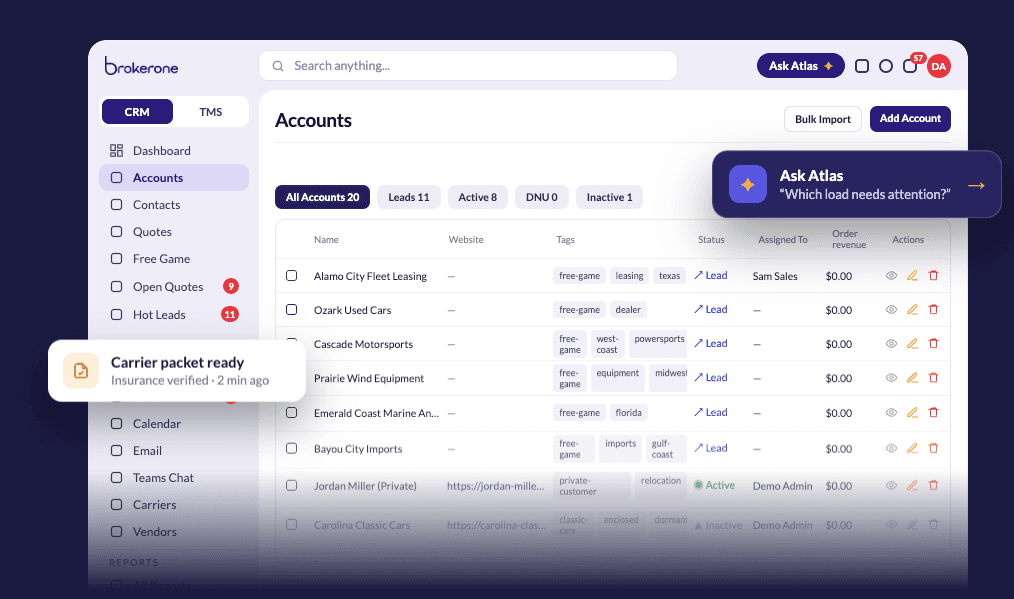
Sigma Solve designed and built an AI-native brokerage platform anchored in three things: one connected record, a team of AI agents, and human control. The architecture draws a firm line. AI agents watch, draft, and recommend, while a person approves every edit, message, and financial action.
Key capabilities included:
- Unified platform CRM, TMS, and finance on one data model, with role-based access and invoices synced to QuickBooks or NetSuite.
- Database-per-tenant isolation Each brokerage has its own PostgreSQL database.
- AI Ops Monitor Reviews every active load each minute for risks like missed pickups, late delivery, no movement, POD delays, and route deviations, then queues each with a recommended next step.
- Atlas companion Answers questions and suggests margin-protecting quotes within the user's own permissions.
- Atlas conversational agent Handles SMS and email with drivers, carriers, and customers inside automated workflows.
- AI order creation Drafts orders from forwarded emails and rate confirmations.
- Visual sequence builder Automates follow-ups, with pauses for approvals and replies.
- Built-in guardrails Traceable recommendations, strict service boundaries, and rule-based carrier filtering for certifications and margin.
- Model-agnostic LLM gateway Supports OpenAI, Anthropic, and Google Gemini, with per-brokerage keys and cost metering.
- Freight integrations Load boards, dispatch platforms, accounting, telephony, email, and tracking tools.
Outcome
Brokers who once heard about problems from an angry customer now see them in the Ops Queue, with time to act. Routine follow-ups run on their own, and sales, operations, and finance work from one record. Because every agent action is permission-bound and approved by a person, brokers trust the AI with live freight. The client now has a foundation ready for new brokerages, integrations, and models without rework.