
How Much Does It Cost to Develop a Hotel Booking App in 2026?
Milind Shah · 12/12/2024 · 16 min read

Ask a hotel CEO what they pay Booking.com in commission, and most can answer within a percentage point. Ask the same CEO what their own website converts at, and the room goes quiet. That gap, knowing the cost of the channel you didn't build but not the one you did, is usually the real reason a "we need a booking app" conversation starts in the boardroom. The instinct is almost always right. The reasoning behind it usually isn't.
Here's the number that should drive this decision: independent hotels lost roughly 63.4% of their bookings to OTAs in 2025, according to Cloudbeds' 2026 State of Independent Hotels report, which compiled over 90 million bookings across 180+ countries. On those bookings, the effective commission once visibility programs and loyalty add-ons are counted, not just the headline rate, typically runs 18-30%, per a distribution-cost analysis from OtelCiro. A development quote can't tell you whether a booking app fixes that. Your own numbers can.
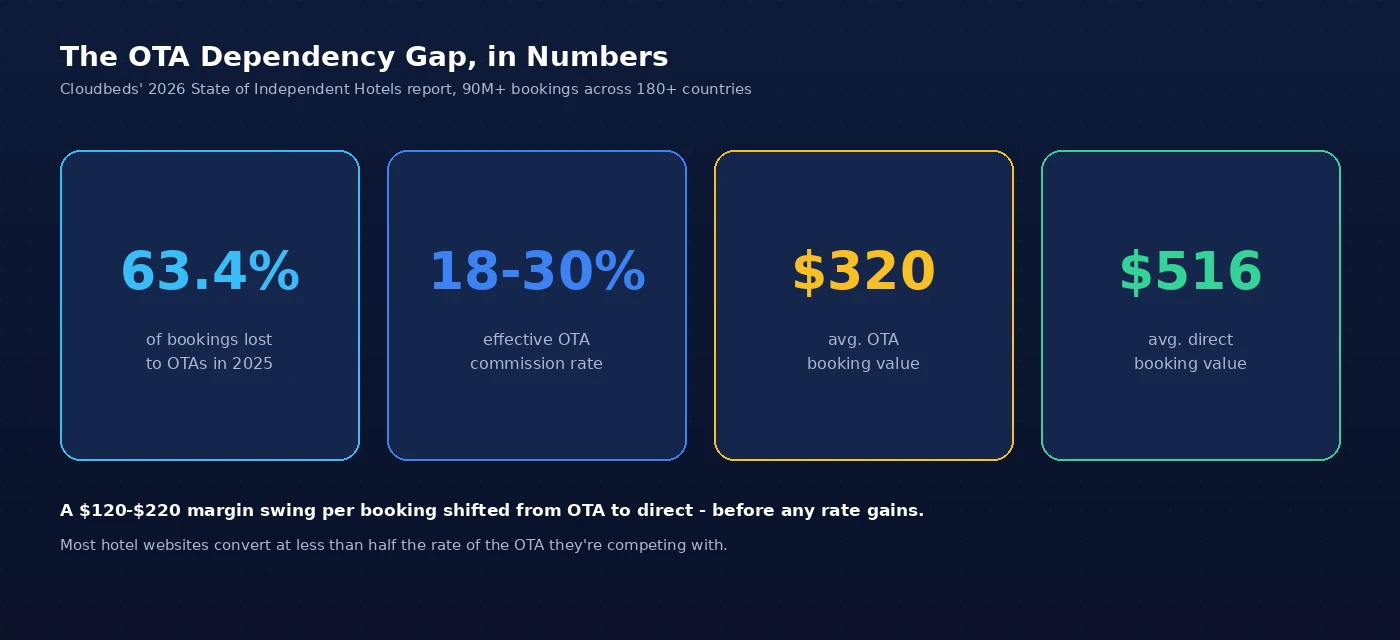
For context, the same analysis puts average booking value at roughly $320 through an OTA versus $516 on a direct channel - a $120–$220 margin swing per booking shifted, before any rate gains. Most hotels don't shift more volume not because the economics are bad, but because their own website converts at less than half the rate of the OTA they're competing with. A booking app is one lever for closing that gap. It isn't the only one, and for many properties, it isn't even the first one worth pulling.
Build vs. Buy: The Decision Before the Budget
Most hotel executives evaluating "a booking app" are actually choosing between two very different investments, and conflating them is where budgets go wrong.
Option one is a booking engine layered on your existing PMS. SiteMinder, Cloudbeds, and Mews all ship booking engines that run $60–$500 per month, depending on tier, per a 2026 pricing survey from Hotel Tech Insight, either bundled into the PMS subscription (Cloudbeds, Mews) or priced separately as standalone products (SiteMinder, Profitroom, Bookassist). For a single property or a small group already running one of these platforms, this is very likely the right answer, and no five- or six-figure build is justified.
Option two is a custom-built app: your own booking experience, potentially your own logic layered over multiple PMS connections, and full control over the guest journey, brand, and data. This is the $25K–$400K+ range most "hotel app cost" articles quote. It's the right call only when off-the-shelf can't do what the business needs: a branded experience spanning many properties under different PMS platforms, a marketplace connecting independent hotels, deep CRM/loyalty logic a vendor's marketplace app can't replicate, or a direct-booking experience the business is treating as a genuine competitive asset rather than a checkbox. Sigma Solve's product engineering team walks through this build-vs-buy tradeoff in more depth in its guide to custom software development in 2026 - the same logic that applies to enterprise platforms generally applies here.
If you're not sure which camp you're in, that's the first conversation to have, before scoping anything.
What a Custom Build Actually Costs, by Platform Type
These ranges reflect Sigma Solve's own project scoping patterns across similar engagements, not a third-party industry index; the final number moves within (and sometimes outside) these bands based on the number of PMS connections, payment complexity, admin tooling, and how much AI or personalization is built in versus bought.
| Hotel booking solution | Estimated cost | Typical timeline |
|---|---|---|
| Single-property booking app | $25,000–$55,000 | 3–5 months |
| Hotel-chain / multi-property app | $50,000–$120,000 | 4–8 months |
| Multi-hotel marketplace | $75,000–$180,000 | 6–10 months |
| Full OTA-style platform | $150,000–$400,000+ | 10–18+ months |
The Integration Reality Most Estimates Skip
This is the part a CTO or CIO needs to press on before signing off on a build, because it's where timelines and budgets break.
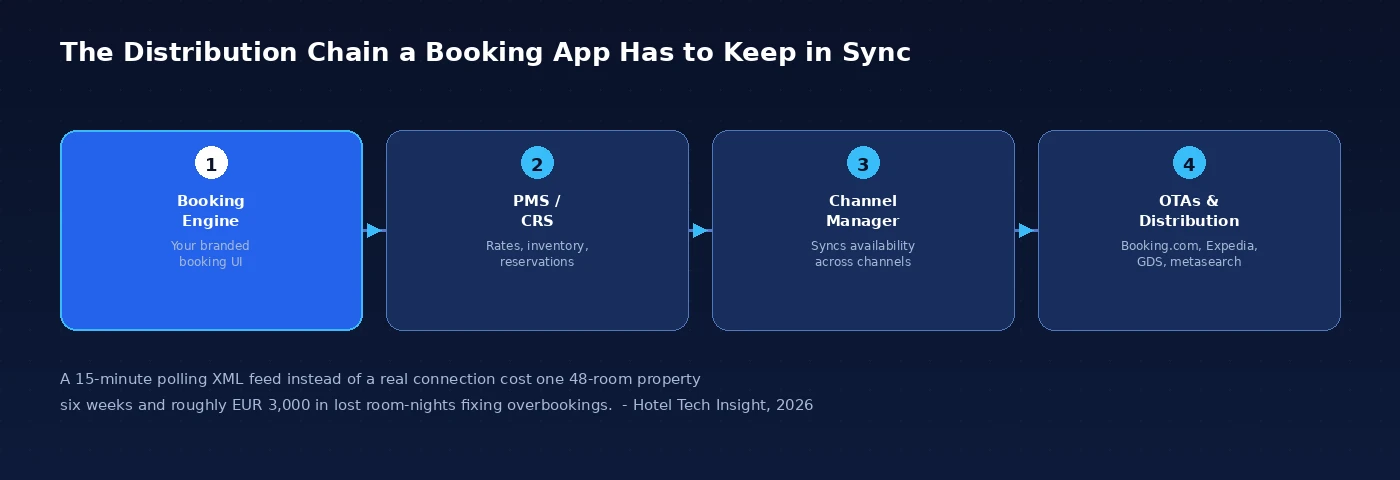
A hotel booking app cannot run on live inventory as an isolated interface, it has to connect through booking engine → PMS/CRS → channel manager → OTAs and other distribution channels, keeping availability, rates, reservations, and cancellations in sync across every link. Hotel Tech Insight's 2026 PMS integration guide documents a real case worth internalizing: a 48-room property in Lisbon lost weeks to stale OTA rates because its "integration" was an XML feed polling every 15 minutes rather than a direct connection, the marketing page promised real-time sync; the actual architecture didn't deliver it. Overbookings started within two weeks, and the channel manager migration to fix it took six weeks and roughly €3,000 in lost room-nights.
For reference, a 40-room property typically runs $150 - $400 a month in integration spend across marketplace-app fees and connectors, on top of the PMS subscription and separate from payment-processing fees, which run 1.4 - 2.9% per transaction. Setup fees for a standard booking-engine implementation run $500–$2,500 with 10 - 40 hours of implementation labor, per Hotel Tech Insight's 2026 survey. A custom build multiplies all of this, because you own the integration work the vendor would otherwise have already solved.
What Else You Should Be Pricing In
Security and compliance aren't a line item to add later; they're architecture decisions made on day one. A platform handling payment data needs to account for PCI DSS scope from the start (a decision that changes significantly depending on whether payments route through a PCI-compliant processor or touch your own cloud infrastructure directly), along with encryption, access control, and auditability appropriate to a system handling guest PII across jurisdictions if the business operates internationally.
Payment complexity is also easy to underprice: hotel bookings involve deposits, authorize-then-capture flows, refunds, partial payments, multi-currency handling, and, for marketplace models, payouts to individual properties, all of which need to hold up during peak-demand periods rather than just in a demo.
Where AI Actually Changes the Calculation
AI is no longer a differentiator worth building custom; for most hotels, it's already sitting inside the PMS stack they're paying for. The more relevant question for a build-vs-buy decision is whether your vendor's AI roadmap already covers what you need, or whether there's a specific capability worth building independently.
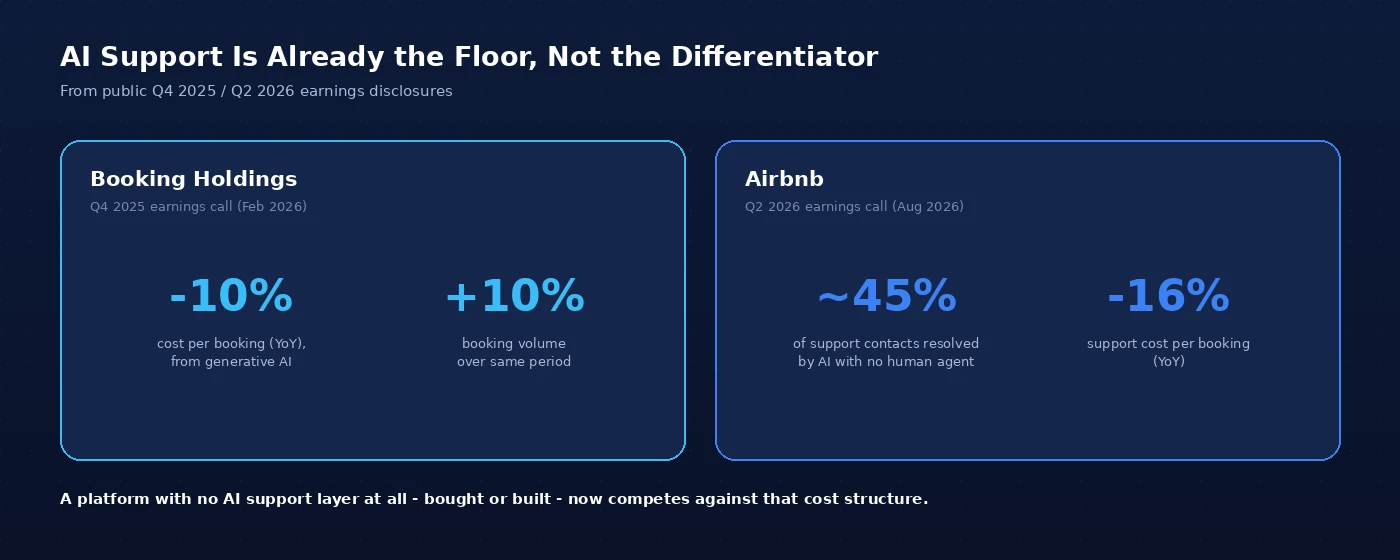
The business case for AI-driven support is now public and specific rather than speculative. Booking Holdings' CFO Ewout Steenbergen disclosed on the company's Q4 2025 earnings call (February 2026) that generative AI had cut customer-service cost per booking by roughly 10% year over year, even as booking volume rose about 10%. Airbnb went further on its Q2 2026 call (August 2026): the company's AI assistant now resolves roughly 45% of support contacts without a human agent, up from 40% in Q1, with support cost per booking down about 16% year over year. Those numbers matter less as a reason to build your own AI layer, and more as a floor; a platform with no AI support capability at all, whether bought or built, is now competing against that cost structure.
Where the Budget Goes on a Custom Build
QA is the line item most first-time buyers underprice. A booking flow touching payments, live inventory, and multiple third-party systems needs proportionally more testing than a typical consumer app; a cancelled room that never releases back to inventory, or a payment capture that fires twice, is a revenue and guest-trust problem, not a bug ticket.
| Development area | What it covers |
|---|---|
| Discovery & architecture | Requirements, workflows, technical architecture |
| UI/UX | User journeys, booking flows, design system |
| Frontend | Web and/or mobile application |
| Backend | APIs, database, booking engine, business logic |
| Integrations | PMS, CRS, channel manager, payments, maps, messaging |
| AI & analytics | Recommendations, assistants, forecasting, personalization |
| QA & security | Functional, performance, security, and device testing |
| Deployment | Cloud infrastructure, app stores, production setup |
Ongoing Costs After Launch
Development is only part of the investment. A production platform carries recurring costs for cloud hosting, PMS and channel-manager service fees, payment processing, mapping and communication APIs, AI model usage, security monitoring, and standard maintenance. Budgeting for total cost of ownership, not just the initial build, is what prevents the post-launch surprise that shows up in next year's IT budget review.
Sequencing a Build to Control Cost
If a custom build is genuinely the right call, the way to control cost is sequencing, not scope cutting. Start with the MVP that proves the model: search, availability, property details, booking, payment, and essential admin tools. Layer in advanced capability, loyalty, AI personalization, marketplace features, based on actual usage data rather than building every feature speculatively at launch. Pre-built payment, mapping, authentication, and communication services reduce how much commodity infrastructure you're building from scratch.
The Actual Decision
For most single-property and small-group operators, the higher-ROI move in 2026 isn't a custom app; it's a modern PMS-bundled booking engine plus the marketing spend to close the conversion gap with OTAs, since that gap is what's suppressing direct revenue. A custom build earns its cost when the business is a hotel chain unifying a fragmented PMS landscape under one brand, a marketplace connecting independent properties, or an operator treating the direct-booking experience as a strategic asset rather than a transaction screen.
Either way, the decision should start with your actual OTA-dependency numbers and your existing PMS stack's real capabilities, not a generic cost range.
Build a Hotel Booking Platform Around Your Business Model
The right hotel booking platform starts with the business model and an honest build-vs-buy assessment, not a feature list. Whether that means a direct-booking solution layered on your existing PMS, a multi-property platform, or a fully custom OTA-style build, Sigma Solve can help scope the architecture, integrations, and technology roadmap before any development starts.
Ready to scope your hotel booking platform? Talk to Sigma Solve about your requirements and get a scope-based development estimate.