
How Freight Brokers Can Reduce the Cost Per Load With AI and Workflow Automation
Milind Shah · 5/9/2025 · 20 min read
Freight brokerages rarely become expensive because they grow too fast or hire too many people. They become expensive because every additional load adds another round of manual touches, and those touches compound in ways that are easy to underestimate until the headcount math stops working.
Someone reads an incoming request and verifies the shipment details. Someone contacts carriers, compares offers, negotiates, and updates the system once the load is covered. Someone else monitors the shipment in transit, answers status calls, chases documents after delivery, and reconciles the paperwork. Each of these actions takes only a few minutes in isolation, but across hundreds or thousands of loads a month they become a substantial share of the brokerage's operating model, and the reason growth so often tracks headcount instead of outpacing it.
This is where AI has the potential to change the equation, though not in the way it's usually pitched. The opportunity isn't to "automate the brokerage" or replace everyone touching operations; it's to examine how much human effort moves a load through the business and determine which of those touches genuinely require judgment. Negotiating an unusual rate, managing a strategic account, or responding to a service failure can't be handled the same way as routine data entry. A large share of the remaining touches exists only because information is fragmented, systems don't talk to each other, or an employee has become the bridge between two disconnected workflows, and that's the share worth going after first.
That distinction should shape how brokers think about AI in 2026. The useful question isn't "can AI cut our operating costs," but rather: how many manual touches does it take to move a load through this brokerage, which of them are necessary, and what happens to cost per load if the unnecessary ones are removed? A brokerage that answers that question well may not cut payroll immediately; it might instead let each employee handle more loads, delay the next hire, or free experienced staff to spend less time coordinating information and more time on the accounts and exceptions that move margin. None of that fits neatly under "cost savings," but all of it improves the underlying economics.
The framework: Automate, Assist, Escalate
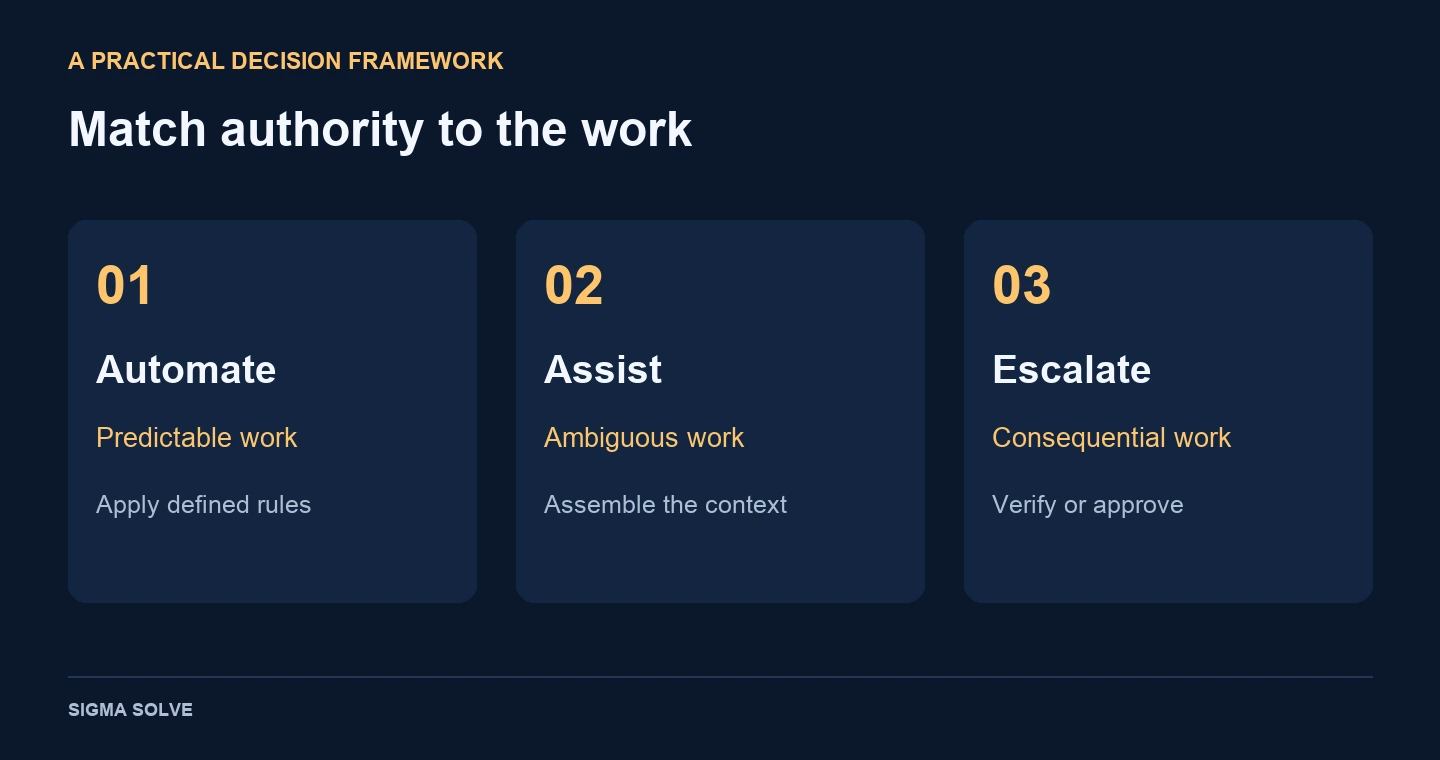
Rather than asking whether a workflow can be "fully automated," a brokerage gets more traction by classifying the work inside it. Predictable activities follow established rules with a clear next step, making them the strongest automation candidates. Ambiguous activities require interpretation because the information is incomplete or context-dependent, and here AI is most useful for gathering information and framing options rather than deciding outcomes. Consequential activities carry real financial or operational risk and should run within strict controls, with verification or explicit approval built in rather than assumed away. This framework is more practical than treating AI as either a wholesale replacement for staff or a chatbot that drafts emails, and it holds up across every stage of the load lifecycle described below.
Where the Touch Density is Highest
The clearest starting point is wherever repetitive work concentrates most heavily, which for many brokerages is the front end of the process. Inbound requests arrive as emails, attachments, and spreadsheets, and an employee must translate that unstructured mess into whatever format the operating system requires, then start another round of back-and-forth if information is missing. AI can extract the relevant details, flag missing fields, classify the request, and hand off a clean record, so the employee isn't starting every request with the same administrative groundwork. The payoff isn't just faster data entry; shortening the gap between an opportunity landing and someone acting on it has a commercial effect as well as an operational one, particularly on time-sensitive freight.
Carrier communication is where AI is moving furthest beyond basic assistance and into controlled execution. Chain's Autopilot Booking Agent, launched in June 2026, conducts carrier outreach, processes inbound offers, negotiates within broker-defined parameters, runs carrier checks through connected tools, and escalates anything outside its guardrails. The significance isn't that carrier reps become unnecessary; it's that a high-volume, rules-based slice of booking can be cleanly separated from the harder work. A routine load on a familiar lane within an approved rate range is a fundamentally different problem than an urgent shipment with unusual requirements or a strategic account attached, and treating both as if they deserve identical manual effort is expensive in one direction and risky in the other.
The same logic applies during execution and in the back office. Most customer status inquiries are requests for information the brokerage already has somewhere in its systems, and an employee's job is often just to find it, confirm it, and relay it, repeatedly, throughout the day. Connected tracking and communication workflows can push that information out automatically when relevant events occur, closing the gap that generates unnecessary check calls in the first place. Documents, invoices, proof of delivery, and rate confirmations follow the same pattern: AI can handle the extraction and first-pass comparison, letting clean paperwork move through untouched while mismatches or unusual charges route to the right person. In every case, the standard for evaluating the automation stays the same, not how much work it processes without a human, but whether it frees people from routine cases without loosening control over the ones that matter.
Why Cost Per Load Beats a Percentage-savings Claim
A generic promise like "AI will cut operating costs by 30%" falls apart under scrutiny, because insurance, facilities, technology contracts, and compensation structures are mostly fixed costs that automation doesn't touch. The number that matters is the addressable operating cost tied to a specific workflow.
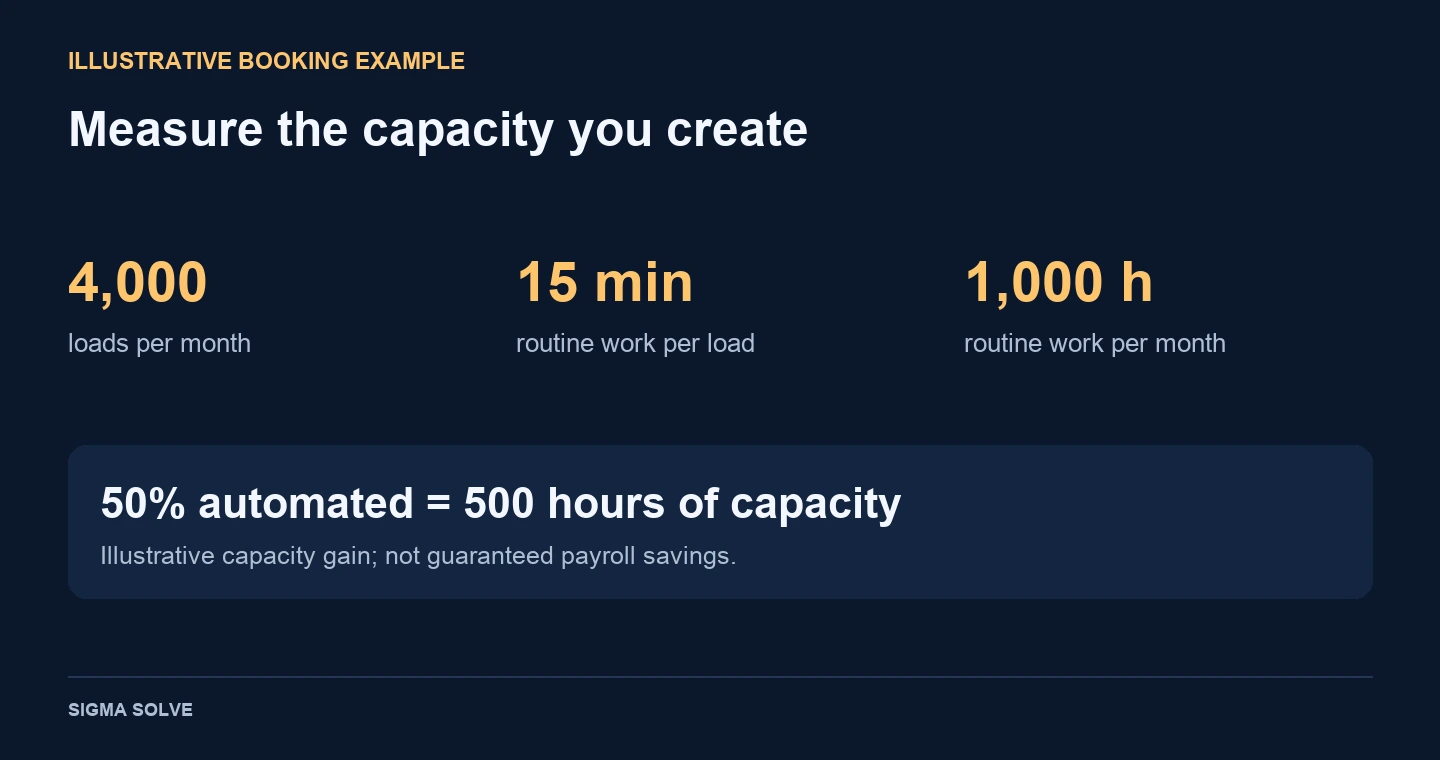
Take carrier booking as an example. Suppose a brokerage moves 4,000 loads a month, and carrier reps spend an average of 25 minutes per load on sourcing, routine negotiation, and status updates that follow predictable patterns, say 60% of total booking time. That's roughly 1,000 hours a month of largely rules-based work. If automation absorbs half of it without adding errors, the brokerage isn't necessarily cutting a headcount line; it's freeing 500 hours a month that can absorb load growth, reduce overtime, or shift toward the accounts that need judgment. Whether that shows up as avoided hiring, faster response times, or fewer billing errors downstream, it's a real economic gain even when it never appears as a payroll reduction. The same calculation can be run against document processing, inbound intake, or CRM follow-up, and doing it produces a far more honest business case than an unsupported percentage claim, because if a brokerage moves more freight while the operational cost per shipment falls, the economics are improving even as total spend keeps rising with the business.
Four Metrics that Prove it's Working
A brokerage doesn't need an elaborate AI scorecard, just a handful of measures that connect automation to actual performance. Manual touches per load establish a baseline: how many times does a person typically interact with information or a system during a standard shipment, and which of those interactions are repetitive versus necessary? Loads managed per operational employee separates direct cost reduction from capacity creation, showing whether the same team can handle more freight without a corresponding rise in errors or service complaints. Time spent on exceptions versus routine work reveals whether experienced staff are solving real operational problems or just managing administrative volume, and a successful automation effort should shift that balance toward the former. Cost per load or per operational transaction ties the whole exercise back to the business, tracking whether the effort required to process each unit of work is declining. These four numbers say more about whether an automation project worked than counting how many AI tools got deployed or how many tasks are technically automated.
Exceptions, and why some manual steps should stay
The hardest work in freight brokerage isn't the normal workflow; it's what happens when the normal workflow breaks. A carrier cancels, a shipment is delayed, a document doesn't match the original agreement, or a rate moves outside acceptable parameters, and each of these creates a cascade: someone has to understand the situation, pull information from multiple systems, communicate with the relevant parties, and update the resulting records. AI adds value here without an authority over the decision itself, by detecting the exception, assembling the relevant context, summarizing recent communication, and surfacing applicable rules so the employee starts from an understanding of the situation instead of a search across five systems. For teams whose experience is valuable precisely because freight doesn't always follow predictable rules, this is the version of automation worth building, one that removes the administrative delay in front of a human decision rather than the human.
Not every manual step is a candidate for removal, though, because some exist to establish trust or control risk rather than to move information along, and that distinction matters more as freight fraud increasingly exploits communication channels rather than paperwork. Highway's Q2 2026 Freight Fraud Index reported that communication-based attacks, compromised inboxes, spoofed emails, account takeovers, and impersonation calls accounted for 50% of classified fraud vectors during the quarter. A workflow that automatically responds to messages or acts on incoming instructions has to evaluate whether the communication itself can be trusted, not just whether the request looks routine, which means verification has to be built into the automation rather than treated as a separate step: routine actions proceed automatically when identity and information meet established criteria, while a change in ownership details, an unusual request, or a channel mismatch triggers additional checks before anything moves. It's the same predictable-ambiguous-consequential logic applied to risk instead of workload, and it becomes more important, not less, as AI takes on more communication and operational authority.
Start with the workflow, not the platform
Many AI discussions in freight imply that a single platform will solve the whole operational problem, which is unlikely for most brokerages. A CRM manages relationships and commercial follow-up, a TMS manages core execution, and carrier networks, compliance tools, accounting systems, and document repositories each hold their own piece of the puzzle. The real opportunity lies between these systems, reading an incoming request, pulling the relevant customer history, extracting shipment details, triggering the appropriate operational workflow, and flagging an employee only when attention is needed. That also means replacing the entire technology stack usually isn't necessary; the actual problem is often that employees are manually shuttling information between systems that already hold valuable data.
The practical way to find the first project is to pick one representative workflow and trace it end-to-end before committing to anything broader: where information enters, which systems are touched, where a person must intervene, and whether that intervention is judgment or just data-moving. The strongest first candidate is usually the workflow with enough volume to matter, enough consistency to automate reliably, and a manageable level of risk; inbound intake, carrier communication on routine lanes, or document reconciliation are common starting points. Whichever is chosen, establish the current baseline first, define explicitly what the automation is and isn't allowed to do, decide where human approval is required, and measure the result against that baseline rather than against how impressive the demo looked.
Measure AI by what it removes, not what it can do
The strongest AI strategy for a freight brokerage doesn't start with a feature list; it starts with a workflow and an honest accounting of how much human effort that workflow currently requires and how much of it exists only because information and systems are disconnected. The brokerage that benefits most won't be the one that automates the greatest number of tasks; it will be the one that can consistently distinguish predictable work from ambiguous work from consequential work and build its systems around that distinction rather than around the loudest AI feature on the market.
How Sigma Solve can help
AI initiatives in freight often fail because the technology gets selected before the operational problem is properly defined. A better approach starts with the workflow itself: how information moves, where manual effort accumulates, which systems are involved, and where automation can create measurable value without introducing new risk. Sigma Solve helps freight and logistics businesses assess these workflows and build AI-enabled automation around their existing technology environment, from CRM and TMS integrations to intelligent document processing, communication automation, and custom AI workflows, to reduce operational friction wherever it has a measurable effect on cost, capacity, and service.
Looking to reduce manual touches and improve the economics of your freight operations? Sigma Solve can help identify the workflows where AI and automation will have the greatest impact.
