
eCommerce Website Cost in 2026
Milind Shah · 1/13/2026 · 10 min read

Introduction
**
The Cost Insights of eCommerce in 2026 – What Most Businesses Miss
Are you planning to launch or scale an e-commerce platform in 2026? But worried about how much it costs or how it will affect your business?
**If so, the real question isn’t just how much it costs it’s whether your investment will actually scale with your business. **
Let us go through some interesting facts
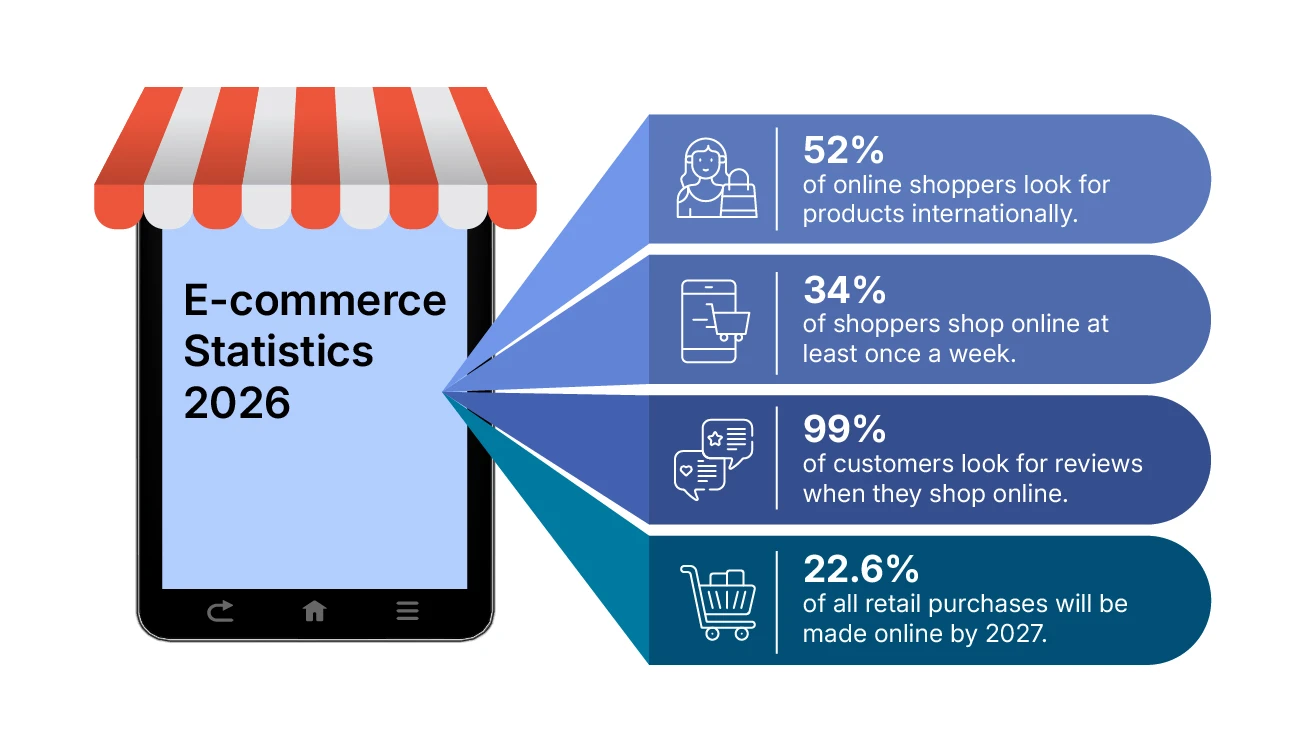
Source: https://www.sellerscommerce.com/blog/ecommerce-statistics/
In this scenario of eCommerce transformation, the real challenge isn’t just launching an eCommerce website; it’s about creating one that can grow, convert visitors, and remain profitable. With digital shopping becoming the norm, every design decision, feature, and integration you choose has a direct effect on your profits.
Today’s customers want speed, personalization, security, and a smooth experience right from the start. But meeting these high expectations doesn’t come cheap. Without careful planning, your budget can quickly get out of hand, leaving you with a disappointing return on investment. As global eCommerce sales surge toward a staggering $8 trillion, your website has transformed from a mere cost center into a powerful growth engine.
This guide will walk you through the nine key cost areas that truly matter, empowering you to invest wisely, scale efficiently, and create an eCommerce platform that’s ready for 2026 and beyond.
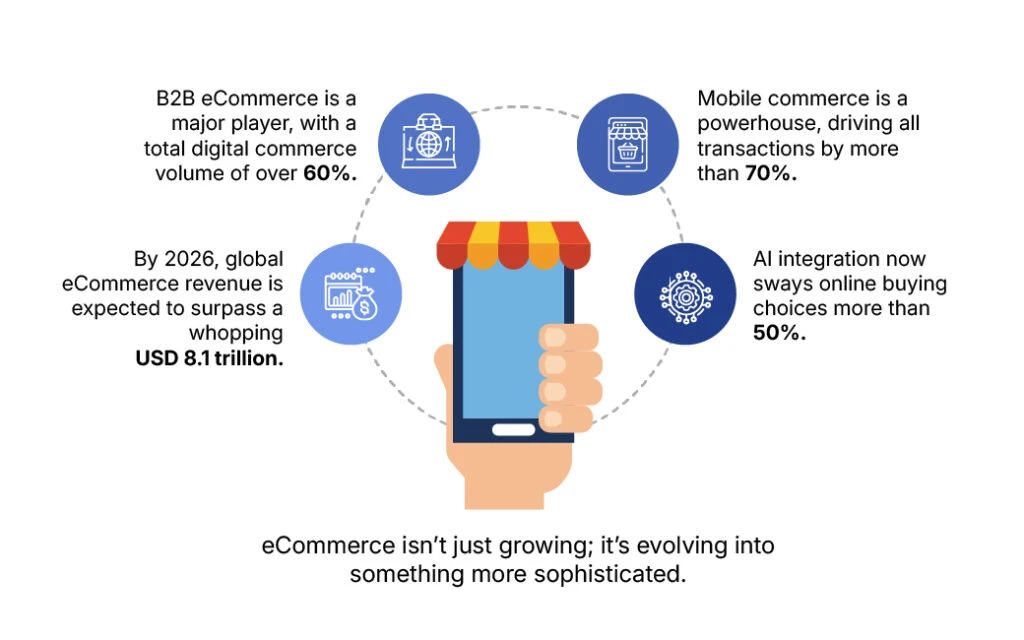
Source: https://www.sellerscommerce.com/blog/ai-in-ecommerce-statistics
Key Cost Factors That Impact eCommerce Pricing
1. Choosing the Right Platform
- Shopify: Offers hosted solutions with predictable costs and quicker setup.
- WooCommerce: Provides flexibility, but you’ll need to handle hosting and security separately.
- Custom Stacks: Give you maximum control, but come with added complexity.
2. Design Complexity
- Using free or premium templates can help keep costs down.
- On the other hand, custom UI/UX design can significantly boost your investment.
3. Features and Integrations
Costs can increase with:
- Integrations for CRM and ERP systems
- Advanced search and filtering options
- Custom APIs
- AI-driven recommendations
- Subscription billing and B2B pricing strategies
4. Development Resources
- Freelancers can be a budget-friendly option, but their scope can be limited.
- Agencies, while more expensive, offer comprehensive end-to-end delivery.
In today’s world, where customer expectations are soaring, technology options are getting more complex, and competition is fiercer than ever, one question keeps coming up:
What’s the real cost of building an e-commerce website these days?
The truth is, there’s no one-size-fits-all answer. The costs can fluctuate significantly based on various factors, including the platform you choose, the level of customization required, the necessary integrations, the complexity of the design, compliance considerations, ongoing marketing efforts, security measures, and the scale of your operations.
This guide aims to provide you with a straightforward, up-to-date, and comprehensive cost framework for 2026, helping you budget, plan, and invest wisely in an online store that aligns with both your immediate needs and long-term objectives.
The eCommerce Cost Equation: Know What You’re Really Investing In
To get a grip on the costs of developing an e-commerce website today, it’s useful to break them down into key categories:
- Platform Licensing & Hosting
- Design & User Experience
- Development & Engineering
- Integrations (ERP, CRM, Payment, Logistics)
- Functionality & Features
- SEO, Marketing & Analytics
- Security & Compliance
- Ongoing Operations
- Team, Support & Maintenance
Each of these categories can vary widely depending on the size of your business, your growth ambitions, and your technical needs.
1. Platform Licensing & Hosting
Picking the right platform can really impact your costs. Shopify (SaaS)
| Model | Pros | Cons |
|---|---|---|
| Fully hosted solution with Standard plans: around $39 – $399/month | Quick to set up | Recurring fees can add up |
| Shopify Plus (for enterprises): starting at about $2,000/month | Managed hosting and security | Extra apps might raise your costs |
| Transaction fees: typically, between 0%–2.9% + $0.30 per transaction (depends on the payment gateway) | Grows with your traffic |
| Model | Pros | Cons |
|---|---|---|
| An enterprise-level platform | Highly scalable | Can be costly and complex |
| Development costs: $100,000 – $500,000+ | Offers enterprise-level functionality | Development takes longer |
| Hosting & Infrastructure: varies based on your traffic and scale |
| Model | Pros | Cons |
|---|---|---|
| A hosted SaaS alternative | Comes with built-in features | Customization options are limited compared to open-source platforms |
| Standard to Enterprise plans: $30 – $2000+/month | PCI compliant |
2. Design & User Experience (UX)
The way your eCommerce store looks and how users interact with it play a crucial role in driving conversions, boosting engagement, and shaping brand perception.
Template / Theme Customization
- Cost: $500 – $5,000
This option is great for small businesses or those looking to launch quickly.
Custom UI/UX Design
- Cost: $6,000 – $50,000+
These are expertly designed experiences that cater specifically to your customers’ journeys.
Impact on Business
A poorly designed store can hurt conversions, even if everything else is spot on. On the flip side, a well-crafted store can significantly enhance key performance indicators (KPIs), often leading to a revenue increase of over 50% in the long run.
3. Development & Engineering
This encompasses everything from front-end coding to back-end logic, APIs, and workflows.
| Basic Feature | Advanced Features |
|---|---|
| Product catalog | Multi-currency pricing |
| Checkout flow | Customer segmentation |
| Shopping cart | Personalization |
| Headless architecture | |
| Cost : $5,000 – $20,000 | Cost :$75,000 – $300,000+ |
4. Integrations
In today’s world, commerce systems don’t just work in isolation. Integrations play a crucial role in ensuring that data flows smoothly between different platforms.
| Integration Category | Common Tools / Platforms | Typical Integration Cost |
|---|---|---|
| Payment Gateways | PayPal, Stripe, Adyen, Apple Pay | $1,000 – $5,000+ |
| ERP & Accounting | SAP, Oracle, NetSuite, QuickBooks | $5,000 – $50,000+ |
| CRM & Marketing | Salesforce, HubSpot, Klaviyo | $3,000 – $20,000+ |
| Inventory & Logistics | ShipStation, 3PL APIs | $2,000 – $15,000+ |
The costs for integration can vary widely based on how much customization you need, the complexity of synchronization, and the volume of data involved.
5.Features & Functional Modules
The more sophisticated your features are, the more you can expect to pay.
| Feature Category | Typical Cost Range |
|---|---|
| Basic features (like catalog and checkout) | $5,000 – $20,000 |
| Advanced features (such as AI recommendations & B2B pricing) | $50,000 – $200,000+ |
| Marketplace modules (for multi-vendor support | $80,000 – $500,000+ |
| Mobile app integration | $40,000 – $200,000 |
6. SEO, Marketing & Analytics
When it comes to technical SEO and ongoing marketing efforts, there’s no room for compromise.
| Marketing Activity | Cost Range |
|---|---|
| SEO Architecture & Optimization | $3,000 – $15,000 |
| Analytics & BI Dashboards | $3,000 – $25,000+ |
| Paid Campaign Integration (Using tools like Google Ads, Facebook Ads Manager, and performance analytics) | $1,000 – $10,000+/month Ongoing |
*Note: Pricing for the above services within each respective region is indicative only and may vary depending on the scope, complexity, and specific requirements of the services engaged.
These investments are essential for boosting visibility, driving traffic, and achieving measurable returns on investment.
7. Security & Compliance
Keeping customer data safe and adhering to compliance standards is absolutely crucial.
| Security Component | Typical Cost |
|---|---|
| SSL Certificates | $50 – $400 per year |
| PCI Compliance | $2,000 – $15,000 per year |
| Regular Security Audits | $2,000 – $10,000+ |
| Data Protection & GDPR/CCPA Compliance Tools | $1,000 – $10,000+ |
Neglecting security isn’t just a financial burden; it can lead to serious consequences.
8. Ongoing Operations & Maintenance
Getting your store up and running is just the first step.
| Expense Type | Typical Annual Cost |
|---|---|
| Hosting & Infrastructure | $500 – $7,500+ |
| Bug Fixes & Enhancements | $5,000 – $30,000+ |
| Support & Monitoring | $3,000 – $25,000+ |
| Content & Merchandising Updates | $5,000 – $50,000+ |
9. Hidden or Indirect Costs
Unexpected costs can catch businesses off guard:
- Transaction Fees: 2.7%–3.2% per sale
- Scaling Infrastructure: $7,500 – $60,000+
- Advanced AI/AR Features: $15,000 – $120,000+
- Customer Support Staff: $35,000 – $60,000 per employee annually
Being aware of these can help you steer clear of budget surprises.
| Region | Basic eCommerce | Custom Solutions | Hosting/Maintenance |
|---|---|---|---|
| USA | $6,000 – $25,000* | $60,000 – $300,000+* | $1,000 – $20,000+/yr |
| India | $1,500 – $6,000 | $12,000 – $60,000 | $200 – $5,000/yr |
| UK | £4,000 – £18,000 | £45,000 – £220,000 | £400 – £8,000+ |
| Australia | AUD 6,000 – 30,000 | AUD 70,000 – 350,000 | AUD 600 – 12,000+ |
| Germany | €5,000 – €22,000 | €50,000 – €280,000 | €500 – €10,000+ |
*Note: Pricing for the above services within each respective region is indicative only and may vary depending on the scope, complexity, and specific requirements of the services engaged.
Choosing the Right Development Partner
The partner you choose can significantly impact the quality of your project, how predictable your costs are, and your overall success in the long run. A top-notch partner should provide:
- Clear and transparent estimates
- Expertise in the platform
- Clear communication
- Dependable support
- Guidance and ownership after launch
You might want to ask:
- How do you determine the pricing for each component?
- What security and compliance measures do you have in place?
- How do you manage updates and support after the launch?
Real World Examples (Case Studies)
Small Business
A niche retailer set up a Shopify store with custom themes:
- Setup & design: $9,000
- Monthly platform & marketing: $500
- Outcome: 3× revenue growth in just 6 months
Mid-Sized Brand
A fashion brand utilized WooCommerce with CRM integration:
- Development: $48,000
- Hosting & support: $600/month
- Outcome: Enhanced inventory accuracy and increased repeat purchases
Enterprise Platform
A global electronics manufacturer adopted Magento with multi-language B2B features:
- Implementation: $380,000
- Monthly operations: $10,000
- Outcome: Smooth global scaling with unified commerce
Conclusion
In 2026, online commerce is no longer an emerging channel; it is the default marketplace for consumers and increasingly for businesses. With over 3 billion digital shoppers worldwide and global eCommerce sales projected to exceed $7.4 trillion, digital storefronts have become central to growth, resilience, and competitive differentiation.
Thoughtful budgeting should encompass everything from platform licensing and design to engineering, integrations, security, operations, and marketing. While costs will fluctuate based on your project’s scope, ambition, and technical needs, a well-thought-out investment can lead to significant growth, increased lifetime value, and a stronger competitive edge.
Are you ready to get a precise estimate for your eCommerce investment? Reach out to Sigma Solve (Website New Link), and let’s create a customized roadmap that aligns cost, capability, and long-term growth goals.